Good behavior bill questioned locally
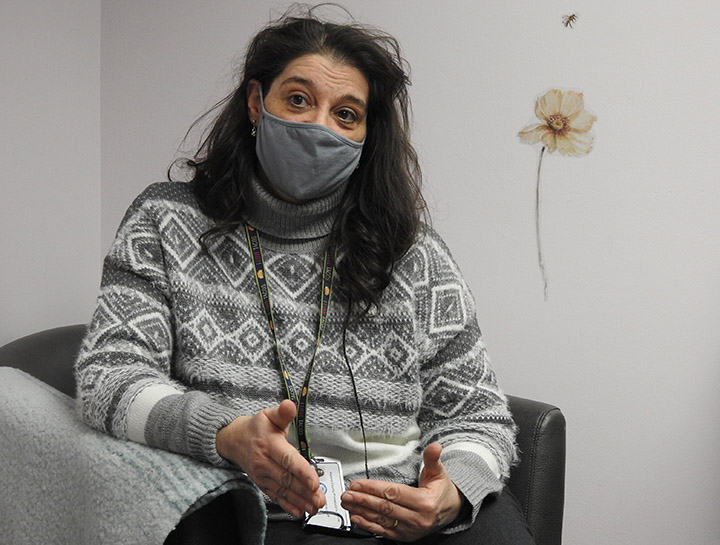
News Photo by Julie Riddle Victim Advocate Julie Jackson of the Alpena County Prosecutor’s Office weighs in on a proposed change to Michigan law that would allow prison inmates to earn time off of their sentences by good behavior.
ALPENA — Earlier this month, an Alpena man was sentenced to 12 years in prison for leading a group of youths in robbing an Alpena home at gunpoint.
As of now, Justin Golder, 32, will serve every day of those 12 years behind bars.
A bill currently before the state Legislature wants to overturn Michigan’s “truth in sentencing” policy that says prison inmates can’t shorten their sentence by good behavior.
Proponents of the change say the possibility of getting out early motivates inmates to better themselves and saves taxpayer money.
A local voice for victims counters that argument, saying good behavior and even possible rehabilitation on the part of inmates doesn’t change the need for a judge’s sentence to mean exactly what it says.
In 1998, Michigan lawmakers eliminated the ability for prison inmates to earn days off of their sentence by following rules or participating in educational, vocational, or self-improvement programs.
Such “good time”-earning possibilities were replaced by “bad time,” or strikes against a misbehaving prisoner that can be considered by a parole board.
The bill introduced to the Legislature early this month proposes a return to the state’s old policy of allowing inmates to earn days off their sentence — up to 15 days for each well-behaved month, depending on the length of their prison stay. Previous attempts to change the law stalled in the Legislature.
In 2018, more than 81,000 incidents of misconduct were recorded among about 39,000 prisoners in the state’s 32 prisons, according to state numbers.
Minor incidents of misconduct — such as lying to a staff member, making excessive noise, or horseplay — are not recorded in the report.
Inmates at county jails, which are excluded from the truth-in-sentencing laws, may earn one day of early release for each six days with no violations of jail rules.
Advocates for eliminating the state’s tough stance on minimum sentences say the law removes incentives for incarcerated people to work toward rehabilitation, keeps people behind bars who are no risk to public safety, and racks up exorbitant costs for taxpayers unnecessarily.
In 2018, the last year for which numbers are available, the state spent almost $2 billion to run the state’s prisons, according to the Michigan Department of Corrections.
Julie Jackson, victim advocate with the Alpena County Prosecutor’s Office, said good behavior isn’t something that should be rewarded.
“That should be expected behavior,” said Jackson.
Reducing minimum sentences is unfair to victims, especially since many inmates have already pleaded to a lesser charge than that of their original crime, Jackson said.
Survivors of physical assault or other traumatic crime don’t get early release from the repercussions of what happened to them, she said. That trauma persists, regardless of whether the person who harmed them is sorry for what they’ve done, Jackson said.
Though rehabilitation can be a byproduct of being behind bars, the criminal justice system mustn’t neglect the punishment aspect of incarceration, she argued.
Minimum sentences that don’t have meaning may make victims wonder why it’s worth the bother to report crimes against them at all, Jackson said.
“And the criminal might think, ‘All I’ve got to do is be good for a little bit and I’m gonna get out early,'” Jackson said. “Faking it is going to be maybe not so hard. And what’s the incentive to not go do it again?”
The state’s lack of good time credits for inmates drew public notice this spring and summer, when jails and prisons tried to reduce their populations to reduce the risk of the spread of the coronavirus in confined spaces.
While county jails had discretion to release inmates early for a variety of reasons, the truth-in-sentencing laws meant the state was unable to release any inmates who had not served their minimum sentence.
More than 18,000 prisoners have been sickened with COVID-19, and 104 have died.
The state says 12% of prisoners are currently eligible for parole and about 140 are released each week. The rest are either serving a life sentence or haven’t served their minimum, according to Chris Gautz, spokesman for the Department of Corrections.
Local News
Michigan releases 2026 Eat Safe Fish Guides
MICHIGAN – The Michigan Department of Health and Human Services (MDHHS) released the 2026 Eat Safe Fish Guides to ...

No plans for big data centers in Alpena County
Alpena County man arrested, felonious assault at car wash
ALPENA COUNTY — Kevin Worth, 51, of Alpena was arrested following an investigation into an alleged felonious ...

Thunder Bay Community Health Service names next CEO

Dohring and Quintanilla, bound over for attempted murder, accessory after the fact