
UPDATED: Private dam receives violations from the state after failure in April
Trending
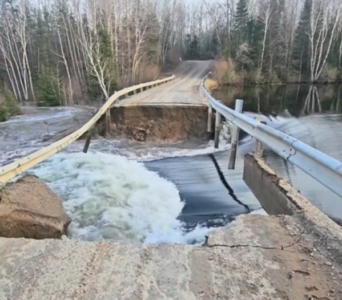
ALPENA – Two months after floods wiped out dams across Northern Michigan, the Michigan Department of Environment, Great Lakes and Energy (EGLE) sent a violation notice on Wednesday to one of the dams that failed.
Michigan received historic flooding across the northern region in early April. By April 21, five dam failures were reported by MLive including Bucks Pond Dam, Hillman Dam, and three of the Hiawatha dams in Montmorency County.
Bucks Pond Dam is privately owned and located near Barton City in Alcona County. The local homeowner's association Lakes in the Green owns the dam. It was constructed in 1930 and is 11 feet high and 300 feet in length, according to EGLE's Dam Inventory.
The dam was last inspected in 2022 and was reported to be in a fair condition. In 2017, EGLE reported the dam to be in satisfactory condition. The dam failed on or before April 13 when significant rain stressed river systems and caused the dam to overtop and fail, according to the violation notice. The breach caused Bucks Pond to drain into the creek, leaving very little of the pond.
Luke Trumble, supervisor for EGLE's Dam Safety Unit, said the violations were made to assess how much damage the dam failure has done and to notify owners that there was a violation of the state law.
"This is the first step into filling in any gaps in that information so we can fully understand what happened and what were the impacts of that dam failure," Luke Trumble, supervisor for EGLE's Dam Safety Unit, said. "And then we can start working with the owner to plan next steps."
According to the violation, the Dam Safety Unit inspected the dam and the areas downstream on April 14 and May 7.
The report stated that on April 14, the unit observed that the stoplogs used to open the channel flow were near the dam breach.
"Proper operation (removal) of the stoplogs ahead of, or during, the rainfall event would have increased the storage and discharge capacity of the dam," EGLE wrote. "Since the stoplogs were left in place to nearly the top of the spillway inlet, the impoundment was at a high level once the rain and runoff began and the spillway could not achieve its maximum capacity causing a greater chance of overtopping and failing."
EGLE wrote that the owner of the dam violated four different sections of the Natural Resources and Environmental Protection Act. The act was created in 1994 and was made to protect Michigan's environment, and regulate the way the land, water, and other natural resources are used within the state.
The violations include:
Part 313 (Section 30304): Prohibits depositing or placing any sort of material to fill the bottom of a wetland, or draining the water without first getting a permit from EGLE.
Part 301 (Section 30102): Prohibits dredging or fill the bottom of the lake; extend, enlarge, remove, or place a structure at the bottom that could interfere with the natural flow of the body of water without first obtaining a permit from EGLE.
Part 315 (Section 31509): Prohibits altering a dam without first obtaining a permit from EGLE.
Part 31 (Section 3109): Prohibits the discharge of any material to waters of the state that is or may be injurious or cause unnatural color or turbidity, or how clear the water is.
Lakes in the Green has to provide proof to EGLE within 30 days that it will be contracting with a qualified consultant, and to provide a written statement with sedimentation surveys, boundary surveys, what its plans are for the dam and witnesses.
Trumble said Lakes in the Green is going to decide what to do with the dam next.
The owner of the dam couldn't be reached for comment.
Grace Walker can be reached at walke1ge@cmich.edu. This story was produced by the Michigan News Group Internship Program, a collaboration between WCMU Public Radio and local newspapers in central and northern Michigan. The program's mission is to train the next generation of journalists and combat the rise of rural news deserts.
Editor’s note:
This story has been modified to correct an error.