Sad stories in Alaska
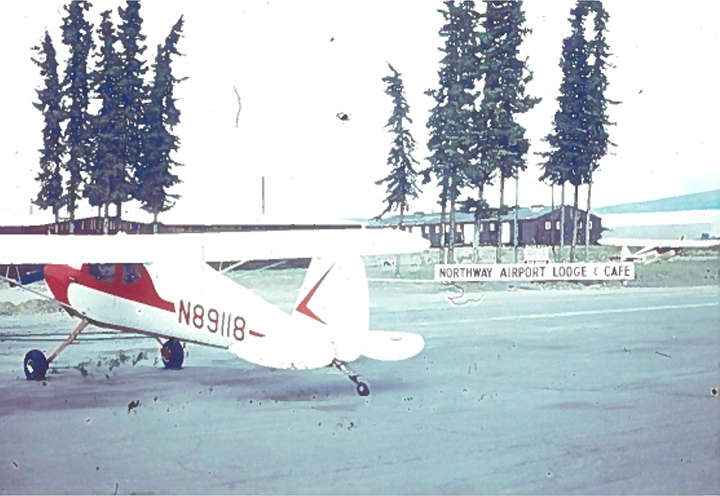
Courtesy Photo The airport at Northway, Alaska is seen in this July 1971 photo.
EDITOR’S NOTE: The following is the 23rd in a series of stories adapted from William Kelley’s book, “Wind Socks, Grass Strips, and Tail-Draggers.” Last week, Kelley finally reached Alaska, landing in Northway.
The lodge was a melting pot for all traffic into and out of Alaska.
It served as a store, restaurant, custom’s office, and social hall.
While I ate pancakes and drank several cups of coffee, I visited.
Weather was not only bad for flying up the pass toward Anchorage, it was also misty and miserable and cool at Northway, so I stayed inside most of the afternoon.
A couple came in and asked me to have a beer with them. I wasn’t flying anywhere, so I consented.
Regulations state that a minimum of eight hours must pass between the last drink a pilot has and his getting into an airplane. The expression “eight hours between bottle and throttle” is a good one to follow.
If a great deal of alcohol has been consumed, more than eight hours may be required before the pilot is fit to take the controls.
While we visited and had two beers, a little girl toddled around the dining area. Just a little thing. Soon, her mother came in and placed the girl in a playpen in a corner of the lounge.
The couple left, but personnel from Flight Service came into the room. I struck up a conversation with them. I had thought of applying to Flight Service, just to stay in Alaska, and wondered about their working conditions.
When all those folks left, I struck up a conversation with the mother of the little girl. We talked away the rest of the afternoon. She would hold the girl. The girl would make the rounds to other tables. She’d talk and squeal.
Finally, the woman said she should fix supper for herself and her daughter, and wondered if I would join them.
I seldom turn down food.
She lived in a trailer house adjacent to the lodge, on the edge of the airport ramp. It had been her boyfriend’s home.
She had been a nurse in Phoenix, Arizona. The previous year, she had met the fellow who lived in the trailer. He was a pilot in Northway. During the offseason, he worked as a mechanic.
One day, some gasoline exploded in a closed hangar and burned him. Facilities were scant in Alaska to treat his burns, so he was flown to a burn center in Phoenix. She was one of the nurses who treated him.
Her marriage was shaky, and, during the months she worked with the burn patient, she had divorced. When he came back to Alaska, he asked her to come with him.
She had arrived in the spring. With no place to stay, she moved in with him.
Just the previous June 30, he was flying a load of diesel fuel to a mining operation in the mountains. Weather conditions weren’t good.
Much of what happened to him was speculation from the folks I met at the lodge and Flight Service.
It was surmised he went above the overcast cloud layer. When he descended and broke out of the clouds, he turned up a valley he thought contained the mining camp. It turned out to be what locals called a blind canyon. He tried to turn around, but didn’t make it.
Investigators at the scene felt he hit the side of the mountain at a speed in excess of 200 knots. The fully loaded Cessna 185 exploded and burned on impact.
Personnel in Flight Service, who knew him, said he was a fatalist. He told those around him that he wasn’t going to live to be 30. He died at age 29.
He took unnecessary chances just to test himself and his theory and lost.
Three weeks had passed since the accident. Already, a legal hassle had developed. The girl was willed all the pilot owned in a “will” written on a small slip of paper she found in the bottom of a ring box. He had bought her a wedding ring and put the paper in the bottom, but hadn’t yet given it to her.
Evening came as we discussed her plight and solved the world’s problems over supper.
Twice, she mentioned I could stay in the trailer for the night. The trailer was warm, pleasant, and it was hard to leave it for the coolness of a damp tent. I decided it was better to “batch it” in my tent than feel out of place in a warm, dry bed.
My clothes had begun to smell a little ripe.
There was a laundromat attached to the lodge beside my tent, but I didn’t want to bother with laundry and a change of clothes until I could take a bath.
Come to think of it, I could have had both things, and turned them down.
Check The News next week for the next installment. William Kelley was a teacher for 32 years and has been a pilot since 1966. He lives in Herron on the family farm where he was born and raised.
Local News
Games and pie, a winning combination
GRAND LAKE — If you haven’t experienced a Pie and Game Night yet, you will be in for a treat. Join the members ...
MiShores seeks volunteers for Wednesday’s beach clean up
ALPENA — MIShores, a local beach cleanup group, is seeking volunteers to help clean up pollution in the Blair ...

Rogers City graduates turn the tassel
The Association of Lifelong Learners event update
ALPENA - The Association of Lifelong Learners (ALL) is hosting several, fun, entertaining, and educational events ...
Education, art and history, civic engagement: celebrating the 50th anniversary of the Alpena Bi-Path