
5 confirmed cases of cyclosporiasis in Northeast Michigan, Tuesday
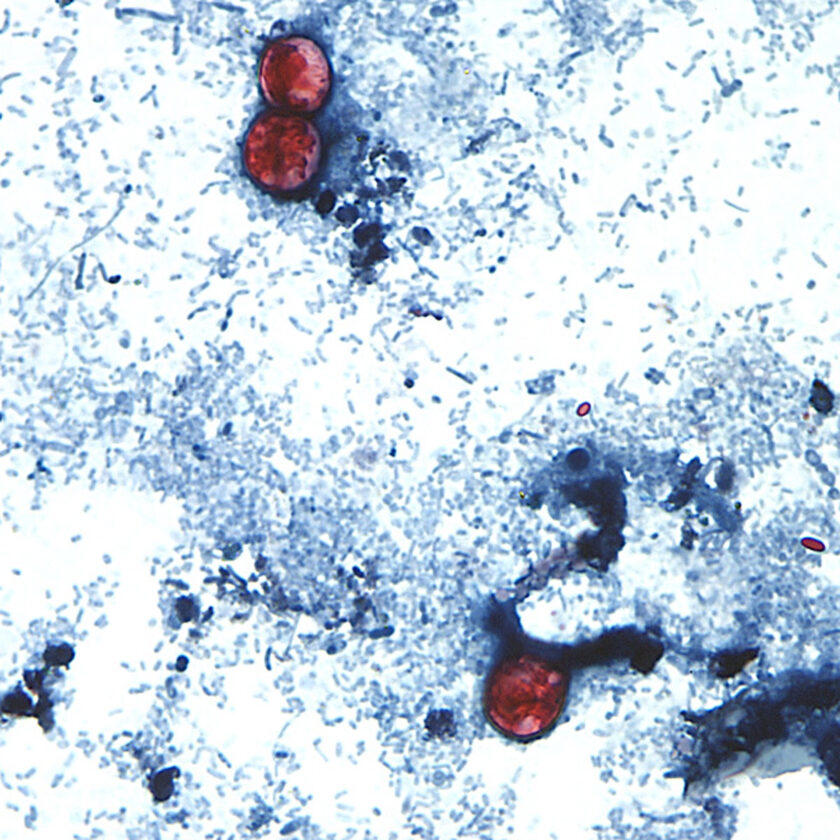
This undated photo taken through a microscope provided by the CDC shows Cyclospora cayetanensis oocysts found in a fresh stool sample which had been prepared with a formalin solution and stained with safranin. (CDC via AP)
MICHIGAN — As of Tuesday evening, Alpena County had two confirmed cases of cyclosporiasis and three confirmed in Presque Isle, according to District Health Department No. 4 (DHD4).
Health officials say that the public should be cautious and make the best decisions for the health of themselves and their families.
According to the Michigan Department of Health and Human Services (MDHHS), cyclospora is a parasite that infects the intestines and causes watery diarrhea, nausea, and stomach cramps. It is often contracted by eating or drinking something contaminated with the parasite. Typically, Michigan only records 40 to 50 cases of cyclosporiasis annually.
However, as of Monday, MDHHS has reported an outbreak of cyclosporiasis with 2,640 cases confirmed.
MDHHS stated in a release on Monday that results point to lettuce or salad greens as a potential source for this outbreak, although other food items have not been completely ruled out. No specific type of produce, grower, or supplier has been identified as the source.
MDHHS also reported that the incubation period for the parasite is up to two weeks for symptoms to develop after exposure.
Recreational water exposure, such as swimming in lakes, is not a recognized risk factor for cyclosporiasis and there is currently no evidence linking recreational water activities to this outbreak, according to the release.
Dr. Joshua Meyerson, DHD4 medical director, also told The News that lettuce and salad greens are a potential source, but there is the potential for other sources of contamination.
“Although the definitive product is not yet known, lettuce and salad greens are a potential source. Given the large scale of this outbreak including over 2600 cases to date in Michigan, the source is likely related to large commercial operations that supply these products to many different stores or restaurants across a large geographic area,” Meyerson said.
He explained that the public should buy whole heads of lettuce rather than pre-washed, bagged or boxed greens or salad mixes.
“The outer layers of leaves can be discarded and then the remaining greens can be washed,” he added.
Meyerson also added that shopping locally from farmer markets may be an alternative to avoid the parasite all together.
“As the source of the outbreak is likely related to produce grown elsewhere and supplied across a large network, locally grown produce, such as from area farm markets, are unlikely to be a potential source and thus a safer option to consider,” he said.
However, if you do become sick, Meyerson recommends contacting a health care provider.
“If you become sick with frequent watery diarrhea you should contact your health care provider to consider testing for the parasite,” he said. “Unlike many other causes of diarrhea, cyclospora is treated with prescription antibiotics along with rest and rehydration.”
Chelsea Engle, DHD4 health officer, told The News that though there were only two cases confirmed in Alpena County, and three in Presque Isle, for cyclosporiasis as of Tuesday evening, tests are pending for suspected cases.
She added that it takes three to seven days to get test results back for the parasite.
“People have been tested and we are waiting on results,” she said.
Engle said that as opposed to the common flu that will run its course, those who are affected with cyclosporiasis must be treated.
“It is something that has to be treated, it won’t go away on its own,” she said.
To prevent acquiring the parasite, Engle said DHD4 is recommending the public use standard best practices when preparing vegetables and fruits. She said people should wash their hands before and after washing vegetables and fruit with water.
“We encourage everybody to follow proper standard practices but to be aware and be extra vigilant that their produce is extra clean,” she added.
On Monday, MDHHS reported that the department is continuing to work with local health departments to “conduct in-depth interviews of individuals testing positive for cyclosporiasis, as well as with other state and federal partners to conduct traceback investigations.”
“Although we do not have a definite product identified as the source of the outbreak, we want to let Michiganders know what we have learned so far so they can take steps to protect their families,” Dr. Natasha Bagdasarian, MDHHS chief medical executive, said in the release. “Early information has shown lettuce as a common product that regularly comes up during the investigation. We will continue to provide updates as we learn more.”
MDHHS recommends the following safe practices for all individuals serving, preparing, or consuming lettuce and salad greens:
FOCUS ON LETTUCE AND SALAD GREENS
Given early information and the historical link between cyclospora and pre-packaged salad greens, MDHHS recommends adopting the following lettuce-specific safety measures:
– Purchase whole heads of lettuce
– Discard outer layers
– Wash inner leaves
– Prioritize cooking. For any greens that can be cooked, cooking to a temperature of at least 158 F (70 C) is the safest option.
PREVIOUS OUTBREAKS
The following foods have been specifically linked to previous cyclospora outbreaks in the United States and Canada:
– Bagged salad mixes and kits
– Fresh cilantro (coriander leaves)
– Fresh basil
– Raspberries
– Snow peas
– Green onions (scallions)
Kayla Wikaryasz can be reached at 989-358-5688 or kwikaryasz@TheAlpenaNews.com.
Local News

Alpena Biker Coalition supports Feeding Kids Ministry
Exchange Club historic flag field celebrates America’s 250 anniversary
ALPENA — In celebration of America's 250th anniversary, the Exchange Club of Alpena is inviting the community to ...

21st biannual Kauer family reunion

Virtual program highlights pelvic health after cancer treatment

Pine Quilt Guild Challenge
VA resource fair in Alpena date change
ALPENA – The United States Department of Veterans Affairs Saginaw Healthcare System will host a veteran town hall ...