
The Katherine V: A bygone era of gill net fishing
Fisheries heritage on the Great Lakes – Part 1
Trending
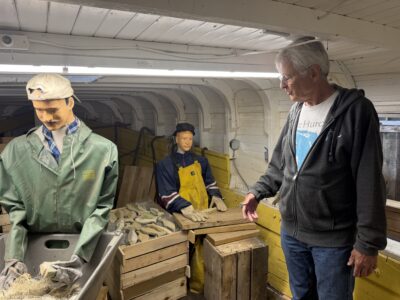
ALPENA -- Jim Johnson, retired fisheries biologist and Besser Museum curator, gave The News a one-on-one curator tour of the museum's Great Lakes Fisheries Heritage exhibit, which features a Great Lakes gill net fishing tug, the Katherine V. The tug boat represents a bygone era of Great Lakes fishing that impacted the ecosystem for decades to come.
The Katherine V construction was financed by the Vogelheim and Klann families. These two families owned and operated the vessel from its launch in 1928 until 1970 when it was retired. The vessel itself has Annishinaabe connections, as it was built by Henry Vincent, a Native American ship builder.
Johnson explained that the ship was built of white oak, northern white cedar, and cypress. It was then sheathed with steel to withstand ice and the longer fishing seasons required for ships to pull a profit.
"They didn’t think they were going to have to break ice when they built the boat, but then as the fishing season had to be lengthened to make a profit, they were fishing 10 months a year by the end of it," Johnson said. "Because there were so few fish left and all these thousand boats were all competing against each other."
Johnson said that gill net fishing, the process of using netting to catch fish by the gills, replaced traditional fishing techniques used by Anishinaabe tribal members who relied on fishing in the Great Lakes for generations.
According to Johnson, local Anishinaabe tribes of the Thunder Bay region, relied on fishing the Thunder Bay River for sturgeon in the early spring months.
"That’s why fishing was so important to Native Americans," he said. "Anishinaabe relied on them as the first food source after winter. Coming out of winter they were on the verge ... were in a state of starvation."
In the early 20th-century, European settlers reshaped the landscape of fishing, pushing Anishinaabe tribal members out of the commercial fishing market as bigger, more efficient fishing vessels dominated the market.
According to Johnson, as the decades wore on, more European settlers started engaging in commercial fishing and introduced gill nets and advanced shipping vessels to the Great Lakes fishing economy.
"They didn’t have the capital to buy these big boats," Johnson said, referring to Anishinaabe commercial anglers. "A lot of times, investment firms or wealthy families would buy the boats, and then hire the crews. The crews were often composed of Anishinaabe, but every decade, it seemed like more and more European-origin fishers were dominating the fishery."
By the 1930s, when the Katherine V was launched on the Great Lakes, gill net fishing was widely used and contributed to overfishing which ultimately led to the gill net ban in the late 1960s and early 1970s. Gill net fishing was particularly harmful to the Great Lakes ecosystem because most fish caught in the netting die. Therefore, anglers could not release fish that were caught beyond their quota.
"I really dislike the use of gill nets, and I think the state wisely chose to not allow them anymore in their state licensed commercial fisheries," Johnson said. "They didn’t allow the commercial fishermen to throw back fish they weren’t entitled to. Catch a lake sturgeon? What's the point of throwing it back if it’s so damaged it’s going to die."
Johnson said that most fisheries and commercial fishing companies switched to using trap nets, which is a net designed to guide fish into an enclosed underwater chamber. They remain "trapped" and alive until harvested.
In the days of the Katherine V, Johnson said that the Great Lakes commercial fishing landscape was already destabilized due to overfishing.
He explained that the tugs were efficient and powerful, and there were about 1,000 vessels of its kind fishing the Great Lakes in the '30s. He added that the tugs set about 72,000 miles of gill nets each year in Michigan alone, which could wrap around the Earth's equator about three times.
Johnson explained that the use of powered "gill net lifters" allowed anglers to pull in miles of nets each day without the fear of crew members being pulled overboard.
"You needed these power lifters," Johnson said. "You could lift miles of nets per day, and it was effortless. So now they could really fish the Great Lakes."
During Katherin V's tenure, commercial fishing vessels began venturing up to 20 miles into open water as the fish population continued to decline.
"The days were much longer, and they wouldn’t get back until 6," he said. "They kind of almost lived half their lives aboard this boat, six days a week, 12 hours a day."
Johnson said that fisheries scientists had been warning the state legislature, up until the gill net ban, of overfishing. He explained that the state government and those in the fishing communities, could not imagine the Great Lakes could ever be destabilized.
"For a long time, people didn’t believe. They just couldn’t believe that you could overharvest the Great Lakes," he said. "'Look how big they are,' 'How can you over harvest all that?' And even though the scientists were saying, 'Hey, these lakes are being over harvested,' the politicians were going, ‘That’s not possible.' They weren’t believed. And so there were minimal harvest controls ... so the crash came."
Johnson said that the commercial fishing crash, combined with the introduction of invasive species, lead to stricter harvest controls and fisheries regulations.
Tomorrow, The News will publish the second installment of this two part series of fisheries heritage on the Great Lakes, covering the recovery of the Great Lakes fisheries and the contributions of the Michigan Department of Natural Resources research vessel, Chinook.
Kayla Wikaryasz can be reached at 989-358-5688 or kwikaryasz@TheAlpenaNews.com.