
Blackwaters provides list of alleged safety violations for fairgrounds
Debate continues as to the extent of disrepair
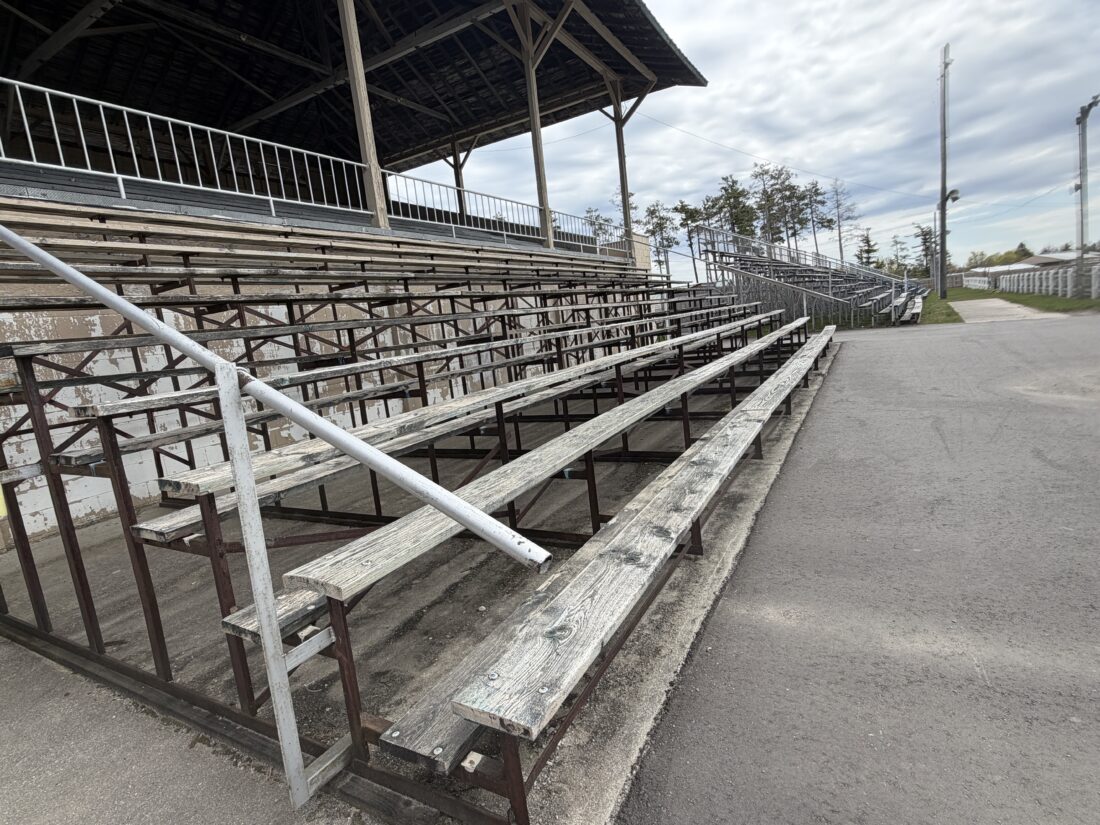
News photo by Kayla Wikaryasz The bleachers at the Alpena County Fairgrounds is pictured.
ALPENA — The News received a list of alleged safety violations from Blackwaters NE on Thursday, the developer seeking a lease for the Alpena County Fairgrounds, which were cited during public meetings for the development project.
Alleged safety violations include structural concerns of buildings on the property, electrical hazards, ADA compliance, and much more.
No matter where the money comes from, Alpena County officials and fair board leaders are aware of the need to renovate and upgrade the Alpena County Fairgrounds to ensure its longevity.
After a proposal to renovate the fairgrounds landed on the county’s lap in late March, visibility of the repairs needed to the property has led to heated conversations online and during public meetings. The consensus is that the fairgrounds have been neglected for years, before the current tenures of fair board members and county commissioners.
At the Alpena County Board of Commissioners full-board meeting on April 28, Alpena Building Official Don Gilmet spoke during the first public comment portion noting safety concerns and the condition of infrastructure at the fairgrounds.
He said, citing his experience as a long-time Building Official, the fairgrounds have been deteriorating for years, including the grandstands.
“We’ve been putting Band-Aids on that forever,” he said.
Gilmet noted concerns at the grandstands such as “crumbling” infrastructure, cracking windows, and leaks.
“Just a lack of maintenance because we didn’t have the money,” he added. “The fairgrounds is not a cash cow.”
According to County Commissioner John Kozlowski, there hasn’t been a recent inspection of the property but the county is working to accomplish one in the near future.
“We are in the works of trying to have one done, we are working to locate an engineer for pricing and availability,” Kozlowski said in an email to The News.
Kozlowski added that the county has concerns for the property and is aware of work needing to be done on the bleachers and grandstand along with some of the structures. However, he said that a professional would have to inspect the property before the county makes any claims as to what needs improvement, what doesn’t, and what the potential cost may be.
At Blackwaters’ initial presentation in an open meeting on April 17, Blackwaters’ leadership cited 600-plus safety violations that the company’s insurance company would require remediation before insuring the property.
Kozlowski said that the county believes at least some of the company’s claims are valid.
“We believe that some of their claims are valid,” he said. “When they expressed these concerns with the county and fair board earlier this year no one seemed to disagree.”
Alpena County Fair Board President Courtney Tauriainen said that the fair board has not received a full list of safety violations from Blackwaters so she could not speak to any of the specific safety violations Blackwaters has cited.
Kozlowski said that the county would accept the fair board initiating the inspection on the behalf of the county.
“We would be fine with them doing the inspection; any help to ensure the safety of those visiting our properties would gladly be accepted,” he said.
Tauriainen said that the fair board’s top priority is ADA compliance which has been part of its fundraising focus since 2022. She also said that replacing the bleachers is a top priority as they are “the biggest hazard that there is here.”
“It’s a never-ending battle because those bleachers were never meant to be outside in the first place,” she added.
She noted improvements that the fair board has made in recent years such as laying asphalt, replacing boards along the race track, painting, and more.
Tauriainen said a recent goal is to replace the wooden bleachers with aluminum ones.
As far as the grandstands needing work, she said “that’s not deniable by any means.”
“Do we necessarily think that it’s going to fall on people like they’re saying it is in the next 10 years? No. Absolutely not,” she said. “It’s not structurally bad.”
She prefaced her comment noting that “we’re not building inspectors.”
Alpena County Fair Board Director Wally Powell said that there are improvements needed at the grandstands though the last inspection was done four years ago by a previous board director.
“Yes, there is stuff that needs to be fixed,” he said. “There’s some blocks that are deteriorating that need to be repaired and patched.”
He also noted that there is likely dry rot in the wooden structural parts of the grandstands since the grandstands are over 100 years old.
“I haven’t noticed anything that’s falling or crumbling or anything like that,” he said. “But wood dries out … I don’t think it needs a new roof by any means.”
Both Powell and Tauriainen said that cosmetics are the “biggest thing.”
Tauriainen said that there are no pressing electrical concerns but noted that the electrical systems on the property are “outdated” and inefficient.
“There’s no hazards that we see,” she said. “Again, we’re not building inspectors.”
The Blackwaters NE office sent The News a list of safety violations that its insurance company had cited as concerns. However, the company noted that the following list is not an exhaustive list.
“Due to our ongoing due diligence, we are providing the following summary of the major repair items currently identified on the property,” the office stated in an email. “These items represent the primary safety, operational, and occupancy concerns that must be addressed before any public, staff, vendor, tenant, exhibitor, livestock, or event occupancy occurs on the property.”
“This is not a complete or final list,” the email added.
Repairs and requirements summary for the fairgrounds property cited by Blackwaters include the following:
GRANDSTAND STRUCTURAL CONCERNS
– Grandstand structural concerns
– Crumbling concrete in stair sections
– Railing and aisles must be installed on all sections of grandstands
– Exposed reinforcing steel
– Concrete delamination at support columns
– Cracks creating trip hazards
– Water intrusion damage beneath grandstand deck
– Rusted steel and sharp edged anchoring hardware
– Deteriorated expansion joints
– Loose handrails
– Uneven walking surfaces and uneven concrete joints
ADDITIONAL STRUCTURAL ISSUES
– Rotten wooden beams and cracks
– Multiple broken support trusses
– Replacement of steel plates
– Inadequate lateral bracing
– Deteriorated load-bearing posts
ELECTRICAL SAFETY CONCERNS
– Missing junction box covers
– Exposed wiring in barns
– Damaged conduit in multiple places
– Extension cords used as permanent wiring
– Non-GFCI outlets near water sources
– Open electrical splices
– Improperly labeled panels
– Downed lines and exposed buried electrical in grandstand area and agricultural area
ADA ACCESSIBILITY
– Bathrooms lacking compliant grab bars
– Improper turning radius in restrooms
– Uneven ground surfaces in barns
– Walking paths have ruts and obstacles
– Missing accessible seating areas
– Non-compliant door hardware
– Lack of accessible parking signage
BLEACHER AND SEATING CONCERNS
– Existing bleachers require full replacement
– Missing guardrails
– Non-compliant egress paths
METAL AND BARRIER HAZARDS
– Damaged metal panels require replacement
– Sharp exposed edges on barriers, complete removal or enclosure needed
– Temporary padding methods insufficient for permanent compliance
HAZARDS IN BARNS
– Barns have sharp exposed metal in multiple areas
– Barns have improper walkways and egress
– Barns have electrical and structural hazards
– Barns have hazards from improper installation of cattle panel and barriers
– Temporary padding methods insufficient for permanent compliance
LIVESTOCK SAFETY STANDARDS
1. Approved livestock containment
Livestock pens, chutes, gates, panels, alleys, and holding areas have to be built of proper livestock-rated materials suitable for the species being housed or moved, according to Blackwaters.
Acceptable containment may include the following:
– Freestanding livestock panels rated for the species and expected pressure load
– Properly braced gates and alley systems
– Permanent posts, rails, and fencing designed for livestock use. Any rotten wood fencing must be removed and replaced
– Temporary pen systems specifically manufactured by an approved manufacturer
– Crowd-control barriers separated from animal-contact areas, which cannot be used as primary livestock containment.
– All containment panels must be labeled with use and area.
– Proper signage in all areas.
2. Prohibited fencing: No wall-hinged livestock fencing, no homemade, unrated, non-engineered enclosures, or area where animals are located
According to Blackwaters, for livestock safety and public safety, no livestock fencing, gate, panel, holding pen, alley fence, or animal-containment barrier shall be hinged directly to a barn wall, building wall, shed wall, concession wall, grandstand wall, or other non-livestock-rated structure.
This includes the following requirements:
– No hinged panels attached only to walls.
– No gates relying on siding, barn framing, sheet metal, decorative wood, or masonry alone for support.
– No improvised swing panels connected to walls with strap hinges, lag bolts, eye bolts, chain, wire, or temporary hardware.
– No fencing where the wall becomes the primary structural anchor resisting animal pressure.
– No crowd-side fencing hinged to walls where animals, exhibitors, or the public could be trapped if the hinge or wall connection fails.
3. Required gate and panel anchoring:
All gates and panels used for livestock containment shall be secured to proper livestock-rated posts, frames, or engineered support systems, according to Blackwaters.
Minimum requirements include the following:
– Gates must be hung from structural posts or frames designed for livestock use.
– Posts must be properly set, braced, and maintained.
– Portable panels must be connected using manufacturer-approved pins, chains, clamps, or latches.
– Panels must not have sharp wire, exposed nails, loose bolts, broken welds, protruding hooks, or jagged edges. All must be completely painted.
– Gates must swing safely, latch securely, and not create pinch or crush points.
4. Species-appropriate design:
According to Blackwaters, containment must be appropriate for the animal type, according to Blackwaters. Cattle, horses, sheep, goats, swine, poultry, and small animals all require different spacing, height, strength, and gate design.
5. Public separation and controlled access:
Livestock areas shall maintain a clear separation between animals and the general public.
Required controls include the following:
– Clear public walkways.
– No public access behind pens, chutes, or holding alleys.
– Controlled exhibitor-only entry points.
– Handwashing or sanitation stations near animal-contact areas.
– Signage warning guests not to feed, touch, climb on, or enter livestock areas without authorization.
– Emergency access lanes kept clear at all times.
Local News
Chillin’ chipmunk
The Katherine V: A bygone era of gill net fishing
Sandcastle building contest ready to roll
DNR reopens the Cheboygan lock

Lots to do on Fourth of July Weekend
Starlite Beach splash park hours extended
ALPENA - The City of Alpena will be extending the hours of operation of the Starlite Beach splash bark beginning ...