
Thunder Bay lake data input session Thursday
Trending
ALPENA -- A public session will be held from 5 to 7 p.m. Thursday to gain valuable community input regarding future weather-observing assets to be placed in Lake Huron.
Interested community members are welcome to come any time between 5 and 7 p.m. at the Great Lakes Maritime Heritage Center, 500 W. Fletcher St., Alpena. Refreshments will be offered.
The Great Lakes Observing System is partnering with Thunder Bay National Marine Sanctuary to host this session.
"A primary goal at GLOS is to enhance the collection, dissemination, and utilization of actionable data, information, and services related to coastal resiliency, coastal frontline communities, the marine environment, aquatic life and ecosystems," a press release explained. "The Great Lakes Observing System is working to contribute reliable data that meets stakeholder and scientific needs."
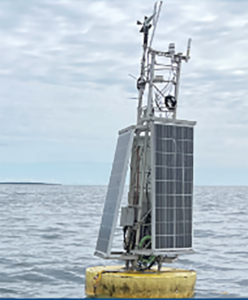
Currently, six meteorological buoys are located in Thunder Bay National Marine Sanctuary, operated by the National Oceanice and Atmospheric Administration's Great Lakes Environmental Research Laboraty. The buoys measure and report lake data in real time, including wave height, surface temperature, and wind direction.
That information can be useful to anyone planning to go fishing, diving, kayaking, boating, snorkeling, or otherwise recreating in the sanctuary.
"Some people will look at the camera (located on a buoy) to see if there are whitecaps before deciding to go out on the bay," said Sarah Morrison, media and outreach support specialist for Thunder Bay National Marine Sanctuary. "It's a great way to be able to check."
"Connecting people to the lake is a key goal for Thunder Bay National Marine Sanctuary, and real-time buoy data is critical to users making safe and responsible decisions when out on the water," a statement from GLOS said. "As part of our planning to expand the observing network in support of safety and sanctuary work, GLOS is eager to hear directly from the community on what data matters most to them and where they'd like to see new buoys placed."
"We are so excited to work with GLOS to continue to grow Thunder Bay National Marine Sanctuary as a center for scientific research and one of the most studied places in the Great Lakes," said Stephanie Gandulla, resource protection coordinator for Thunder Bay National Marine Sanctuary.
"If you use Lake Huron, and you have something you want to share, it's valuable," Morrison added.
For more information about the buoys, visit the National Data Buoy Center at ndbc.noaa.gov.