
DHD4 advises residents to be cautious with flood waters
Trending
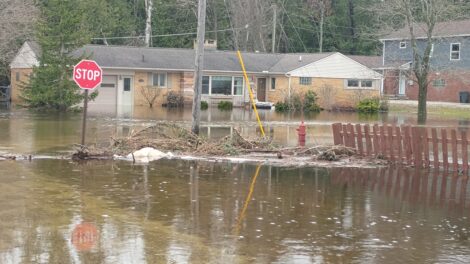
ALPENA - District Health Department No. 4 (DHD4) is advising residents to proceed with caution as it relates to standing water or sewage issues citizens might be experiencing, and to use caution as water levels continue to rise.
Environmental Health Director for DHD4, Joe Scheele, a registered environmental health specialist, advises area residents about the risks and health concerns flooding issues bring with it.
"The DHD4 staff are also members of the communities within our district, and we want to provide helpful and factual information to help keep our people safe and healthy in the presence of any possible dangers," Scheele said.
Scheele urges residents to use caution when encountering any flood related areas, especially in areas with electrical wiring or equipment.
"The potential for electrical shock and submerged hazards is very real, especially within a home," Scheele explained. "Do not attempt to go into a flooded basement under any circumstance. Contact your power provider and let a professional (and insured) company handle it,"
Without testing, there is no way of knowing what kind of harmful microorganisms (bacteria, viruses, protozoa) are present in the water, or to what degree, he said.
"If there are raw sewage backups, the potential for contamination of e. Coli is very high," Scheele said. "The safest bet is to assume that all flood water is unsafe for human contact and to avoid them completely."
DHD4 works in conjunction with the Michigan Department of Environment, Great Lakes, and Energy (EGLE) which is the state agency responsible for managing Michigan’s environmental, water, land, and energy resources.
"We have a contract with EGLE to test Great Lakes Beaches during the summer months for fecal coliform bacteria," Scheele said. "If levels exceed EGLE standards, we issue a swimming advisory so that people know the water is unsafe for swimming."
"Without testing, it is best to assume that flood water is unsafe for human contact," Scheele added.
If your home has been flooded, it is recommended that you thoroughly clean any household items and then sanitize them with some bleach and water.
"Remember, cleaning and sanitizing are two different things," Scheele said. "A sanitization step should ensure the elimination of any harmful microorganisms on surfaces."
The most critical concern pertaining to flooding is with residential wells, it can introduce severe contamination into your drinking water, including bacteria, viruses, sewage, fertilizers, and pesticides, making it unsafe for consumption.
"If your well has been flooded or there is standing water around your well casing, you cannot rule out the possibility of contamination in your well or water system without testing it for coliform bacteria," Scheele explained. "It is important to test from the pressure tank, as that is typically the first spot a homeowner can draw water from and is indicative of the water quality coming directly from the well."
"Anywhere downstream of the pressure tank could also have contamination being introduced by the home’s internal plumbing system," Scheele added. "If repeated samples show a presence of coliform bacteria, the well can be chlorinated by a registered well driller and the system flushed out."
DHD4 highly recommends that any person with concerns about the water quality of their well , stop in the health department and get a bacteria testing kit to test your well.
The Michigan State Police issued a press release on Wednesday with the following emergency preparedness information tips to help keep people safe in flossing scenarios.
– Follow all emergency orders.
– Standing water can be deceiving, do not attempt to drive or walk through flooding water on the roadway. Six inches of water is enough to lose control of your vehicle.
– Floodwater could cover live, downed electrical lines or other hazards.
– For downed trees or debris blocking travel, call 9-1-1.
– For downed power lines, stay at least 25 feet away and contact your local electric provider.
– During flooding, move to higher ground, if advised, and keep emergency supplies ready (food, flashlights, water, etc.).