Alpena County land parcel assessments may be inaccurate, says Somers
Taxable value increase for 2026 is down
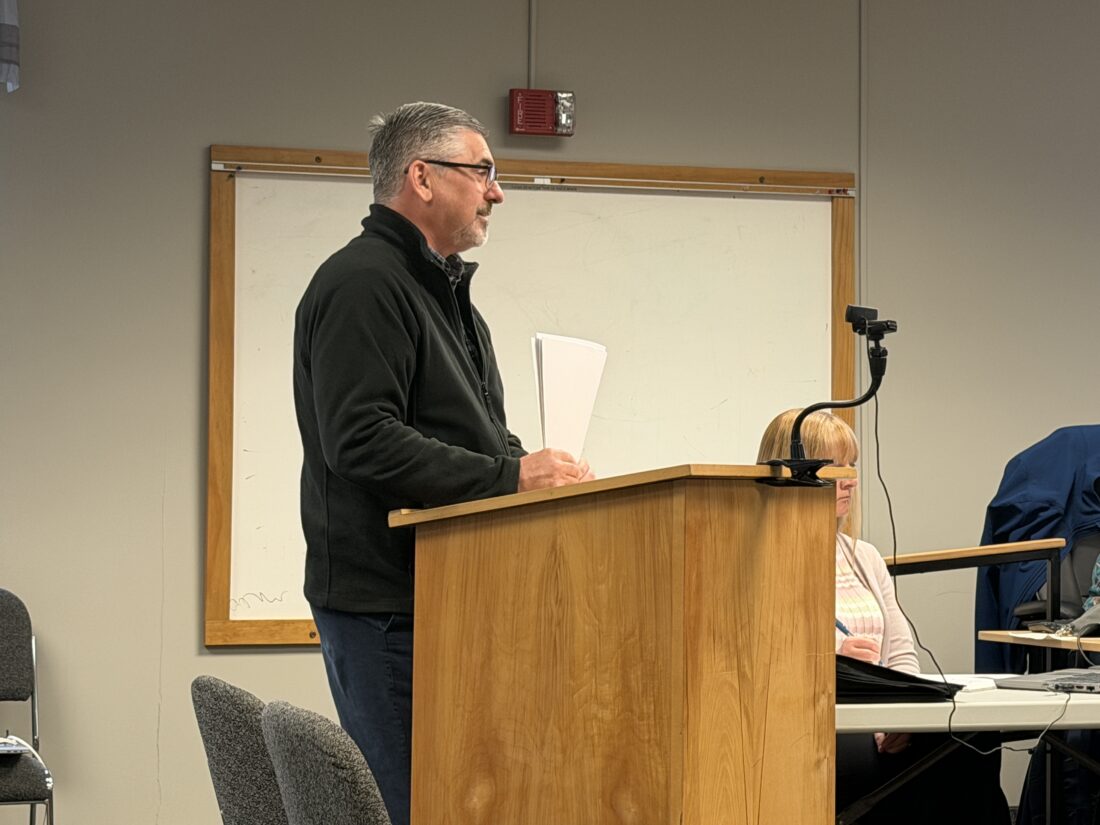
News photo by Kayla Wikaryasz On April 14, Alpena County Equalization Director Ted Somers is seen presenting the 2026 Equalization Report to county commissioners during the monthly Finance, Ways, and Means committee meeting.
ALPENA — Increases in taxable value of property in Alpena County for 2026 is lower than previous years. Alpena County Equalization Director Ted Somers said this has been a trend the past few years due to inflation, but parcels of land may also not be accurately assessed.
At the Alpena County Finance, Ways, and Means committee meeting on April 14, Somers presented the 2026 Equalization Report to county commissioners.
This report documents the equalized value of parcels of land in the county.
Somers told the commissioners that as a whole, Alpena County saw an increase of 9.2% of equalized value and a 5.14% increase in taxable value.
He added that the largest increase came from the residential class, at 10.29%. The second largest increase came from the agricultural class at 7.61%.
At the meeting, Somers stated that the taxable value increase is lower than the equalization department has seen the past few years.
“I would say 5.14% in taxable values, a little bit lower than we’ve been seeing, but it’s still holding,” he said.
Board Chair John Kozlowski expressed his concern regarding the accuracy of assessments and whether or not the county is missing out on income. He noted building projects that assessors might neglect to assess once the project is complete.
“My concern is … assessors that may not be going out reassessing those projects years later,” Kozlowski said. “We are missing out on taxable income.”
Somers said that his department discovered these potential inaccuracies “a year or two ago.” He added that it is difficult for his department to locate parcels that have improvements that were missed by assessors.
Somers told commissioners that his best advice to remedy the situation is to keep local units (i.e. townships) accountable for their assessments.
“In my opinion … put pressure on the local units would be my best advice,” he said.
“More importantly, from our standpoint, it’s being equal and fair to everybody,” he added. “It’s not fair that some people are paying for their improvements and some people are not. So from my seat, it’s not so much a revenue thing as it is being fair and equal to everybody.”
Somers told The News that improvements that are billed to the property go directly to the taxable value. He explained that if land is not being properly assessed, and there are value increases not accounted for, taxable value could be lower and affect millage rates, which are based on the taxable value.
“So the lower that is, the less revenue,” he said.
Somers explained that the increase in taxable value in Alpena County was lower than the previous three years because the consumer price index was lower than it had been the previous three years. He said that his department was not surprised by this.
“We did expect a decrease,” he said.
For residential, Somers said that the increase was due to the “lack of inventory” for “good” housing which has inflated the housing market.
He added that the agricultural class saw an increase as well because of high market value for farmland. He said that there was a $300 to $400 increase per acre for agricultural-classed land.
Somers explained that the equalization department evaluates how parcels of land are assessed, and ensures that those parcels are taxed at 50% of their actual market value, or for how much they’d be sold.
“We would do the studies, and the local unit assessors would actually record and maintain the improvements of each parcel,” Somers said.
He explained that at the beginning of each year, the equalization department picks a sample size of parcels to check for accuracy. He added that these sample sizes usually equal 10% of parcels in each class of property within each of the local units.
Somers stated that the challenge his department has recently faced is that its results are not equal to the assessments from the local units.
“When we compare them with the local unit databases, we’re finding some discrepancies and more, most importantly, unfinished or not accounted for improvements,” he said. “If somebody might build an addition or a barn or something to that effect, we’re finding quite a bit of that missing from the assessment.”
Somers said that his department is limited as to how they can intervene and remedy those discrepancies. He added that the most his department can intervene is by alerting local units and hoping that they address the issue.
“As for us in equalization, there’s not a whole lot we can do other than bring it to the attention of the local unit officials, which we have attempted to do,” he said. “And we’re not having very good luck getting that issue addressed.”
Somers added that he suspects there are more discrepancies within the county because his department doesn’t check every parcel of land for accuracy.
“I presume there’s a lot more than what we’re finding, just simply because we don’t look at all the parcels,” he said. “We’re only doing a sample.”
He said that by the nature of the work, total accuracy is not always attainable, though another real issue lies with assessors not following up on building permits.
“I’m sure there’s no assessor that’s 100% perfect,” he said. “It seems like they’re not really being inspected the way they should be.”
Though a concern for county government continues to be missing out on potential revenue, Somers said his concerns mainly lie in equity.
“Where I’m sitting at in my seat, it’s being fair and equal to all people,” he said.
Kayla Wikaryasz can be reached at 989-358-5688 or kwikaryasz@TheAlpenaNews.com.
Local News

Congrats Steve!

Cavitt testifies on plan to help Michigan’s first-time homeowners
Masons support Friends Together

Szymanski earns Mahaz Family Spartan Scholarship
Officials hopeful Bay View Park restrooms ready for July 4