
Rabbideau responds to state school aid budget
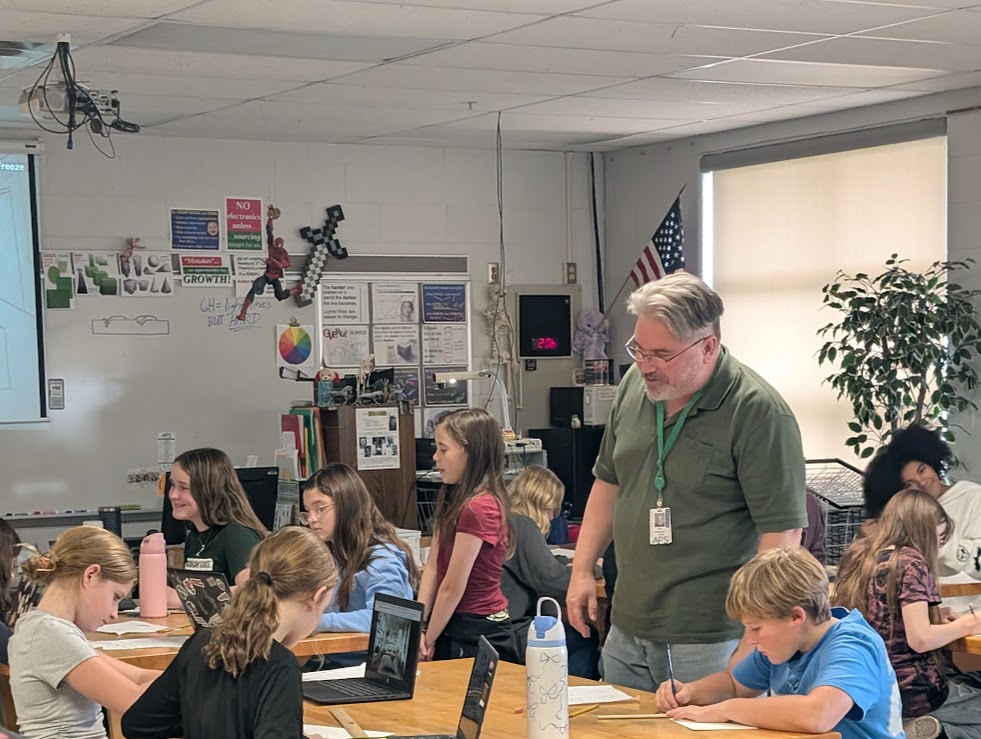
News Photo by Reagan Voetberg Students at Thunder Bay Junior High are pictured in art class on Wednesday, led by art teacher Kyle Kieliszewski.
ALPENA — School districts across Michigan breathed a sigh of relief when the state school aid budget was passed on Oct. 3, allowing districts to continue operations without worry. While record spending is going towards education, the reality is that schools are receiving less than it looks like due to funds being reallocated or eliminated altogether.
Universal free breakfast and lunch will continue for all 1.4 million children in Michigan’s public schools, helping students focus on learning and saving families nearly $1,000 per year, according to a Monday press release from the Michigan Executive Office of the Governor.
A record $593.5 million will support school operations through a 4.6% increase in base per-pupil funding–equating to an additional $442 per student, for a total of $10,050 per pupil. That increase will support Michigan students and educators by delivering more resources for classrooms such as books, pencils, paper, electronics, and more.
Alpena Public Schools Superintendent Dave Rabbideau said that the unrestricted revenue the district is receiving from the state is actually decreasing rather than increasing.
Unrestricted revenue is funding that the district can use where they feel it is needed most. That funding is decreasing by about $63,000, which is a loss of around $17.50 per student, Rabbideau said.
However, the district is receiving increased funding from local tax dollars, increasing the total amount of unrestricted revenue by about $207 per student. Two years ago, that increase was $404.
“We are grateful that we have a budget now, and that we are not operating in limbo,” Rabbideau said. “The budget could certainly be better for our district and districts across the state of Michigan.”
One area of concern is that the district now has to pay $1.25 million to cover costs for employee pensions that they did not have to cover last year, Rabbideau said.
“Last year, they paid the district to offset those costs,” Rabbideau said. “Now they are not.”
Those pension payments take away from the $442 dollar increase in per pupil funding, making the $10,050 figure not as great as at first glance.
“We would certainly ask that the legislators look more closely at what the actual outcome is, it’s these things on the backend that reduce that pretty significantly,” Rabbideau said.
The budget also allocates $274 million to provide a 25% increase in funding to support academically at-risk students, English language learners, career and technical education students, and students in rural school districts, according to the press release.
Rabbideau said that the district has 60% at-risk students, so increased funding to that categorical spending is a positive for the district. However, that money can only be spent on those 60% of students, and not the other 40%.
The increase in categorical funding is coming from areas where the district had more freedom in how that money could be spent, which is a downside.
Funding for mental health services has been raised, he said, and that can be used for all students.
A total of $190.9 million will be used to continue expanded support for special education services, a 9.4% increase in the state allocation from adjusted current law levels, according to the press release.
The budget assigns $142 million for career and technical education (CTE) operations, including $70 million to support the expansion and creation of programs in underserved areas, and $125 million to continue support to districts for school transportation.
“They left CTE funding alone… that is increasing for us at $48,000, that’s a positive,” Rabbideau said.
Transportation funding will remain the same for the district as well, another positive for the challenges that APS faces as a rural district.
Local News
How salmon helped save our eagles
Alpha Xi Chapter of Delta Kappa Gamma meets
ALPENA — Alpha Xi Chapter of Delta Kappa Gamma, a society of women educators, met on May 13 for a dinner meeting ...
Grass cutting in Alpena
ALPENA - The City of Alpena would like to remind all property owners and tenants of City Ordinance requirements ...
Northern Michigan is on track to have its wettest year on record
Construction begins Monday on Bay View Sportsplex pavilion
Northeast Lower Peninsula fishing report
ALPENA - The summer fishing season is approaching and the DNR provided an update on local fishing action and ...