‘Red Dot Project’ inspects addresses, prompts fixes for safety’s sake
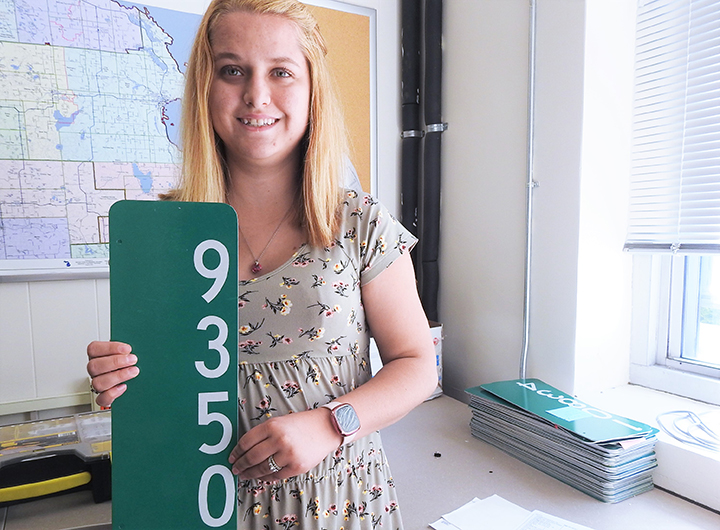
News Photo by Julie Riddle Sabrina McGirr, legal secretary for the Alpena County Equalization Department, holds one of the house number signs the department will provide to county residents to help emergency responders find their home faster.
ALPENA — To fight a fire, a firefighter has to find it, first.
To help paramedics, firefighters, police officers, and other responders reach emergency scenes as quickly as possible, Alpena County’s 911 office is working with the state to validate and standardize local addresses.
That means some area residents checking their mailboxes in coming months will learn that their home has been tagged to receive a new house number.
Homes most likely to see change include those out of numerical sequence or identified by a number that should belong on the other side of the street, said Kim Elkie, director of the recently renamed Alpena County Office of Emergency Management and E911 Services.
Despite the inconvenience accompanying such a change, a new address could make a life-or-death difference at the time of a fire, break-in, or medical emergency, when every second counts, Elkie said.
“The focus is on safety,” she said. “We don’t want a faulty address to hamper help getting where it needs to be.”
While address changes have long been the purview of the county equalization department, the 911 office is pushing for a more thorough inspection of local addresses to make residents safer.
Last year, county officials agreed to join a handful of initial participants in an address synchronization project of the State 911 Committee.
The county shared its addressing data with the state, which processed the data and turned it into a map that uses red dots to mark addresses inconsistent with local addressing standards.
In what Elkie calls the Red Dot Project, the 911 office has joined with several other entities — including the equalization department, city and township governments, and the county road commission — to find and fix address inconsistencies.
Most local addresses — appearing as yellow dots on the map — follow addressing rules and need no adjustment, Elkie said.
Orange dots mark locations that don’t follow rules but also don’t present safety hazards.
“It’s all about the red dots” — the few-and-far-between locations where a bad number could slow response time at a crucial moment, Elkie said.
Paramedics, their minds focused on the medical emergency ahead, could easily miss an address sign for an odd-numbered house located on an even-numbered side of the road, then have to spend time turning around and searching for the correct number, she said.
Lead dispatcher Roy Wekwert regularly updates the county’s database that helps dispatchers send responders to the right place.
Current records don’t indicate why some house numbers fail to follow standard numbering sequences or how some roads obtained names known by locals but never made official on the county’s books, Wekwert said.
“How it happened, people don’t know,” Wekwert said. “We’ve just got to get it fixed.”
The equalization department will notify Red Dot residents whose address must change, and some will not like that news. An address change complicates residents’ lives, and people become emotionally attached to their house numbers, Elkie acknowledged.
But safety has to come first, she said.
If a loved one were to suffer a medical emergency, “I’d rather be in my house doing CPR than at the end of my driveway trying to make sure the ambulance can find us,” she said.
Residents assigned a new address will be given a physical house number by the equalization department to post near their mailbox or in their front yard, visible to emergency responders.
Some people don’t get around to posting the house number they receive from the equalization department or their local fire department. Others refuse to post them, calling the number signs unattractive, Elkie said.
“They might be ugly in some people’s eyes,” she said. “But these things can be lifesavers.”
Presque Isle and Montmorency counties also agreed to participate in the state’s address synchronization project, according to state documents.
Julie Riddle can be reached at 989-358-5693 or jriddle@thealpenanews.com. Follow her on Twitter @jriddleX.
Local News
Alpena Community College hosts Law Enforcement Career Academy
Purple Heart Day Ceremony planned at Veterans Park
Getting ready for the fair

Habitat for Humanity to host pickleball tournament fundraiser
Circuit Court to consider implementing seasonal lake levels on Grand Lake
PRESQUE ISLE – On August 10, 2026, the Presque Isle County Circuit Court will hold a hearing to establish ...