
WITH VIDEO: Animal removal a last but sometimes necessary option, officer says
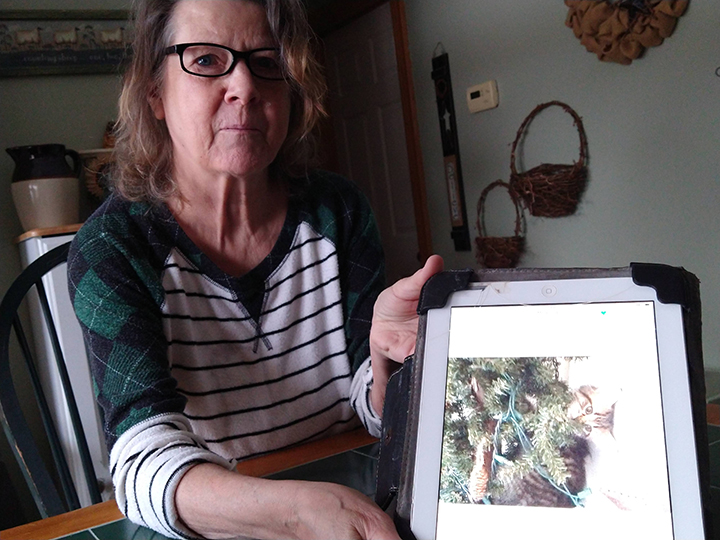
News Photo by Julie Riddle Bev Smith on Thursday holds a photo of one of 42 cats removed from her Alpena County home last year.
News Photo by Julie Riddle Alpena County Animal Control Officer Michelle Reid consults with Michigan Department of Agriculture and Rural Development veterinarian Dan Robb before visiting a cattle farm in Green Township on Thursday.

News Photo by Julie Riddle Michelle Reid, Alpena County animal control officer, plays with dogs during a kennel inspection at the home of Terri Haken, left, on Thursday.

News Photo by Julie Riddle Bev Smith, left, thanks Alpena County Animal Control Officer Michelle Reid in Smith’s Alpena County home on Thursday. Smith removed 42 cats from Smith’s house last year.
News Photo by Julie Riddle Bev Smith on Thursday holds a photo of one of 42 cats removed from her Alpena County home last year.
News Photo by Julie Riddle Alpena County Animal Control Officer Michelle Reid consults with Michigan Department of Agriculture and Rural Development veterinarian Dan Robb before visiting a cattle farm in Green Township on Thursday.
News Photo by Julie Riddle Michelle Reid, Alpena County animal control officer, plays with dogs during a kennel inspection at the home of Terri Haken, left, on Thursday.
News Photo by Julie Riddle Bev Smith, left, thanks Alpena County Animal Control Officer Michelle Reid in Smith’s Alpena County home on Thursday. Smith removed 42 cats from Smith’s house last year.
Trending
ALPENA -- Bev Smith wept the day animal control took her cats away.
"I fed them, loved them, and I thought that was enough," said the Maple Ridge Township woman on Thursday, in a house free of the unsanitary conditions in which she and her husband lived when workers removed 42 cats from her home last April.
An animal control officer's job sometimes means breaking humans' hearts for the good of the animals under their care - and for the good of their caretakers, said Michelle Reid, Alpena County animal control officer.
Fielding non-stop requests to look into animal welfare concerns as the county's only animal control officer, Reid can't return every call or check on every animal. Even suspected hoarding situations sometimes have to wait as Reid tackles even more urgent requests, she said.
Check out the video below. Viewing on mobile? Turn your device horizontally for the best viewing experience. Story continues below the video.
Many people distrust animal control officers, accusing them of either negligence toward their job or unfairly separating animals from their owners, Reid acknowledged.
But the job still needs to be done, she said.
"If I'm not out here protecting the animals," Reid said, "and I'm not out here protecting people from animals, who else is going to do it?"
'TOOK OVER MY LIFE'
Smith knew her cat hoarding was out of control as she spent hours a day cooking chicken and rice for her cats, bleaching cabinets where they had climbed, cleaning up after destroyed stores of food, and mopping a hallway strewn with cat feces.
"They took over my life," Smith said, recounting trying to care for the dozens of animals demanding food and attention and filling every space in her small house. "That's a lot of chicken and rice."
When health problems landed her in the hospital several times, the situation worsened, her husband unable to keep up with the cleaning and struggling to breathe in the unhealthy conditions.
Alerted to the cats' plight, Reid obtained a warrant and visited the home in April, removing the cats on the spot.
"It was the hardest thing I've ever been through," said Smith, eyes welling with tears as she sat at her kitchen table in a home now clean and calm.
Smith credits Reid for saving her from a situation from which she couldn't escape on her own.
"I knew I had too many," Smith said. "But, when you love something, how do you let them go?"
LOOKING FOR A FIX
Animal control officers aren't trying to be the bad guy, said Reid, as she drove to an inspection on Thursday.
A spiral notepad, tucked into her visor, held pages of notes listing locations where residents had reported suspected cases of animal neglect or cruelty.
With only one person on the job, some of those complaints might never receive a visit, Reid said.
Those visits she does make start with a conversation, not an attack, she said.
"I like to try to work with people," Reid said. "Can we fix it? Can this be an educational thing instead of being criminal?"
Animals will behave like animals, and it's up to the humans around them to find solutions to fix problems such as a dog that intimidates a mail carrier or escapes from its yard, Smith said.
If animal owners make changes to keep their animals and their neighbors safe, she doesn't have to take the animals away - and that's always her preference, said Reid, who sometimes leaves behind a bag of dog food or a load of hay for a kennel after her visits to help owners take the next right step.
Not everyone is willing to make such changes, though, she said - and that's when she has to remove animals from their homes.
A dairy farmer whose 40 cattle Reid recently found emaciated and without food except straw was ordered to sell his herd, some of which had died, their bodies left strewn on the ground.
The 10 holsteins still in the farmer's yard on Thursday were eating hay but had not gained weight, according to state veterinarian Dan Robb, whose help Reid requested in removing the cattle - a complicated procedure in a bovine tuberculosis-positive county.
Reid will request criminal animal neglect and cruelty charges against the farmer, she said.
The farmer didn't understand why Reid is harassing him, he told her.
BEING THEIR VOICE
"This is a lose-lose career choice," said Reid, who has been called "every name in the book" as she stands in people's doorways, asking about their animals.
Most people think an animal control officer either isn't doing enough or is only out to yank animals away from their rightful owners, Reid knows.
She does the work because animals need her to be their voice, Reid said, flipping through reports of dogs chained to trees in the cold, kittens left to die, pet rabbits without shelter, horses left to run loose.
Humans who care for animals need help, too, she said, sharing a photo she'd taken the day before of a woman bitten by her dog.
Flesh from the woman's cheek hung down, a deep laceration leaving her face numb.
Animals can hurt humans, and humans can hurt animals, and it's the job of an animal control officer to help them all, Reid said.
"We rescued them, and then they had to be rescued from us," said Smith on Thursday of her 42 cats, as Reid eyed a plate of food on Smith's kitchen floor.
Behind a closed door, Reid discovered two new cats.
"I'm not going to let you backslide," Reid told her, insisting the couple call a veterinarian on the spot to schedule a spaying and neutering.
Smith readily agreed. No more hoarding, she promised.
"You can still have animals in your life," Reid told Smith, giving her a hug. "We're just not going to let it turn bad again."
Julie Riddle can be reached at 989-358-5693 or jriddle@thealpenanews.com. Follow her on Twitter @jriddleX.