Crash reconstruction debated at Matthews’ preliminary exam
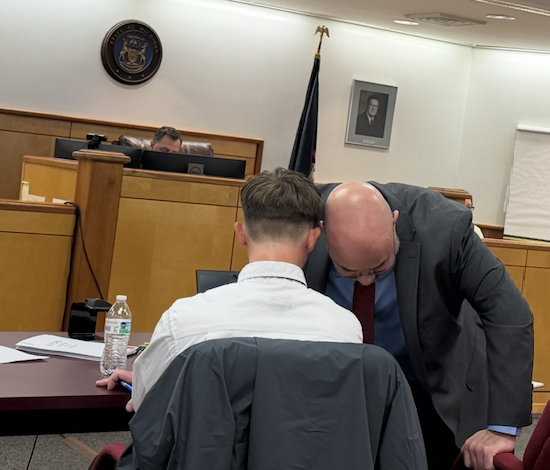
News photo by Kayla Wikaryasz Attorney John Freeman is seen speaking to his client, Devin Matthews, during the first part of Matthews’ preliminary examination in April.
ALPENA — Attorney John Freeman, representing defendant Devin Matthews, 23, of Harrisville, questioned the use of a fatal crash reconstruction in Matthews’ preliminary exam on June 24. This reconstruction was created nearly two years after the crash and data could only be pulled from one of the vehicles involved in the wreck.
Matthews is being charged for his alleged involvement in a fatal crash which occurred in Alpena in March 2024.
In total, Matthews is charged with two counts of second degree murder, two counts of involuntary manslaughter, two counts of Operating While Intoxicated (OWI) causing death, two counts of reckless driving causing death, one count OWI causing serious injury, and one count reckless driving causing serious impairment of a body function.
Judge Alan Curtis, 88th District Court, presided over the case and no decision was made whether or not to bind Matthews over to the 26th Circuit Court on June 24.
In April, during the first part of Matthews’ preliminary examination, Freeman questioned MSP Trooper Brett Immel regarding the crash and whether or not an official reconstruction report had been generated by Michigan State Police.
Immel said he did not know of any official report and Freeman claimed to have never received one from the prosecution at the time of the preliminary examination in April.
“Your Honor, I’ve asked the prosecutor for any accident reconstruction report in connection to this case and I’ve been told that one does not exist,” Freeman told Curtis.
According to Immel, another trooper was called to the scene of the crash and took measurements.
“Wat was done with those measurements?” Freeman asked Immel during his cross examination.
“As far as I know, I couldn’t tell you,” Immel said.
Alpena County Prosecutor Cynthia Muszynski told the court that an official crash reconstruction at that point had not been generated.
“At this point, a reconstruction report or analyzation has not been completed,” she said “I’m not saying that’s not going to happen.”
During her examination of Immel, Muszynski referred to a diagram that Immel created for his crash report for MSP. Immel said this was the first fatal crash he had responded to in his career.
“My diagram is just a photo, a still photo, essentially, of the location of the vehicles … where they were … when I came on scene,” Immel said.
In June, the prosecution presented an official reconstruction of the crash which was created by MSP SPL/TPR. Brady Ahola. Ahola said that he was brought on to create the reconstruction report within the “last two to three months.”
According to Ahola, MSP Detective Sergeant Cody Bellmer had requested Ahola to work on a reconstruction of the crash because “a reconstructionist was not assigned to” the case.
To reconstruct the crash, Ahola said that he gathered data from the Chevy Avalanche which could be located at a scrapyard. The Dodge Ram involved in the case could not be found.
Freeman asked Ahola if he had the opportunity to inspect the Dodge Ram at all, and Ahola said he hadn’t had that opportunity.
“So you never had the opportunity to physically examine the second vehicle involved in the crash?” Freeman asked.
“No, not at all,” Ahola answered.
Ahola stated that data retrieved from the Avalanche was recorded of up to five seconds of the crash, and that it was going a “consistent 60 miles an hour.”
He added that the Avalanche was equipped with wheels that were larger than what the vehicle was originally built for, therefore the actual speed was likely 3.5% faster than what was recorded. For context, Ahola said that the Chevy Avalanche was “probably” going about 62 miles per hour.
He explained that the Avalanche recorded a velocity change of 49 miles per hour, which would be consistent with the crash.
Ahola also stated that he had reviewed a Snapchat video which Cameron Bellanger, a passenger of the Dodge Ram, had recorded moments before the crash allegedly happened. In April, Bellanger had told the prosecution that the video depicted Matthews driving and holding a canister of nitrous oxide.
From the video, Ahola overlaid an image of a Dodge Ram speedometer, from the same make and model, on top of a still image of the video. This way, Ahola could determine where the needle on the speedometer was, which he said indicated the vehicle was going approximately 83 miles per hour.
He added that the recorded kilometers underneath the miles per hour on the speedometer also matched up with the approximated speed of the Dodge Ram.
Ahola also reviewed the media properties of the video which revealed that the video was taken at 7:46 p.m. on March 11, 2024. According to an MSP press release from January, at approximately 7:48 p.m. that evening, troopers responded to the two-vehicle crash.
Ahola created a diagram of the scene of the crash and stated that the Chevy Avalanche was facing northeast and the Dodge Ram was facing south.
The prosecution claims that the nitrous oxide allegedly consumed by Matthews at the time of the crash was a contributing factor. The defense has also claimed that the deceased driver of the northbound Chevy Avalanche was under the influence of 648 nanograms of methamphetamine at the time of the crash.
Kayla Wikaryasz can be reached at 989-358-5688 or kwikaryasz@TheAlpenaNews.com.
Local News

Community Foundation welcomes new trustees

A meaningful day of learning and connection
APS school board passes ‘tight’ budget for 2026-2027
Crash reconstruction debated at Matthews’ preliminary exam

Lifelong Learners continues Adventures in Music series