
Construction begins on education project at Alpena’s Duck Park
Trending
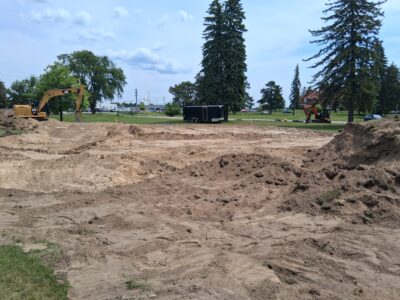
ALPENA – Site preparation is underway for a new educational pavilion and restrooms at Duck Park.
The groundbreaking marks a key step forward in a long-planned effort to expand outdoor environmental learning along the Thunder Bay River.
Crews have buried sewer lines and scraped the area where the facilities will stand, according to Judy Kalmanek, board chair of the Thunder Bay River Center. The 40-by-40-foot pavilion is designed specifically for educational use and will include benches and Americans with Disabilities Act-accessible entries on all four sides.
"The birth of the project was actually in the late 1980s and the members of the Alpena Wildlife Sanctuary board at that time came up with it and there are no members of that board remaining," Kalmanek said. "They wanted a place where they could do outdoor immersive environmental education. Primarily with students from pre-school age through college."
The idea has evolved substantially over nearly four decades. When Kalmanek joined the board in 2012, early plans called for a 15,000- to 20,000-square-foot building -- a scale she described as unrealistic. The city later made clear it could not take on maintenance costs for another structure.
"At one point when I became director of the board I met with the city, and they wisely stated they cannot afford to maintain another building. There simply were not enough funds in the budget," Kalmanek said. "We wrote a number of grants over the years, some of them successfully, and we are able to build phase one right now because of those grant funds."
Phase 1 consists of the pavilion, which will function as an outdoor classroom, and accompanying restrooms. The project is part of a broader shift away from a large indoor River Center toward a series of outdoor learning stations and interpretive exhibits spread across Duck Park and the adjoining Island Park. Some existing features at the site can be incorporated into the new exhibits, Kalmanek said.
"The goal is to help people become immersed in the environmental treasures that we have in our community, and we have a lot of them," she said.
Duck Park, a 2.5-acre city property at the corner of U.S. 23 and Long Rapids Road, offers direct access to the Thunder Bay River and serves as the gateway to Island Park via a handcrafted covered bridge. The park already provides picnic areas, parking, a kayak and canoe launch with rentals, fishing access and wildlife viewing within the Alpena Wildlife Sanctuary. The new facilities are expected to enhance visitor experience while supporting hands-on education about the river watershed.
City of Alpena Engineer Steve Shultz said work is moving forward with a local contractor.
"The contractor is getting started on it, the tentative timeline is mid-fall for completion," Shultz said. "The bathrooms are similar to the ones that went up at Culligan Plaza, and pole barn style pavilion."
The roughly $513,000 project is supported by a combination of grants, including a $150,000 award from the Michigan Department of Natural Resources, contributions from the Thunder Bay River Center, city funds and Alpena County Youth and Recreation millage dollars. Meridian Contracting of Alpena was awarded the construction contract late last year.
The pavilion and restrooms represent the most tangible progress on a vision that has spanned generations of local volunteers and adjusted to funding realities and municipal capacity. While a large indoor education center is no longer part of the plans, officials say the outdoor-focused approach will still deliver immersive learning opportunities for school groups and the public without creating ongoing operational burdens for the city.
Kalmanek emphasized that the project remains true to its original roots in environmental education while adapting to what is sustainable.
Construction is expected to continue through the summer and into the fall, with completion targeted for mid-fall 2026. Once finished, the pavilion will provide a covered space for programs focused on the river ecosystem, native species, water quality and other topics tied to Alpena's natural assets.
For more than 35 years, the concept has centered on connecting people, especially young students, directly with the environment rather than through traditional indoor exhibits alone. The current phase keeps that focus while delivering practical amenities that have been discussed and refined through multiple planning cycles.
As work progresses on the pavilion and restrooms, attention will turn to developing the outdoor learning stations and interpretive elements that will complete the updated vision for the riverfront site.