Microschools offer new alternatives to Michigan families
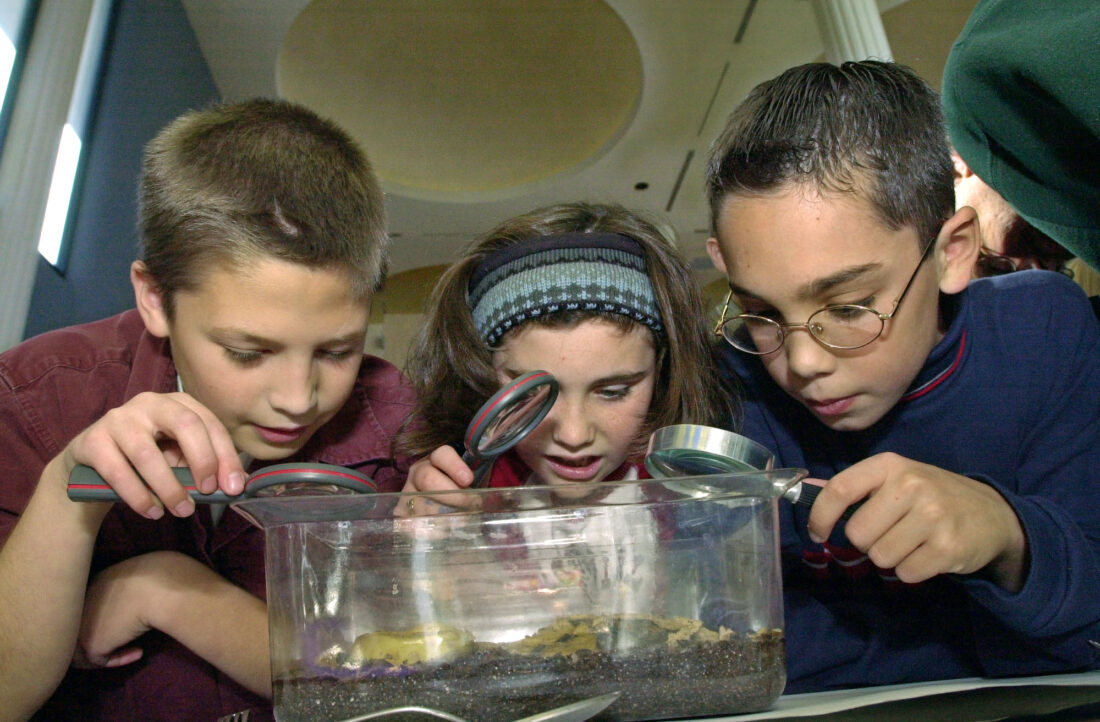
AP File photo of students working on a project while in class.
LANSING – Across the country, anything from a faith-based homeschooling group to a small private school to an extracurricular organization is calling itself a microschool.
The National Microschooling Center in Las Vegas estimates that there are around 95,000 of them in the United States.
The Feldman Law Group, a law firm in California, reported in 2024 that only 16% of microschools were accredited.
Carlos Esquivel is the director of strategic development at The Social Microschool in Zeeland. Esquivel and his wife started their microschool during the COVID-19 panic after both quit their jobs as public school teachers.
“Little by little we noticed there were some difficulties that we were encountering,” Esquivel said. “We began to think, ‘How can we build something better?'”
Since then, The Social has grown each year, attracting around 100 students.
The Social is considered non-academic and is not accredited but offers project-based courses related to art, nature and construction.
“Everything is vocation-focused,” Esquivel said. “We’re attempting to bring that to a much younger age.”
This focus is partially driven by artificial intelligence, Esquivel said.
“For the longest time, education has kind of kept that to itself where only those who could excel in academic areas are going to excel in careers,” Esquivel said.
Esquivel said he thinks that will change in the coming decades.
“As far as how students learn and how they’re prepared for a vocation, it’s absolutely going to change,” Esquivel said.
Esquivel said the school caters its courses to workforce demand, which the team is currently working on by developing courses in geography and drone operation.
Students at The Social get their academics from homeschooling, Esquivel said.
“We call them hybrid students or new schoolers where they’re doing some sort of extracurricular enrichment, which is what we’re considered,” Esquivel said.
He said many parents turn to alternative education models because of difficulties related to public school funding and values.
“Parents are looking for the freedom to choose what they want,” Esquivel said. “They’re more willing to make these changes in their household income to do something like our program.”
The Social offers programs ranging from $50 to $945 per year.
A different kind of microschooling is happening across the state in Farmington Hills, where Anne Marie Palazzolo founded AMPed Education.
Palazzolo also began her microschool around the time of the COVID-19 pandemic.
However, AMPed operates as a small private school, rather than as an extracurricular or homeschool group.
The Feldman Law Group reported that 37% of microschools operate that way, while 55% operate under their states’ homeschooling laws.
“We consider ourselves a microschool because we’re a tiny private school,” Palazzolo said. “Many other places with the word ‘hybrid’ in their name are actually like faith-based homeschool organizations.”
The school currently has 32 K-12 students, and Palazzolo said she has no desire to expand the school beyond its capacity of 72.
That allows for 12-student classes, led by both a teacher and a teacher’s aide. Palazzolo said that allows the school to customize each student’s education.
“Every kid at our school gets a personalized education plan,” Palazzolo said. “You can kind of compare it to an IEP.” IEPs, or individualized education programs, are developed for students with special needs.
AMPed also applied for accreditation through the Middle States Association, Palazzolo said. The association, based in Philadelphia, accredits “early-childhood through post-secondary, non-degree granting public, private, faith-based educational institutions, including special purpose schools and learning services providers,” according to its website.
AMPed Education follows a hybrid schedule, Palazzolo said, giving students time to understand how they function as learners.
“They are figuring out how much they need to study so they don’t end up a freshman in college who is failing math because they didn’t go to class and studied the night before the test,” Palazzolo said.
Palazzolo said she thinks there are a lot of reasons that families are moving toward alternative education models.
“There’s more of a focus on standardized testing, and teacher autonomy has kind of decreased,” Palazzolo said of public schools.
According to Palazzolo, the changes also have a lot to do with students’ needs.
“We’re learning more and more about the variety of brains that kids have and how diverse learners can be,” she said. “Families don’t go looking for a private school or any alternative schooling if the traditional model is working for them.”
Michigan News
Nessel wins ruling protecting critical federal funding for Michigan

Northern Strike returns to Michigan
Stephanie Chatfield sentenced for embezzling from peninsula fund
LANSING – On Tuesday, Stephanie Chatfield, 38, of Levering, was sentenced to 6 months’ probation, 25 hours of ...
Peters and Slotkin bipartisan bill to extend Great Lakes funding advances in the Senate
Unemployed Michigan workers must now complete three weekly work search activities to receive benefits
Michigan’s Unemployment Insurance Agency (UIA) is reminding workers that an increased work search requirement ...