
Trending
In 1955, the outlook was dire for Michigan's commercial fishery. Sea lampreys and overfishing had destroyed almost all the lake trout and severely damaged lake whitefish populations. These were the mainstays of the industry. The invasive alewife and rainbow smelt had helped to drive ciscoes (once called herring) and walleye to near extinction in lakes Huron and Michigan. So, what was left for commercial fishing families to harvest during the mid-20th Century? Could they make a living?
Let's think of lakes Huron and Michigan as a single lake for this discussion - they are, after all, joined by the Straits of Mackinaw. Fish readily swim between them. They share the same lake levels, and they responded similarly to invasive sea lampreys, rainbow smelt, alewives, and more recently, zebra and quagga mussels.
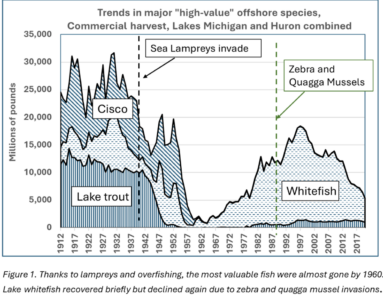
Prior to the 1940s, before sea lampreys had wrecked their havoc, Lake Huron/Michigan yielded over 25 million pounds of high-quality fish (by "high quality" I mean they commanded the best prices and were more profitable than other species). For the offshore fisheries, these were lake trout, whitefish, and cisco. The commercial fishery employed tens of thousands of people, and anyone could apply for and receive a license to commercially fish. Over a thousand Michigan commercial licenses were issued annually.
This much fishing proved excessive, driving lake trout to a tipping point; thus, they collapsed dramatically when sea lamprey arrived. Whitefish and cisco took a little longer to decline; here is how it worked with them: as lake trout numbers nose-dived, invasive alewives and rainbow smelt exploded in number. These are prey species, meaning they are supposed to be fed upon by larger fish, the predators. With no predators to control them, overabundant alewives and rainbow smelt ate almost everything available - particularly zooplankton and tiny fish, including most of the recently hatched whitefish and cisco. Consequently, whitefish and cisco eventually plunged. By 1960, commercial harvest of high-value species in Lakes Huron/Michigan had declined to two million pounds. In only 20 years, harvest had declined nearly 75%, see figure 1.
So how did commercial fishers stay in business? Many did not and dropped out; by the1960s there were only 300 to 400 licenses issued by Michigan. Those still fishing set evermore nets as harvest declined. They were also forced by these circumstances to switch to what we will call "low value" fish, species often sold for pet food or when sold for human consumption sold for much less.
That helps explain why commercial catches of such fish as alewives, rainbow smelt, suckers, and carp rose as high-value species declined. Alewives and rainbow smelt were super-abundant and even though they sold for little, their numbers made it possible for some commercial fishers to make a meager living. Some species, particularly the deep-water chub or "bloater", grew faster than normal after cisco disappeared. And there were more of them because their main predator, lake trout, was no longer eating them. Normally, most chubs never reach marketable size, remaining below 8 inches in length, but in the 1950s and '60s, with less competition from the declining ciscoes and whitefish, and minimal predation, chubs started reaching 10 and even 12 inches. Rainbow smelt similarly responded to these same changes - remember the runs of smelt in our local steams, some fish running up to10 inches long? Larger chubs are a very popular product when smoked and for many years tourists sought smoked chubs almost as much as they did fudge at northern Great Lakes ports. But chubs sold for low prices compared with lake trout and whitefish; to catch enough fish to make a living, fishers set more and more nets. By the late 1960s Michigan-licensed commercial fisheries were setting over 70,000 miles of gill nets per year! Even with the increase in nets, the harvest of these low-value species simply could not pay the bills for most fishing families. Many took second jobs to supplement their incomes. Sea-lamprey control laid the foundation for restocking the Great Lakes with predator fish and thereby restoring the lost balance between predator fish and their prey, which would in time bring back high-value fisheries. The DNR realized, however, that most of the stocked fish would be caught in gillnets. This meant that, first, something had to be done about gillnets, which kill most of their catches. To this end, during the late 1960s and early 1970s the DNR made two changes that reshaped the commercial fishery: 1) it limited commercial licenses to operations that were already fishing full time and almost no new licenses were issued, and 2) it banned the use of gillnets by most commercial fisheries (tribal fisheries were managed differently), subsidizing those who wished to remain active in the fishery in their conversion to less lethal trap nets. Stocked, protected predator fish such as trout and salmon could now be released from commercial nets alive. Some Michigan-licensed fishers dropped out, while some converted to trap nets. The number of commercial licenses in Michigan slipped again; now there were only 176, and licenses continued to decline as the gill-net ban was enforced. Those remaining in the fishery struggled because of the scarcity of high-value species. During the early 1970s, the fishery was still in trouble. Relief was coming, though it proved short lived.
As predators rebounded, Great Lakes ecosystems came into a sort of balance. With fewer alewives and rainbow smelt, lake whitefish reproduction soared. Whether this relationship was cause-effect or serendipitous is unclear (Google: "Management of whitefish commercial fisheries, Mark Ebener". See page 108). Commercial harvest of whitefish in lakes Michigan and Huron reached record levels during the 1990s. It seemed, at the time, the future of the commercial fishery had been secured.
Then came more catastrophe: first, zebra and then quagga mussels arrived aboard sea-going vessels during the 1990s and robbed juvenile whitefish of the small plankton they need for food. Bloater chubs were also starved and no longer reached marketable size. Alewife numbers crashed, meaning predators such as lake trout and walleye foraged more on baby whitefish and chubs than they had previously. This second crash in whitefish is continuing today, and the prognosis is bleak - to date, research has not revealed solutions. Harvest from Lakes Huron/Michigan is now below five million pounds with no indication of it stabilizing. In 2024, only 18 of Michigan's remaining 45 commercial licenses reported harvesting any fish. Our commercial fisheries are again in peril.
Whitefish desperately need help. But exactly what to do remains unclear. If funding was made available to study and determine the exact mechanisms of whitefish decline and potential methods for controlling the invasive mussels, perhaps recovery will prove possible. Michigan DNR and its partner agencies and universities are working together to garner funding that could lay the groundwork for solutions. Let's hope they are successful!
Be sure to visit the new Besser Museum Fishery Heritage Exhibit this June, where you can learn more about our shared Great Lakes fishery heritage.
For more information: Google Michigan DNR History Commercial Fishery.
Jim Johnson worked as a research biologist at the DNR's Alpena Fishery Station. He and the DNR's research vessel, the RV Chinook, as well as Boat Captain Clarence "Tuffy" Cross retired to the Besser Museum