Study: mulch, shade most effective methods of supporting Christmas tree survival
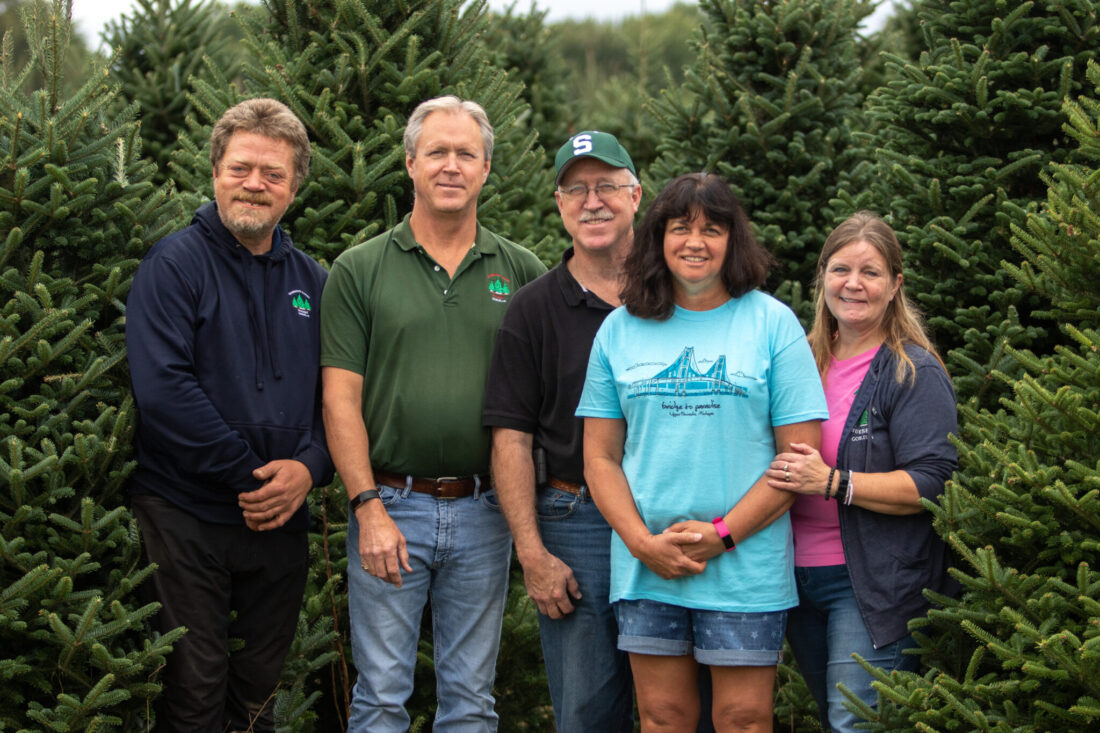
Business Feature: Portrait of the family- (left to right) Tom Wahmhoff, Ken Wahmhoff, Dan and wife Lorie Wahmhoff, and Betsy Perales at Wahmhoff Farms in Gobles, MI 10/02/2018. Photos by Steve Jessmore/Steve Jessmore Photography
LANSING — Dan Wahmhoff, like most of his colleagues in the Christmas tree industry, has received heavy-handed pitches from chemical companies.
They’ll claim that their new product, whether some sort of fertilizer, biochar (a form of charcoal) or otherwise, is a must-have for growers looking to maximize the survival of conifers on their farms, said Wahmhoff, who co-owns Wahmhoff Farms in Gobles in Van Buren County.
“A lot of times you try it, and hopefully you gain something,” Wahmhoff said. “But you do, or you don’t.”
A new study from researchers at Michigan State University and Oregon State University suggests that, more often than not, you don’t — or, at least, that more tried-and-true, natural methods of bolstering Christmas tree survival are more effective.
Between 2021 and 2023, researchers collaborated with conifer farms in the Pacific Northwest and the Great Lakes region — the two biggest areas in the country for the Christmas tree sector — to test the effectiveness of varying methods of supporting the vitality of the trees.
At each farm in the study, between 400-600 trees were used. At the Michigan farms, 20 combinations of treatments were tested.
The treatments included four sorts of root dips, where the roots of baby conifers are dipped into a chemical before going into the ground; and, five above-ground treatments, which included shade, mulch, a combination of both and anti-transpirant, a substance applied to plants to prevent them from losing moisture.
The study in the journal Horticulturae found that “mulch and, to a lesser extent, shade provided the most consistent benefit to tree survival,” while “root dips and anti-transpirant were ineffective.”
Figuring out how to maximize the growth of conifers is a pressing challenge for Christmas tree growers.
That’s because the input costs of planting a single tree — namely, the planting stock itself and the labor needed for planting — are “among the largest operational expenses associated with producing Christmas trees,” the study said. That, in turn, increases the “desire for growers to produce a salable tree from each transplant.”
However, water scarcity and lack of access to irrigation make that desire increasingly difficult to fulfill, said Bert Cregg, a professor in MSU’s Department of Horticulture and one of the lead researchers on the study.
That issue is most pronounced in the Pacific Northwest, he said, where climate change is driving extended droughts and where more stringent laws prevent irrigation.
But that’s not to say climate change doesn’t pose problems for growers in the Great Lakes region, too.
“For us, it’s more just increasingly erratic weather patterns,” Cregg said, pointing as an example to the weekslong drought in June and July of 2023, which fell inconveniently for Christmas tree farmers “when the trees had just been planted.”
He added, “I don’t want to get too political here, but one group of people that you don’t have to convince climate change is real is farmers, even if they might be pretty red.”
For now, the Christmas tree market remains open for growers in both the Great Lakes region and the Pacific Northwest where climate change presents challenges, Cregg said.
Cregg is also on the front lines of further research aimed at finding affordable solutions for growers as the climate crisis continues.
He noted that there’s currently a “big project” funded by the U.S. Department of Agriculture and headed by North Carolina State University that brings together “all the researchers in the country that are working on Christmas trees” to focus on their genetics.
Such examination is expected to reveal “mechanisms of drought tolerance and pest tolerance” and allow Christmas tree farmers to select “for trees that are going to be better able to be adapted to future climate scenarios,” he said.
He added, “That’s probably where the ultimate solution for a lot of these things lies, to come up with better genetics, trees that can survive these things.”
That effort and the new study that found mulching and shade blocks are the most effective ways to maximize Christmas tree survival come amid sweeping cuts to federal funding for scientific research.
Amid that changing financial landscape, Wahmhoff, the Christmas tree farmer, said he appreciates Cregg’s efforts.
“A lot of research is done for the sake of research, to be printed in a journal somewhere” he said. “I’m sure there’s value in that.”
“The research Cregg and other MSU researchers do for our industry are specifically application-oriented research. It is intended to be applied and used by growers to aid in our production. To me, that’s an important distinction,” he said.
Cregg shares that belief in his research’s importance: while it’s often “more of an incremental thing,” it’s undoubtable that it has an impact.
Look no further than Wahmhoff.
About a year into his farm’s cooperation with the study, amid an unusually dry spell in late May, Cregg gave him a sneak preview of his data.
While lack of rain meant a lack of moisture across the farm, Cregg’s numbers showed that the mulched tree plots were able to preserve a significantly higher amount of moisture — which is key for conifers’ vitality.
So, on Memorial Day weekend, Wahmhoff went out as quickly as possible to purchase mulch to use on the rest of the trees on his sprawling farm.
Ultimately, “I lost very few trees whereas other guys lost 25% of their plants or something like that,” Wahmhoff said.
Michigan News

AAA: Michigan gas prices drop to lowest point since April
DNR checks in on inland fisheries with lake and stream surveys

Whitmer signs bipartisan bills to ensure all votes are counted, strengthening and securing Michigan’s elections
Meteor lights up Northeast Michigan skies

Agencies warn residents of invasive pests and disease risk in firewood