
Taking a stand against sexual assault
Help and compassion available to victims in Alpena area
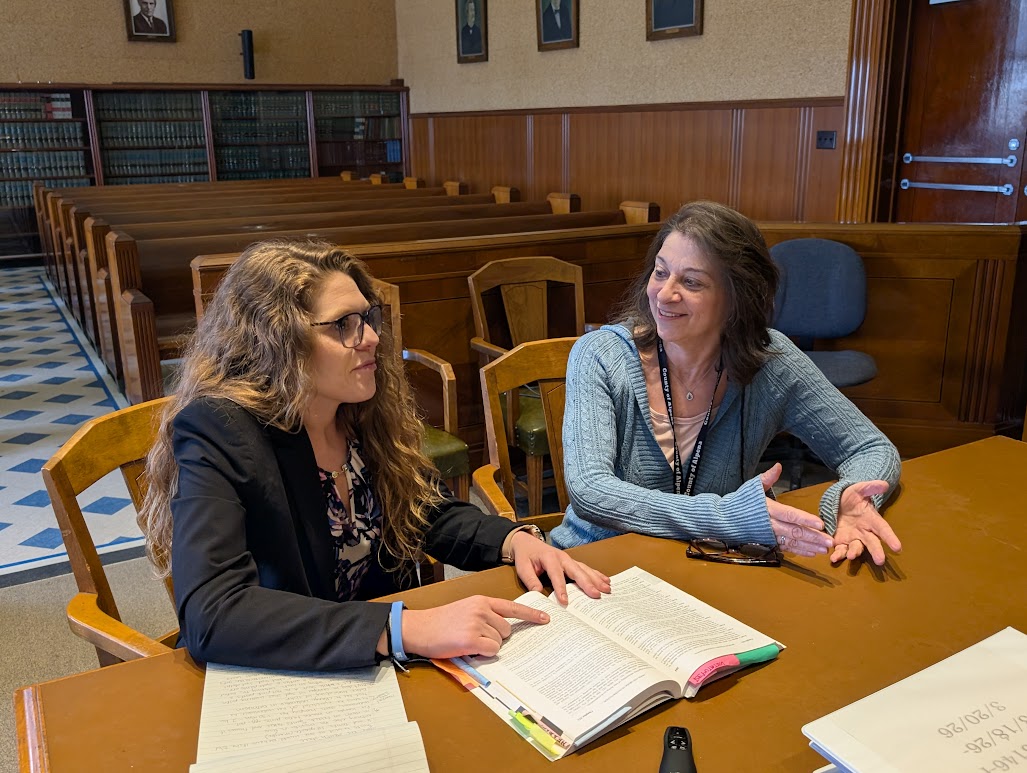
News Photo by Reagan Voetberg Alpena County Assistant Prosecuting Attorney Alyssa Miller and Crime Victim’s Rights Coordinator Julie Jackson talk in the 26th Circuit Court room on Friday.
ALPENA — Speaking up after surviving sexual assault can be one of the most difficult decisions in a person’s life. Sexual assault awareness month this April draws attention to survivors and the advocates working to help them speak up and get justice if they choose to.
One local resource in Northeast Michigan helping survivors is Hope Shores Alliance.
Hope Shores provides 24/7 services for people that are experiencing sexual assault or domestic violence, Adrianna Gumtow, emergency services coordinator at Hope Shores, said.
“We do have a team of advocates that can dispatch if there were to be like a sexual assault exam at the hospital or something like that our advocates will…provide supports to them,” she said.
Hope Shores also provides advocates for people that want to press charges and go through the legal process.
“All of our services are 100% free and confidential to folks,” Tressa Snider, advocacy services coordinator said. “We’re able to meet folks where they’re at in their healing journey.”
To make it easier for survivors to speak up about what happened to them, Gumtow said that contacting Hope Shores is a good place to start. Survivors can call the 24/7 help line anonymously to talk about options or talk about what happened if they choose to.
“Just letting folks know what you’re there for them, holding that space for folks,” Snider said.
Gumtow answered whether sexual assault is something that can be prevented.
“I don’t think there’s anything that a person can do to prevent themselves from being sexually assaulted,” Gumtow said. “It really is up to the perpetrator that is making that decision to do those things. It’s not about what you wore or if you went out and drank alone, or if you are walking home alone at night. That’s something that people like to portray in the media and in life, and just say well ‘if you didn’t do this, this wouldn’t have happened to you’ I wish we had a good answer on how to prevent it.”
Snider said there is a prevention department working on initiatives like boys to men to try and prevent violence in the community. Boys to men focuses on teaching about safe relationships and consent.
“One of them is just by creating safer spaces and communities for folks,” Snider said.
The prevention department is also looking at child interventions and recognizing the earlier they can get into those spaces the more likely they are to prevent violence.
“It can’t necessarily be prevented because it’s an unfortunate reality in our society, both for children and for adults,” Alpena Assistant Prosecuting Attorney Alyssa Miller said. “But I think there are ways to protect people against it.”
She said that looking out for grooming techniques and educating the public on what those can be, especially in child cases, can be helpful. Grooming is a process where a perpetrator builds a trusted relationship with someone to eventually abuse them.
“And I think talking to kids and talking to people both children and adult family members you have if you think there’s some sort of abuse going on in their relationship, just to ask them, because so many people just don’t ask,” Alyssa Miller said. “‘If they wanted to tell, if something was going on they would tell me.’ And it’s like not really. Most of these cases, both kids and adults, are all delayed disclosures.”
Gage Piper, an Alpena resident and a survivor of sexual assault, said his perpetrator started abusing him when he was 6 years old. Alpena resident Ashley Miller (Prano), his mother and a survivor of sexual assault herself, was abused at 3 years old. Both took around a decade to speak out about what happened to them.
“Especially in my case at three years old, how am I to know that that’s wrong or not supposed to happen when you’re groomed to think that’s normal?” Ashley Miller said. “Why would you think to prevent it?”
“I don’t feel as though it could be prevented either because like she said when you’re that young, you could easily be manipulated into not saying anything,” Piper said.
Talking about prevention can also lead to victim blaming, Julie Jackson, Alpena County crime victims’ rights coordinator, said. Jackson has been working with victims of crimes and helping them through the legal process for nine years.
Victim blaming entails making a crime perpetrated against a victim their own fault. Instances could include blaming victims for the kind of clothes they wore or that they drank too much at the bar.
Jackson said that many of the victims she works with already deal with self-blame.
“They’re like ‘oh I should have done this and I should have done that’ and that’s so frustrating for me as a person, and it breaks my heart because you can’t go back,” Jackson said. “In hindsight, the warning signs are hindsight. You can’t do anything about those warning signs because they’re behind you.”
Alyssa Miller said as of April 7 there are 21 active sexual assault cases in Alpena County, and three more are under investigation.
She gets referrals from law enforcement or Child Protection Services (CPS) and in many cases does not end up authorizing charges, whether it’s from a lack of evidence or the possibility of another explanation. Alyssa Miller looks at the evidence from all angles to determine whether charges should be filed.
There is a series of steps before a case makes it to trial. The first step is the investigation, where police gather evidence and reports that are then brought to Alyssa Miller.
“I want to be sure that I can win if you know we do this, or at least that I know it happened. Ethically, I would never want to bring charges on somebody I didn’t think did it,” Alyssa Miller said. “I find there’s probable cause is the standard but personally I think the standard should be higher so I think, in my own view, beyond a reasonable doubt, did this happen, and then I sign off that there’s been probable cause.”
She sends it back to the police and they check it to find probable cause. Then it goes to the magistrates who review the affidavit and the charges, and they have to agree that there’s probable cause.
Then there’s a preliminary examination, where the victim actually has to be put on the stand, Alyssa Miller said, whether they’re four years old or an adult. The defense has a chance to bring their own witnesses and evidence, and then the judge determines if there was probable cause.
From there, the case moves to Circuit Court. The defense and prosecution both have the chance to file motions, which could include suppressing evidence.
Many cases end in plea deals, where the prosecution and defense negotiate and a defendant pleads guilty or no contest to some or all of the charges.
If there is no plea deal, the case goes to jury trial. Victims, witnesses, and experts testify and the jury determines whether the defendant is guilty of the charges or not.
What’s difficult with sexual assault cases is that typically there is no video footage of the crime happening, Alyssa Miller said. Abusers usually perpetrate their abuse in private. Witnesses may be able to testify to behavioral differences or have alibis that align with the crime occurring, but that may be the best available evidence. That paired with the fact that first degree criminal sexual conduct has no statute of limitations–meaning there is no limit of the time allowed between the crime’s occurrence and initiating legal proceedings–can also limit the available evidence.
For survivors, the legal process can cause a range of emotions. They have to tell their stories over and over again in detail through the investigation, examination, and trial, reliving an unwanted sexual encounter to strangers.
“(you’re) coming in to talk to complete strangers about such intimate details that nobody would want to talk about anyway but especially if it’s something you didn’t want to do,” Alyssa Miller said.
Piper recently saw his perpetrator sentenced after over two years of the case going through the justice system.
“When I first came out I was scared,” Piper said. “I was nervous. When we started going through the court process I was still nervous. And then when I was in the courtroom I was angry and once it was all over I felt relief.”
His mom Ashley Miller said Piper has been on a sleep medication for a long time. Since his perpetrator was sentenced, Piper has not needed to take one ounce of sleep medication.
“I do feel like it gave him a lot of relief and comfort to have received justice,” Ashley Miller said.
Ashley Miller never went through with legal proceedings for her own sexual assault case. She was put into foster care after speaking out at 12 years old about the abuse by her father. Her experience of feeling isolated and alone after speaking out has helped her be there for Piper in the ways that he needed a parent to be there.
Like Ashley Miller, not all survivors end up receiving justice. For cases that go to trial, Jackson tries to prepare victims for both outcomes, whether the defendant is found guilty or not guilty.
“That’s probably the hardest part of my job is a non-guilty verdict,” Jackson said. “When you know something happened, you believe them, you know that it happened, right? And then a jury comes back for whatever reason and says not guilty. That’s awful…that person doesn’t feel validated. They don’t feel believed. What I try to do is make sure that they know they are believed… We wouldn’t have pressed charges if we didn’t believe them.”
Before sentencing, whether a defendant was found guilty through trial or entered a plea deal, victims can give a victim impact statement before the judge. Jackson said she has never seen anyone regret writing their impact statement.
Hope Shores has been hosting a series of events in April to help survivors and their loved ones show up and speak out. Hope Shores started a ‘start by believing’ campaign.
“That was brought about from EVAWI which is the end violence against women international,” Gumtow said. “They started this campaign and it really has gone global where we are going to pledge to start by believing survivors.”
“First and foremost, most important thing that somebody can do when they have like someone in their life disclosing a sexual assault to them is believe them and support them and validate them in their experience,” Gumtow said.
There is also a creative writing workshop to teach survivors how to use writing as a tool for healing at 4:30 p.m. Wednesday at Hope Shores Alliance on 3022 U.S.-23 South.
Local businesses participated in paint the town teal to spread awareness about sexual violence. The teal ribbon represents survivors of sexual assault.
“I can absolutely say I will sit and talk or whatever with anybody if they ever need somebody to talk to,” Ashley Miller said. “Because the feeling of being alone is horrible.”
“It doesn’t matter how little or how much, just show them you care,” Piper said. “And show them that you’re there for them no matter what.”
Local News

Chillin’ chipmunk
The Katherine V: A bygone era of gill net fishing
Sandcastle building contest ready to roll
DNR reopens the Cheboygan lock

Lots to do on Fourth of July Weekend
Starlite Beach splash park hours extended
ALPENA - The City of Alpena will be extending the hours of operation of the Starlite Beach splash bark beginning ...