More Michigan schools move toward EV buses
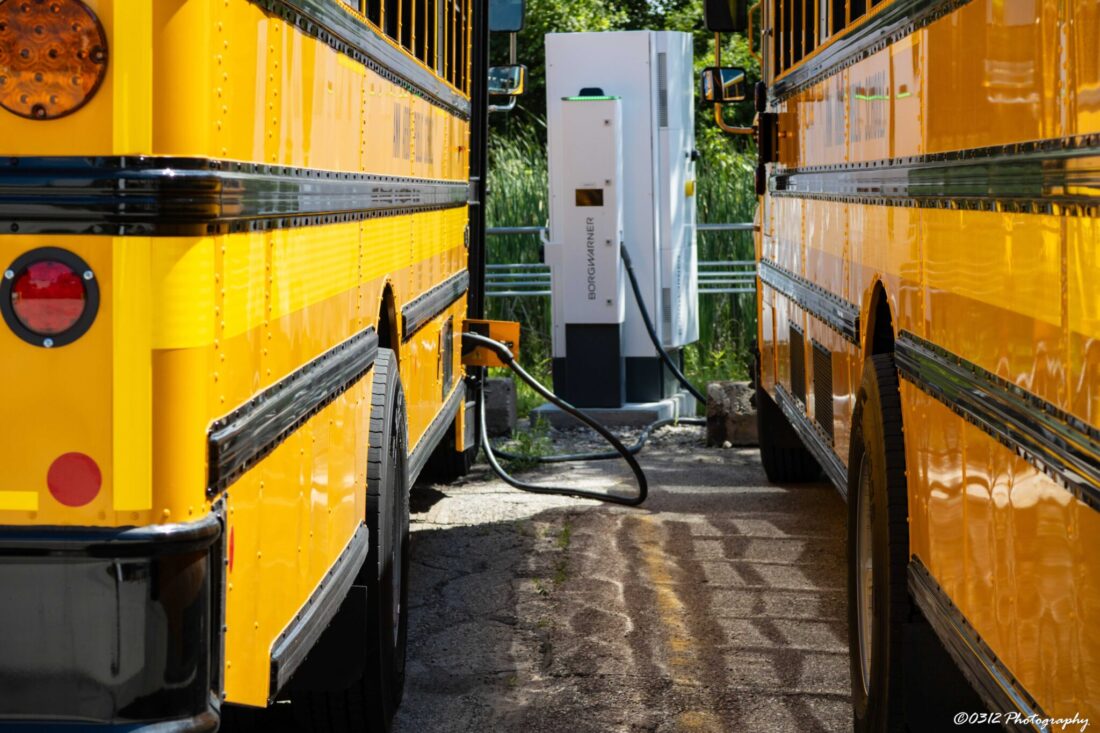
Courtesy photo by Moe Nagpal, manager of capital programs and construction projects for Ann Arbor Public Schools Electric school buses plug into a charging station in Ann Arbor. Credit: Moe Nagpal, manager of capital programs and construction projects for Ann Arbor Public Schools.
LANSING – Michigan is accelerating its transition to electric school buses, with dozens of districts adding new vehicles through a state-funded program aimed at replacing older diesel fleets.
As the transition expands, districts are adopting electric buses at different stages, but all face the same question: Are the benefits worth the costs and challenges?
Holt Public Schools is among those starting the process. It has no electric buses currently in its fleet but received about $4.4 million through the state’s Clean Bus Energy Grant program to add 10 electric buses, along with charging infrastructure. Officials expect them to be in operation within a year.
“We had to determine whether electric buses would work for us, including how far they could go between charges and whether that would fit our half-day and full-day schedules,” said Michael Dunckel, the assistant superintendent of business services at Holt Public Schools.
“We found that we could replace 10 of our routes with electric buses,” he said.
The move builds on the district’s earlier clean energy efforts, including LED lighting upgrades and water efficiency improvements.
“We went through an energy bond prior to this and put in energy-efficient lighting and low-flow water valves, so this seemed like a good next step,” Dunckel said. “We can’t replace all of our diesel buses because of the length of time, but this is what we could do right now,” he added.
As some districts begin transitioning, others have already moved much further.
The Pontiac School District, for example, has already switched its entire daily bus fleet to electric, becoming one of the first in Michigan to fully replace diesel buses.
“We already have 40 electric buses,” said Bill Holcomb, the energy and technology innovation specialist for the Pontiac district. “All of our daily routes are covered by electric buses.”
The district built its fleet using nearly $16 million in federal funding and is now using about $3.6 million in state grants to expand charging infrastructure. Holcomb said the transition has required extensive planning, including training drivers, mechanics and first responders to safely handle high-voltage vehicles.
“First responders need special training to handle electric buses because of the high-voltage systems, including how to avoid cutting into electrical wiring during emergencies,” Holcomb said.
State officials say the transition already has a broad impact.
The Clean Bus Energy Grant program has funded about 376 clean school buses statewide, including roughly 276 electric and 100 propane, with about 100 districts receiving support for buses and charging infrastructure, said Ken Coleman, a press officer for the Department of Education’s Office of Public and Governmental Affairs.
The most recent grant recipients include the Britton Deerfield, Chippewa Valley, Howell, Hudsonville, Manchester, Pentwater, Riverview, Sand Creek and Zeeland school districts, according to the Education Department.
However, districts have also reported challenges.
In some rural areas, longer routes require additional charging to complete daily pickups, Coleman said.
Pontiac officials say they have adapted to such challenges by rethinking how charging works.
Instead of assigning a charger to each bus, the district uses fewer charging ports and rotates buses as they finish charging.
“We have 25 charging ports for our 40 buses,” said Holcomb.
“Once one bus is charged, another is moved into place, which we see as a more efficient use of our resources.”
Ann Arbor Public Schools also faced challenges with charging and battery capacity.
Those problems created “range anxiety” for first-time drivers, said Moe Nagpal, the manager of capital programs and construction projects for the district.
“Those challenges have been addressed through technological improvements and operating procedures,” Nagpal said.
“For example, buses are heated or cooled while plugged in to preserve battery capacity for routes,” he added.
The district also received about $5 million through the state program to move toward its goal of a fully electric bus fleet by 2035.
Ann Arbor currently operates eight electric buses and is adding 16 more over the next year.
“The Clean Bus Grant is a catalyst for helping Ann Arbor Public Schools move toward our long-term sustainability goals,” Nagpal said.
Another major challenge is the upfront expense of electric buses, which can cost up to three times more than diesel models, said Katrina Morris, the executive director of the Michigan Association for Pupil Transportation based in Okemos.
“On average, an electric school bus can cost between $350,000 and $425,000, while a diesel bus typically costs between $110,000 and $150,000,” Morris said. “There are also additional costs for charging stations and necessary electrical upgrades.”
However, Morris said electric buses can lead to long-term savings.
“With fewer moving parts, there are fewer parts to break down, which can reduce maintenance and repair costs over time,” Morris said.
Electric buses may also serve purposes beyond transportation.
In Pontiac, district officials say the buses could be used during emergencies to support the community.
“We can use our buses if there’s a catastrophic event,” said Holcomb.
“They’re basically generators on wheels.”
Holcomb said the buses can provide power for phones and small medical devices during outages and are equipped with Wi-Fi, allowing them to serve as temporary community hubs.
However, officials across districts agreed that the most important benefit is cleaner air for students.
Electric buses produce no tailpipe emissions, allowing students to breathe cleaner air during their daily rides.
Michigan News

Bald eagle success story faces new threats

Nessel blocks administration from exerting federal control over elections

Peters, Bergman lead Michigan delegation in calling on Small Business Administration to approve disaster declaration

Brush up on Great Lakes beach safety

Enjoy the outdoors but keep tabs on tenacious ticks