
Faith in foundations
Celebrating the 50th anniversary of the Alpena Bi-Path
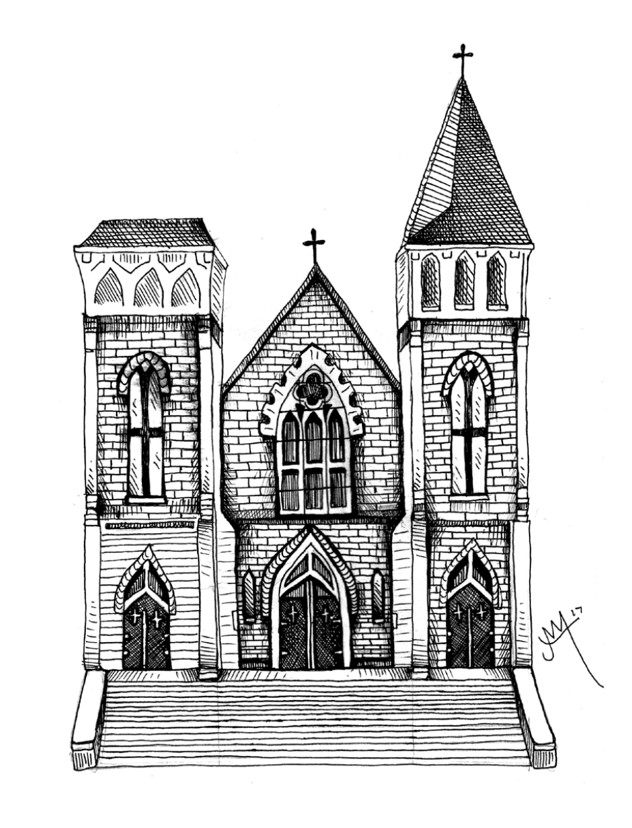
Courtesy art This is a drawing of St. Bernard Catholic Church by Anneliese Mathia for the Alpena Bi-Path Scrabble Booklet, which can be found at www.thunderbayarts.org.
Following the most recent installment of this series on architecture and historical markers along The Alpena Bi-Path, this installment connects to the architectural foundations of faith within our community. Among the most enduring architectural and cultural landmarks along the pathway are Alpena’s historic houses of worship.
These churches stand as expressions of craftsmanship and cultural identity. Their sanctuaries and steeples have witnessed Alpena’s growth from a frontier lumber settlement to the vibrant community it is today. Along the Bi-Path, historical markers preserve the stories behind several of these congregations, reminding travelers that faith communities were among the earliest institutions established by Alpena’s settlers.
St. Bernard Catholic Church – Historical Marker (1983)
One of the earliest religious communities in Alpena traces its roots to the missionary journeys of Bishop Frederic Baraga, often known as the “Snowshoe Priest.” In 1861, Baraga traveled from Sault Ste. Marie, through harsh winter conditions–crossing snow-covered forests and icy waters–reached the growing settlement of Alpena, where he established a Catholic presence in the community.
While the parish began in 1861, it was not until 1888 that Father Patrick Murray became the first resident pastor of the church dedicated to St. Bernard. Father Murray played an instrumental role in the construction of the parish’s first permanent church building.
The foundation for the original stone structure was laid in 1880, and the church was completed in 1884. Over time, the growing Catholic community divided into three separate parishes reflecting the ethnic composition of the congregation. The French-speaking parish retained the original structure and became St. Anne Parish, the Polish congregation established St. Mary Parish, and the Irish congregation continued under the name St. Bernard.
Today, the St. Bernard parish represents the oldest Catholic parish between Bay City and Cheboygan, a testament to the perseverance and faith of Alpena’s early settlers.
Located along Chisholm Street, the historic marker commemorates this remarkable story of missionary work, immigration, and community formation.
First Congregational Church – Historical Marker (1999)
Another significant religious landmark along the Bi-Path is the First Congregational Church, whose origins date to the earliest years of Alpena’s settlement.
Shortly after the arrival of white settlers in 1856, J. K. Miller began holding religious gatherings in the home of Daniel and Sarah Carter. These informal meetings gradually evolved into a formal congregation, and on March 2, 1862, the First Congregational Church was officially organized with Reverend Charles G. Brisbee serving as its first pastor.
Among the church’s founding members was Deacon Samuel Hitchcock, an Alpena developer who advocated openness within the congregation. Hitchcock encouraged acceptance and fellowship among people of all faiths–an outlook that reflected the cooperative spirit needed in a growing frontier community.
The congregation constructed its first church building on the Washington Avenue site in 1868. Nearly a century later, local philanthropists Jesse and Anna Besser contributed funds to build the present church structure, a concrete masonry building completed in 1955.
In 1961, the congregation joined the United Church of Christ, continuing its long tradition of service and community involvement.
Today, the historical marker along Washington Avenue commemorates the congregation’s early gatherings and the individuals whose vision helped shape Alpena’s religious and civic life.
Architecture, Faith, and Community
Like the civic buildings and historic commercial structures found along the Alpena Bi-Path and adjacent to it, houses of worship represent another expression of architecture as art, including the historic Jewish Temple Beth-El. Their design reflects the architectural styles and building techniques of their time, but their deeper significance lies in the communities that built them.
Houses of worship were often among the first permanent structures erected in nineteenth-century settlements. They served not only as places of worship but also as centers of education, social gatherings, and mutual support – threads that tie us together and help establish the community’s moral and civic foundations.
The presence of these historic congregations along the Bi-Path and adjacent to it reminds us that Alpena’s development was shaped not only by industry and commerce but also by shared beliefs, traditions, and a commitment to community and spiritual life with firm foundations.
A Binding Path
As travelers move along the Alpena Bi-Path today, they encounter sculptures, memorials, natural landscapes, and historic architecture. The churches and religious landmarks along
the route add another dimension to this experience, linking spiritual heritage with Alpena’s broader story of growth and development.
Together, these sites form a living historical corridor–one where architecture, faith, and community intersect along a shared path. They remind us that the story of Alpena is not only written in brick and stone but also in the lives of the people who gathered within these walls with purpose for more than a century.
As the community celebrates the 50th Anniversary of the Alpena Bi-Path, these historic houses of worship stand as quiet yet powerful reminders of the traditions and values that helped shape the city–and continue to guide it into the future.
Local News

Chillin’ chipmunk
The Katherine V: A bygone era of gill net fishing
Sandcastle building contest ready to roll

DNR reopens the Cheboygan lock

Lots to do on Fourth of July Weekend
Starlite Beach splash park hours extended
ALPENA - The City of Alpena will be extending the hours of operation of the Starlite Beach splash bark beginning ...