
Diversifying the agriculture industry in Northeast Michigan
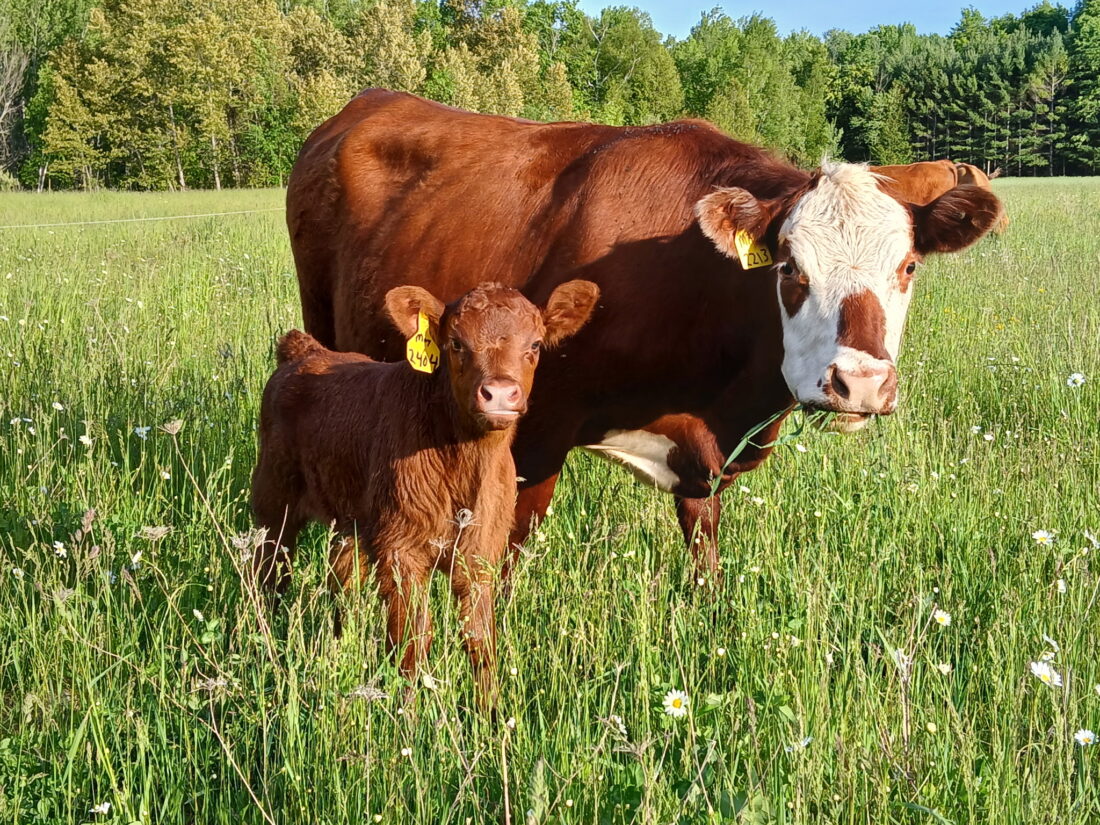
Courtesy Photo Cattle are seen grazing on Ben Nowakowski’s farm, B&B Farms, in Alpena. Nowakowski said the price of beef has increased steadily over the last five years.
ALPENA – Agritourism is just one form of farming that leverages the land and natural resources to support a local economy.
In October, Governor Gretchen Whitmer proclaimed the month as Agritourism Month to recognize farms and orchards across the state, which provide economic and social benefits to local economies, according to an October Michigan Department of Agriculture and Rural Development (MDARD) press release.
“Agritourism connects Michigan families to locally grown food and beverages while enabling farmers to diversify and build resiliency into their businesses,” MDARD Director Tim Boring said in the release. “MDARD is proud to support Michigan agritourism operators that strengthen our food and agriculture industry, boost agricultural education and improve quality of life for Michiganders.”
According to the release, agritourism supports Michigan’s food and agriculture industry, worth nearly $126 billion, and tourism industry, worth nearly $54.8 billion. Agritourism offers farmers the opportunity to diversify their businesses, which can help them stay viable during adverse weather conditions and market fluctuations.
Scott Kromer owns Knaebe’s Apple Farm and Ciderworks, located near Rogers City, which is an apple orchard that features a petting zoo, bakery, microbrewery, and pizza restaurant. Kromer said that in 2025 his business saw growth, particularly in September and October.
“Business was on par with what we saw in the previous season … a bit of an uptick in September and October,” Kromer said.
He explained that Knaebe’s is a destination for many people, as he sees generations of patrons return year after year. Due to this consistent flow of business, Kromer said that Knaebe’s attracts people to the Rogers City area, thus encouraging patronage to other Roger City businesses.
Kromer said that the agritourism industry, both nationally and locally, is “strong and healthy and growing.”
He added that a national push to “know where your food is coming from” is supporting the growth and viability of the agritourism industry.
“It has a strong future,” Kromer said. “Getting wholesome food from where you know it came from.”
Kromer explained that he has 100 to 200 apple trees planted every year to ensure a steady supply of apples for years to come. He added that his orchard is home to 52 varieties of apples and that he plans on expanding the selection in future.
He said that it takes two to three years for Knaebe’s dwarf and semi-drawf trees to produce. His trees’ lifespans range from 20 to 25 years, but as his trees are well cared for, he said they have continued to produce fruit.
“Our primary crop being apples … it lends itself very well to the area,” Kromer said. “The apples are our draw.”
Kromer explained that he sources saplings from nurseries around the country so he said his business has not been negatively impacted by President Donald Trump’s tariff policy.
“Nothing has really affected the trees, luckily,” Kromer said.
Another business that leverages Michigan natural resources to diversify the local economy is Cedarbrook Trout Farm in Harrisville.
In November, Cedarbrook Trout Farm received part of a $3.1 million grant package awarded to 34 Michigan entities through the U.S. Department of Agriculture’s (USDA) Resilient Food Systems Infrastructure Program (RFSI).
Cedarbrook Trout Farm is a trout farm that specializes in stocking fish and public fishing. Jerome Kahn, owner of Cedarbrook Trout Farm, told The News in November that the grant money will be used to add a communal kitchen and expand cold storage and distribution capacity to the operation.
Kahn explained that the money will allow the facility to harvest trout and freeze filets for purchase. The farm’s expansion will also add employment opportunities for the community.
“It’ll make the community more food secure and diverse,” Khan added. “It will definitely be a plus for the community.”
According to an MDARD press release in November, the RFSI program aims to support the food supply chains across the state. Cedarbrook Trout Farm is just one entity among a diverse set of farms and agriculture focused facilities.
“MDARD has been working hard to build more resilient food supply chains across Michigan through our innovative Farm to Family Program,” MDARD director Tim Boring said in the release. “The RFSI program builds on our success at the state level by making further targeted investments in local food processing, aggregation, and distribution, which means more avenues for farmers to sell in their communities and more opportunities for Michigan families to purchase nutritious, locally grown foods.”
The RFSI grants invested in Michigan food hubs, farm stops, fruit and vegetable farmers, regenerative agriculture practitioners, fish hatcheries, food processors and more, according to the release.
Boring told The News that MDARD was “really pleased to be able to put out these infrastructure-related portions of these RFSI grants to farms across Michigan.”
Boring said that agriculture partners and producers in Northeast Michigan often ask MDARD for help in supporting additional capacity for agriculture operations. Boring explained that the grant awarded to Cedarbrook Trout Farm directly addresses those concerns.
Boring explained that another common challenge that farmers and rural communities experience are barriers for community growth and economic opportunity. He said he believes Michigan residents can leverage agriculture to create a path to more financial stability.
“There’s concern about the health of people, the kids in schools, and agriculture is a path to addressing so many of these challenges that we have in rural areas,” Boring said. “Grants like these, and how indicative they are for our overall approach as a department, I do think provide some optimism that brighter days are ahead.”
Like the fickleness of Michigan weather, and the ebbs and flows of the Great Lakes, farming has its ups and downs. Michigan residents, particularly Northeast Michigan residents, have seen a steady increase in beef prices over the past few years.
Ben Nowakowski, owner of B&B Farms, explained that his prices for beef have steadily increased in the last five years. As of July, Nowakowski said that his farm was charging $3.83 per pound for cattle in the 500-pound range.
A year prior, Nowakowski said that he charged $3.18 per pound; five years ago, he charged $2.16 per pound.
Nowakowski explained that prices in the beef market are all dependent on cattle numbers.
“What drives that is availability,” Nowakowski said.
He explained that there is a shortage of cattle nationwide, the lowest it has been in 50 years.
A Farm Bureau economist, Bernt Nelson, reported in February 2024 of the cattle shortage, stating that the U.S. had its lowest cattle population since 1951. Nelson explained that this shortage is a result of drought conditions that began in 2020.
A February 2025 USDA Michigan Cattle Inventory press release reported that as of January 2025, the total number of cattle and calves totalled 86.7 million head in 2025, a 1% decrease from 2024. The press release reported that Michigan’s total number of cattle and calves totalled 1.11 million head in 2025, increasing 2% from 2024.
A USDA report released on Jan. 23 reported that cattle and calves on feed for the slaughter market in the United States totaled 11.5 million head on Jan. 1. This inventory was 3% percent below the totals from Jan. 1 2025.
In July, Tom Shooks, owner of Standard Provisions, told The News that he also has noticed beef prices increasing.
“It’s steady going up, that’s for sure,” Shooks said. “But there’s a shortage.”
Shooks noted a hay shortage as the culprit for the current cattle numbers. He said that hay shortage occurred a year to a year-and-a-half ago throughout the country, leading to a mass slaughter of cattle.
Shooks said that it will be a while before the market is relieved of the shortage due to the labor and time it takes to build herds back up.
“That’ll be another year-and-a-half before (calves) get bred to have calves … so this is going to be going on here for a while,” Shooks said.
Both Nowakowski and Shooks explained that this market spike in beef prices is part of a 10-year cattle cycle that ebbs and flows with the supply and demand of both herd numbers and beef sales.