
State test scores continue seven-year decline
Trending
ALPENA -- Standardized test scores among Northeast Michigan students improved marginally this year over last, but not enough to make up for a seven-year downward slide, according to recently released data.
Last year, the share of Alpena-area students who failed to meet grade level expectations jumped by 21% over the tests administered in spring 2019, the last test given before the COVID-19 pandemic struck Michigan classrooms.
That increase follows a roughly 30% decrease in the share of Northeast Michigan students who met or exceeded expectations on the Michigan Student Test of Educational Progress, or M-STEP, since 2015.
The local slide in test scores parallels a similar decrease statewide, although a smaller percentage of Northeast Michigan students reach testing expectations than kids statewide.
Educators pointed to the pandemic to explain a regional and statewide sag in 2021's test scores, but, though classrooms largely returned to normal during the most recent school year, test scores in many classrooms failed to return to pre-pandemic levels.
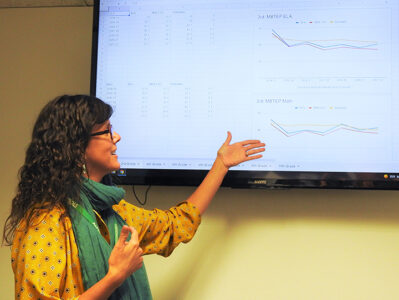
If such scores only reflected a blip in a normally strong testing trend, educators could feel confident that schools and students will rebound, but the pandemic only exacerbated an already negative trend, said Meaghan Gauthier, deputy superintendent for instruction at Alpena Public Schools.
School districts need to use declining scores as tools to help their students do better, she said.
"We're only as good as the data that we dig into," Gauthier said. "If we don't have the M-STEP data in our sight, if it's not something we're discussing and planning for, we're not setting ourselves up for success to see that kind of change."
Check out the interactive graphic below. Story continues below the graphic.
FALLING TEST SCORES
In the most recent school year, a third of Northeast Michigan students in grades three through seven met or exceeded state expectations on English tests, while two-thirds fell below that benchmark, according to a News analysis of M-STEP data provided by the Michigan Department of Education.
A quarter of students achieved advanced or proficient scores in math.
Even given an irregular testing year last year, in which test participation fell below normal levels, this year's scores fall in line with a long-term trend of declining test scores.
Since 2015, the share of Alpena-area students scoring not proficient on English M-STEP tests has increased by 14 percentage points, from 26% to 40%.
That parallels a 13-point, from 29% to 42% increase since the 2014-15 school year in students who did not even partially meet state expectations in math.
Trend data does not include test scores from the 2019-20 school year, when the U.S. Department of Education waived testing requirements.
While statewide M-STEP scores have fallen at about the same rate as those in Northeast Michigan, Alpena-area students have scored below the state in most grades and subject areas for the past seven years, since the state mandated use of the M-STEP.
Standardized test scores for eighth-graders and 11th-graders, who take the national PSAT and SAT instead of the M-STEP, have more closely reflected state scores for those tests, Gauthier noted.
Check out the interactive graphic below. Story continues below the graphic.
'A LOT OF WORK TO DO'
Despite a return to relative normalcy during the 2021-22 school year, area-wide, the percentage of students scoring at the lowest levels barely budged this year, with two out of five students not meeting state expectations.
Such figures can't be brushed aside by school districts, Gauthier said.
While most Alpena Public Schools classrooms saw an increase in the number of students meeting or exceeding state expectations over last year, teachers and administrators need to study test results to find ways to stop the downward slide of test scores over time, she said.
Other nationally standardized tests, administered to APS students several times during the school year, should predict how students will do on the M-STEP. Scores have increased on those other tests, Gauthier said, but those improvements don't show up on the end-of-year state assessment.
Only days before COVID-19 sent kids home from school in March 2020, Gauthier sent letters home to families of kids at risk of not performing well on the M-STEP, based on those benchmark mid-year tests. The letters offered parents suggestions for strengthening students academically.
With the pandemic no longer dominating schools' focus, educators can get back to addressing all-year efforts that should raise spring test scores, Gauthier said.
To that end, and knowing the emotional toll of the pandemic has challenged students academically, APS has installed behavioral health workers in every school, she reported.
The district has hired a director of special populations to help meet the academic needs of a growing population of students requiring special accommodations and has established other administrative roles to provide academic interventions.
After hiring 111 new teachers since the 2018-19 school year -- a substantial turnover in a district of 196 teachers -- the district has invested in eight instructional coaches to help compensate for the institutional knowledge, professional development, and experience lost to the departures of so many teachers, Gauthier said.
Those steps will help raise student test scores, but, she said, the district must also dig into M-STEP and other testing data to ferret out weaknesses and address those needs through strengthened curriculum and instruction.
"It's all got to work together to try to figure out that magic potion of what is going to help us move forward and really start to see results," Gauthier said. "We have a lot of amazing things happening, but we also have a lot of work to do."
Julie Riddle can be reached at 989-358-5693, jriddle@thealpenanews.com or on Twitter @jriddleX.