Northeast Michigan counties upgrading emergency alert systems
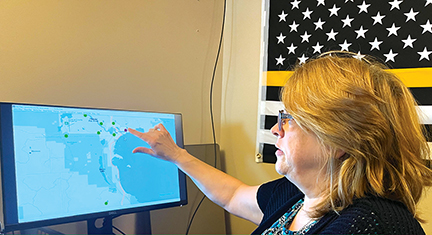
News Photo by Steve Schulwitz Alpena County Emergency Services Coordinator and 911 Director Kim Elkie shows the locations of eight emergency sirens that warn residents of impending emergencies, including severe weather. She said the sirens are only one way the county passes along information to help keep them safe.
ALPENA — The types of emergency alert systems Northeast Michigan counties utilize to inform their residents of imminent danger is a mixed bag.
Some have layers of warning options to connect with thousands of people instantly. Others are working to improve their methods of providing potentially life-saving alerts.
The tornado that decimated Gaylord last week served as a reminder of the importance of being able to quickly notify the public of impending danger.
Although a cell phone notification warned people in Gaylord about the approaching tornado, which killed two people, injured 44, and caused widespread damage, no audible emergency sirens sounded.
Alcona County is taking steps to improve its current emergency alert system. Emergency Manager Scott Rice said there are about six tornado sirens scattered around the county that are used for other emergencies as well and controlled by the 911 center — however, in such a large county, not everyone will hear the sirens when they sound.
Rice said currently there is no electronic alert system that sends out notifications, but that will change in the coming months. The county will utilize a RAVE notification system that notifies people who register of potential weather threats or other emergencies.
“It will help us to get news out to the people and we are working on getting it together and online,” Rice said. “We will be able to send out mass cell phone notifications. I would like to have it running yesterday or last Friday when the severe weather was in the area, but our goal is to have it up by the end of the summer, or no later than the end of the year.”
Rice said people can still use applications on their cell phones, tablets, and computers to sign up for severe weather alerts until Alcona’s new system is online.
Alpena County has a multi-layer system that alerts people in specific areas about possible weather threats, Emergency Services Coordinator and 911 Director Kim Elkie said.
She said there are eight sirens strategically placed throughout the county dispatchers can activate when a severe weather warning is issued or when severe weather is observed and reported from a reliable source such as police and fire agencies.
The sirens are tested on the first Saturday of every month at 1 p.m.
Elkie said unfortunately, the horns aren’t able to be heard in all areas of the county, so the county also utilizes the Integrated Public Alert and Warning System, also known as IPAWS.
She said IPAWS is linked to agencies such as the National Weather Service, Federal Emergency Management Agency, and other agencies. Notifications are sent out to people when emergencies are expected or taking place. Elkie said the technology is so precise it can utilize geo-tracking technology to alert people in specific areas that are in the path of danger and exclude those who are not.
“It goes to every cell phone and is not a subscription service, and people don’t need to sign up for it,” Elkie said. “We can actually pin certain locations and send alerts to all the cellphones in that location.”
Elkie said the county also utilizes social media to spread information and instructions.
Montmorency County is expected to have its new notification system online Wednesday, Trisha Moore, emergency management coordinator said.
She said there are no horns or sirens that operate in the county, but notifications are sent out alerting residents of bad storms or other critical information.
Moore said the new technology will be able to be able to reverse dial 911 and contact people who have landlines. She said if there is no answer, the call to the phone is entered back into a queue and the appropriate number is dialed again.
Cell phone notifications, text messages, Facebook accounts will also be used to get the word out on potential dangers.
Moore said plans for the updated alert system have been in place for months, but the recent Blue Lakes Fire in Montmorency County made clear that improving the system was the right call.
“The fire really enforced that this was a major need,” she said. “Just for sharing information about the road closures and the size and the direction the fire was moving. The new system will allow us to send out information in real time and give us more ways to get a hold of people.”
After the tornadic storm moved through Gaylord, it eventually tracked into parts of Presque Isle County, bringing high winds and sizable hail which caused damage.
Sarah Melching, Presque Isle County emergency management coordinator — who had damage to her house and vehicles from the storm — said existing alert systems, which do not include a working horn or sirens, notified people in the path of the storm, but she said improvements to the system are needed.
The county currently uses a notification system called Code Red, which is linked to state and federal agencies that send out notifications when necessary.
“The technology that was installed years ago is still in place but outdated and probably not working,” she said. “We are currently in the process of getting quotes for a new system.”
Melching said a siren system may be costly, but she would like to see several in populated areas like Rogers City, where they can be mounted on community buildings like fire and police stations.
It would add another layer for warning the public, she said.
Presque Isle County is slated to receive approximately $2,442,141 in funding from the American Rescue Plan Act it can use to help offset the costs of large projects. Melching said she intends to submit a proposal that the emergency alert system be updated and paid for with the federal government money.
“It is something that I supported, but am really going to push now after the storm,” she said. “That will be one of my proposals.”
Local News
Health department 2024 audit nears completion

The Salvation Army of Alpena collecting undergarments for back to school

New Great Lakes Now episode

Pickleball tournament coming to Alpena Aug. 22–23
9 candidates to run for 4 APS school board seats