Gas prices squeeze Alpena emergency services, impact trucking companies
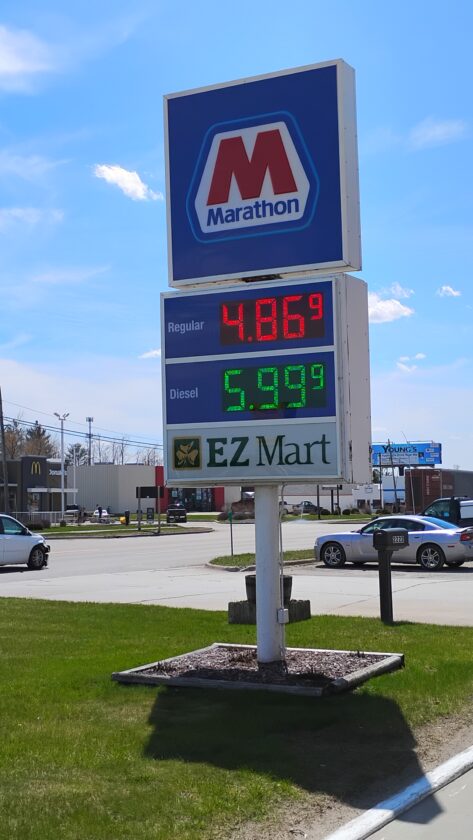
News photo by Josh Jambor Gas prices in the area remain high and because of the rising cost of fuel, local fire, and police stations, as well as trucking companies, might have to make operational adjustments.
ALPENA – With gasoline prices averaging just a tick under $5 a gallon in Northeast Michigan and diesel fuel hovering near $6 a gallon, local police, firefighters, and truckers are absorbing some of the steepest cost increases in recent memory.
The city fleet of law enforcement vehicles puts on approximately 100,000 to 150,000 miles annually. Alpena Police Chief Eric Hamp said as of now, no changes to operations or response are needed. However, if the current fuel prices linger or push higher, action may need to be taken down the road.
“No changes in response protocols or patrols have occurred,” Hamp said. “If gas prices remain elevated into the new budget year beginning July 1, there is a possibility of changes in response protocols to reduce fuel expenses.”
“The department would look at implementing changes in response protocols,” he said. “For example, non-emergent calls for service could be handled by phone instead of sending an officer to the caller.”
“Much like a personal budget, if fuel expense exceeds what is budgeted, other areas of the budget may be impacted to keep the overall budget from being overspent,” Hamp added.
The Alpena Township Fire Department, which operates two stations, faces similar pressure from rising fuel costs. Alpena Township Chief Tim Baker said that regardless of the fuel costs, the department’s commitment to ensuring public safety will not be diminished.
“Fuel costs do not change the obligation to respond under the mutual-aid agreements,” Baker said. “Operationally, the Alpena County Chiefs Association will continue to ensure efficient regional planning as a priority.”
There is concern with an already limited budget that if the fuel costs continue to rise it could put strain on other department line items.
“Key concerns are that even though fuel is about 1% of the budget, it is a critical operational cost,” Baker added. “For a budget that is already limited, it puts more pressure on other budget items.”
Baker stated that the department puts on approximately 10,000 miles annually on it fleet of vehicles.
For local trucking companies, like C & S Carriers, which specialize in paving industry support, particularly hauling liquid asphalt and providing dust control services, diesel costs have nearly doubled since 2024.
Additionally, C & S is an interstate carrier that transports general freight, including metal sheets/coils, building materials, machinery, logs/lumber, and dry bulk commodities. Owner of C&S, Travis Konarzewski, discussed how much operating costs have increased in recent months.
“Typically, it’s an average of about 23% for fuel costs, our average fuel bill during our busy summer months is about $50,000 a week,” Konarzewski said. “Recently that weekly cost for fuel has increased to $65,000 a week.”
Konarzewski spoke about the average fuel cost per mile and how that has changed in the last six months to a year.
“The last two months it has really gone up, six months ago fuel kind of plateaued around $4 a gallon and that was tolerable,” Konarzewski said. “It is a struggle because we bid jobs back in November that we will not be doing until August or September and you try to calculate a buffer for fuel costs but it’s hard to calculate a buffer for this magnitude of fuel cost increases.”
The rising fuel costs have certainly had an impact on cash flow for the trucking company. Konarzewski explained the impacts of bidding on a job prior to the cost of fuel increasing and how it impacts his bottom line.
“It is certainly a hindrance on cash flow because a lot of work is done through the state, and sometimes the billing gets stretched out, ” he said. ” Fortunately, we have a bulk tank, and we can buy our fuel at a slight discount but a lot of times our trucks are away from our home terminal, and we don’t have that luxury, so we must buy fuel at the pump. Typically, the price of fuel is about 30% more when not buying in bulk,” Konarzewski added.
Although no changes have been made to any routes yet, if the cost of fuel continues its current trend, it could result in modifications to the company’s idling policies, and other adjustments might be made to improve fuel efficiency.
“Because our season is just starting, and even when fuel costs are low, we try to be as efficient as we can,” Konarzewski said. “We do try to keep our idling to a minimum, some of our trucks have auxiliary power units and that helps quite a bit.”
“We did put some shut off timers on some of our trucks, so they shut off after five minutes,” Konarzewski added.
Local News

Montmorency County police update
Power restored after morning outage affecting Alpena Power customers

Alcona County police update

Michigan hopes to turn apprenticeships into degrees with new program
Target Huron RISE Initiative launches
ALPENA — Target Huron Economic Development Corporation announced in a press release on Friday the launch of the ...