Alpena County Sheriff and MDOT urge ‘Slow Down, Move Over’ after tragic accident
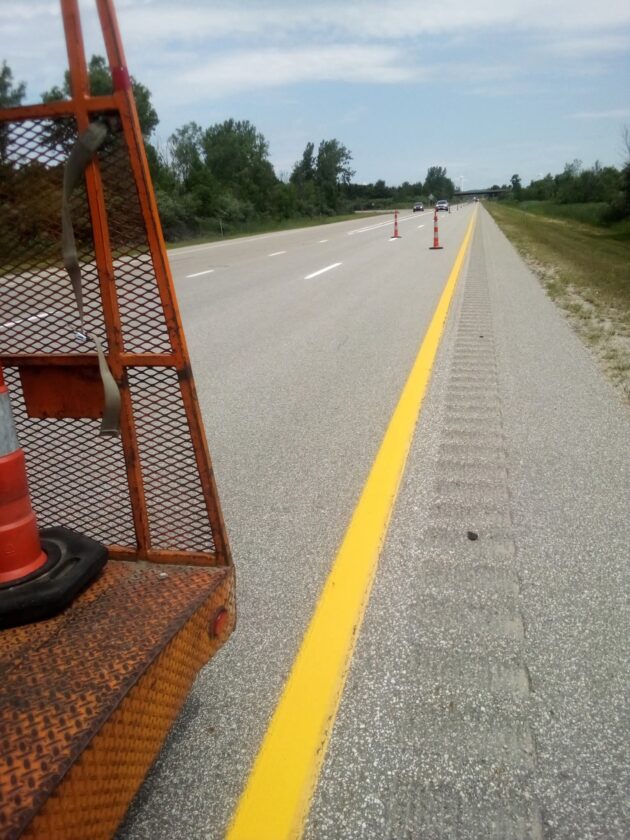
News photo by Josh Jambor A work zone is being established prior to crews applying crack sealant to a local road. Local law enforcement and MDOT officials are urging drivers to slow down, move over if possible, and stay alert to protect the workers keeping our roads safe.
ALPENA – Following the deaths of two Michigan Department of Transportation (MDOT) workers in a work zone crash near Lansing on Tuesday, local law enforcement and state officials are stressing the importance of drivers prioritizing safety on Michigan roads.
Alpena County Sheriff Erik Smith emphasized the personal stakes for first responders and road crews.
“Unfortunately, it happens, it’s near and dear to us because about eight years ago we had a deputy struck by a driver while conducting a traffic stop and was severely injured,” Smith said.
Smith also highlighted the Seguin family’s story: former Alpena deputy Phil Seguin’s son Ryan, who was inspired by his father to become a law enforcement officer, was killed in the line of duty.
On February 15, 2006, a 23-year-old Broward County Sheriff’s Deputy Ryan Christopher Seguin, a Michigan native, was struck and killed by a passing motorist during a traffic stop on I-595 in Florida. His family played a key role in advocating for Michigan’s Move Over Law.
The latest tragedy occurred on northbound US-127 near Holt Road in Alaiadon Township in Ingham County, where a 24-year-old driver lost control of an SUV and struck three MDOT workers from the Mason area. A 49-year-old man and a 51-year-old man died at the scene; a third worker was injured but treated and released. The driver was hospitalized in critical condition.
MDOT North Region Communications Representative James Lake addressed ongoing efforts to protect road workers amid record infrastructure investments. About one month prior, MDOT held its annual National Work Zone Awareness event. Lake noted that after Tuesday’s events, “we need a stronger understanding from the public about the circumstances road workers face every day.”
MDOT coordinates closely with state and local law enforcement for patrols in active work zones when resources allow, though Lake stressed that “this doesn’t negate the need for safer driving practices from the public.”
On balancing urgent road repairs with worker safety, Lake acknowledged it is an “ongoing challenge,” especially with new funding bringing more construction. “Slowing down, following work zone signing, and voiding distractions behind the wheel are truly the only way to keep road workers safe.”
Lake encouraged the public to do more than just slow down: “Talk to anyone who will listen to you and discuss safe driving around work zones. Your teen drivers, your elderly drivers, your friends and family. Driving is a privilege, but safe driving is the only way we can truly move the needle.”
MDOT Director Bradley Wieferich issued a statement:
“Yesterday’s work zone crash resulting in the deaths of two of my fellow MDOT employees is a solemn reminder of how short and precious life is. The public and private sector employees building and maintaining roads across the state deserve our gratitude and our attention as part of the awesome responsibility that comes with driving. MDOT lost not just colleagues, but friends, and their loved ones are left with a void that can never be filled. At this time we remain committed to supporting our staff, their families, and continuing to advocate for safe driving in and around work zones, so everyone can make it home safely.”
Under Michigan law, drivers approaching stationary emergency or authorized vehicles (including police, fire, ambulances, tow trucks, and MDOT vehicles) with flashing lights must move over one lane if safe, or slow to at least 10mph below the posted speed limit and pass with caution. Violations carry fines and points, with increased penalties for injuries or fatalities.
Michigan police officers receive extensive training on roadway safety through MCOLES approved academics, covering traffic stops, scene control, and minimizing risks in live traffic.
Sheriff Smith’s advice remains critical for Alpena drivers: “Whether you are in a work zone or encountering law enforcement or emergency services, you need to slow down, move over, and put your electronics away and focus on the road. Safe driving is a shared responsibility that honors those who keep our roads safe.”
Local News
Commissioners look ahead to fairgrounds’ future

Heat expected to roll in next week

Alcona County Library events
Prentiss Street closure
ALPENA - On Monday, Prentiss Street, between Harbor Drive and the pier will be closed to all traffic. Prentiss ...

Brush up on Great Lakes beach safety