Thiamine Deficiency Syndrome – the Alewives’ Revenge?
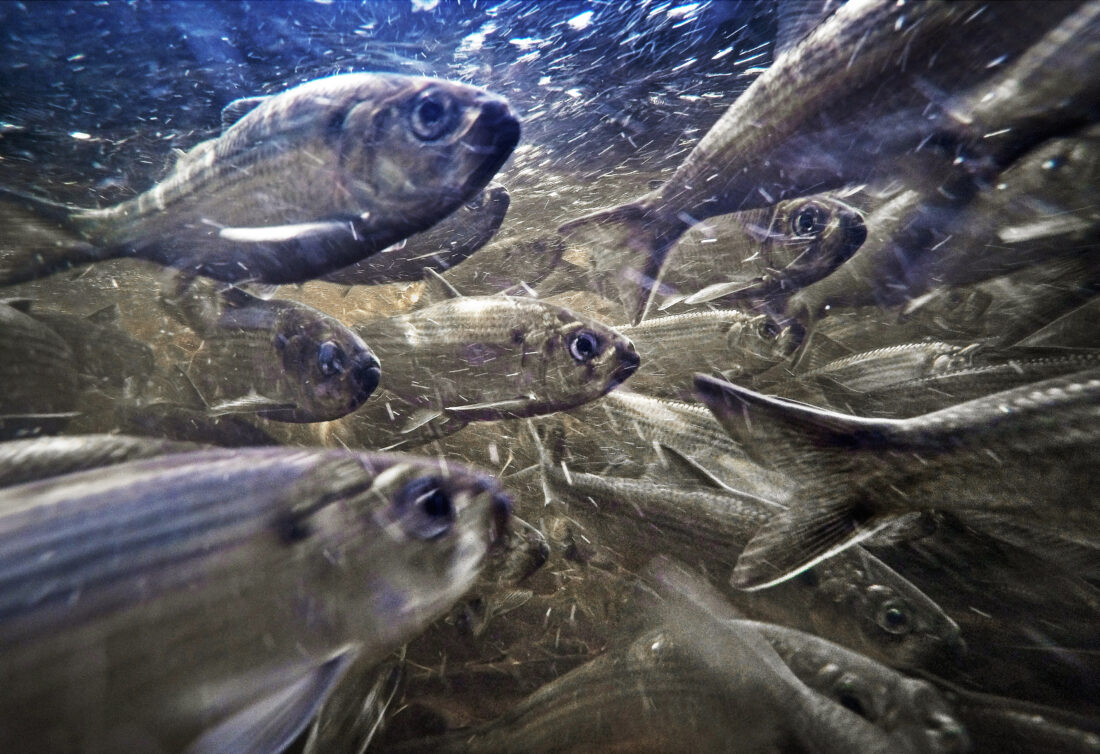
AP file photo River herring, also known as alewives, swim in a stream on May 16, 2021.
Thiamine Deficiency Syndrome – the Alewives’ Revenge?
Predator fish, especially trout and salmon, suffer from thiamine deficiency if they eat too many alewives. It works like this: alewives’ digestive tracts are loaded with an enzyme called thiaminase. The suffix “ase” means it’s an enzyme, in this case an enzyme that destroys the vitamin that makes up the base of the name. Thus, thiaminase destroys thiamine. Without enough thiamine, trout and salmon cannot reproduce – their embryos die. Like French fries are to humans, alewives are an irresistible junk food for trout and salmon. If you are a trout or a salmon and you eat too many of them, you suffer “Alewives’ Revenge”: reproductive failure.
Thiamine, vitamin B1, is one of eight B vitamins. Thiamine helps turn food into energy and keeps the nervous system healthy. Just as with trout and salmon, humans cannot make thiamine for themselves. However, you can usually get all you need from your food. Thiamine is found in a variety of foods, with good sources including pork, fish, poultry, whole grains, legumes, and fortified cereals and breads. And even beer. Like us, fish are unable to make thiamine and must find it in their prey. But if their prey base is 95% alewives, as it was in lakes Michigan and Huron in the 1970s-1990s, thiamine deficiency rears its ugly head.
Coho salmon, Chinook salmon, Atlantic salmon, and lake trout are among the most vulnerable species, wherever alewives are the predominant prey. Thiamine deficiency is not generally a problem in Lake Superior, where alewives are scarce. Rainbow smelt are a source of thiaminase but have not been implicated in recent thiamine deficiency issues. Smelt may have contributed to problems with lake trout during the 1940s and 1950s. Distressed and dying lake trout were reported then by many commercial fishers. This was a time when smelt were especially abundant in the Great Lakes, but diagnostics were not available during that time, so we cannot be sure.
Thiamine deficiency in trout and salmon is most often expressed in the form of embryo and fry mortality, shortly after hatch. Symptoms of thiamine deficient fry are lethargy, disorientation, and failure to begin feeding. The fry become thin, lay on their sides, turn very dark in color, and finally die. This reproductive failure was widespread during the early days of salmon stocking, in the late 1960s through the late 1990s, when alewives were extremely abundant in all the Great Lakes but Lake Superior. Hatchery managers learned that fry survival could be greatly enhanced by bathing the eggs and recently hatched fry in thiamine solutions. This deficiency was not only a problem in hatcheries. Natural reproduction of trout and salmon was suppressed, and this became a major constraint to restoration of native lake trout. Thiamine deficiency and reproduction failure subsided in Lake Huron as alewife numbers declined, and the prey base became more diverse. The round goby, which invaded the Great Lakes during the 1990s, is rich in thiamine and is now important to the diets of lake trout; thankfully, lake trout are now reproducing again. A bonus with round goby is that it feeds on the invasive quagga and zebra mussels and converts them into a thiamine-rich, healthy prey for lake trout, walleye, and many other species.
Jim Johnson worked as a research biologist at the DNR’s Alpena Fishery Station. He and the DNR’s research vessel, the RV Chinook, as well as Boat Captain Clarence “Tuffy” Cross retired to the Besser Museum
Local News
Alpena Public Schools: A year in review

ACES Academy graduates honored in ceremony
Charter Township of Alpena Planning Commission meeting Monday
Charter Township of Alpena Planning Commission will host its monthly meeting at 6 p.m. at the township office ...
Lost Lake Woods Club celebrates 100 years
Alpena Municipal Council approves Taylor Street project
ALPENA – The Alpena Municipal Council voted Monday to approve awarding a contract to MacArthur Construction of ...