Utilities ramp up tree trimming to address long-standing reliability problems
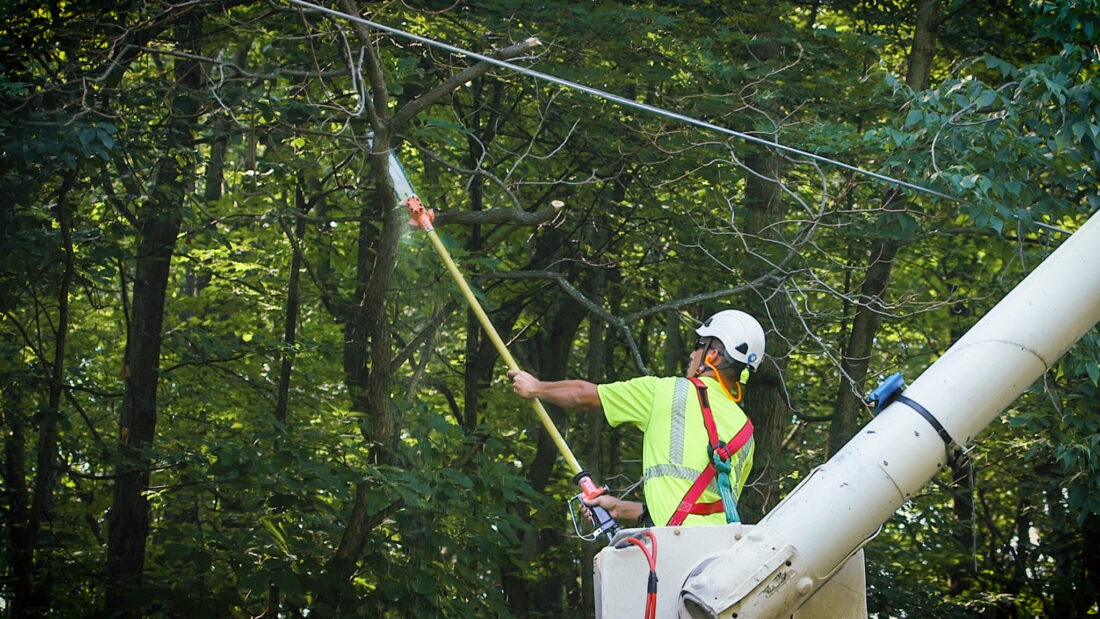
A contractor trimming trees. Credit: Consumers Energy
By SONJA KROHN
Capital News Service
LANSING – While charging comparably high electric rates, Michigan utilities continue to rank among the worst in the nation in reliability.
Now, the Public Service Commission (PSC) wants them to increase their tree trimming efforts to address this long-standing problem.
“Falling trees and branches are the single biggest source of power outages in Michigan,” PSC public information officer Matt Helms said.
The state had the second-highest number of outage minutes per customer in 2023, according to a report by the Citizens Utility Board of Michigan.
And rankings have been persistently low.
The five-year averages for Michigan’s utility reliability performance metrics have been the worst of any Great Lakes state, the board said.
“The major utilities in Michigan, DTE and Consumers Energy, have historically underemphasized tree trimming,” Assistant Director Chris Trubac said. They are the state’s largest electric utilities.
“That is a big cause of the poor electric reliability offered by those utilities,” he added.
In 2024, the PSC, which regulates rates for investor-owned public utilities, announced the results of an independent, third-party audit it had commissioned.
“The audit found that the utilities’ tree trimming cycles were much longer than the four-to-five-year cycle that is a common industry practice,” Trubac said.
At that time, DTE had a trimming cycle of five to seven years and Consumers Energy a cycle of seven years, although in practice it was closer to 10 years because of a trimming backlog, the PSC said in a press release.
The commission highlighted the need for both utilities to improve tree trimming efforts to increase reliability, directing Consumers Energy to analyze the costs and benefits of moving to a four-year cycle.
Douglas Jester, a managing partner at 5 Lakes Energy in Northport, said, “More than 99% of the outages that we experience are because of the distribution system.”
There is enough power generation to meet demand, he said, and when it comes to reliability, people shouldn’t be worrying about whether the state has enough power plants.
Instead, “they need to be worrying about whether we’re managing the distribution system adequately,” Jester said.
PSC Chair Dan Scripps said the reliability of the distribution grid has been an area of emphasis for the commission over the last couple of years.
It has worked with utilities to shorten tree trimming cycles – reducing the time it takes for them to completely trim vegetation around their lines, he said.
Through authorization of additional tree-trimming funding, Helms said, the commission has approved efforts by DTE and Consumers Energy to reduce vegetation-related outages in recent years.
In mid-February, it approved a $242.4 million rate increase for DTE “to continue its work to upgrade its electric distribution system and maintain its more frequent cycle of tree trimming,” a PSC press release said.
While currently funding a 5-year cycle, it also directed the company to investigate the costs and benefits of moving to a 4-year cycle.
The approval comes amid signs that DTE “is showing tangible improvements in reliability,” the commission said.
However, an Attorney General’s Office press release called the PSC decision “yet another rate hike” for DTE customers.
Consumers Energy is still awaiting its rate case decision by the commission for the year.
The company expects the decision towards the end of March, media relations specialist Trisha Bloembergen said.
In recent years, she said, “80% of rate increases have gone directly towards securing the grid.”
Clearing trees and limbs around power lines – a process Consumers Energy calls “line clearing” – has been a key initiative in its reliability roadmap, Bloembergen said.
Because trees and limbs account for about 40% of all power outages at Consumer Energy, the company wants to proactively clear vegetation that could interfere with its power lines.
“Line clearing is one of the most cost-effective ways to improve reliability for our customers,” Bloembergen said.
But because it is directly tied to rate case decisions, how many miles of lines the company can clear is decided year by year.
Last year, she said, Consumers Energy conducted 7,900 miles of line clearing, costing $135.2 million. That’s up from 6,500 miles in 2021, which cost $86.6 million.
In this year’s rate case, the company proposed a $165 million investment towards line clearing, which would amount to 9,700 miles. But the exact number will depend on the rates the commission approves for the year.
With the proposal, Bloembergen said the utility plans to work towards clearing one-fifth of its system per year starting in 2026, resulting in a 5-year trimming cycle.
Last year, Consumers Energy saw direct reliability improvements from line clearing, Bloembergen said.
Across all normal days of the year – excluding those with major weather events like ice storms or tornadoes – its customers experienced on average 163 minutes of outage.
“If we wouldn’t have invested in line clearing, that number would have been up by 11 minutes,” she said.
Emily Smith, a policy manager at Michigan Environmental Council, said she does not oppose tree trimming for safety and reliability.
However, the issue is allowing the removal of full trees – not just trimming branches – without replacing them with smaller plants.
A bill passed in the House in late January would allow the removal of whole trees “from the ground to the sky” to save costs or improve reliability.
“While ideal for power lines, this is not ideal for ecosystems, habitats or even cities that tend to have fewer trees as it is,” Smith said.
Trees are beneficial for cities, she added, because they help curb flooding, control rising temperatures and reduce carbon and air pollution.
The bill as passed by the House would allow for vegetation management for up to 15 feet from the outermost portion of the electric wire – “or whatever distance is considered necessary to improve reliability.”
The bill introduced by Rep. Phil Green, R-Millington, is now in the Senate Energy and Environment Committee.
Supporters include Reps. Gregory Markkanen, R-Hancock; Ken Borton, R-Gaylord; Angela Rigas, R-Caledonia; Gina Johnsen, R-Portland, and Curtis VanderWall, R-Ludington.
Separate from the legislative debate, there are signs of improvement to Michigan’s long-standing utility reliability problem.
PSC’s Scripps said, “The good news is that we’re making some significant progress,” noting that outages have lowered by almost an hour since 2019.
While better weather may have contributed to the improvement, “preliminary figures indicate that Michigan’s reliability performance was significantly better in 2024 than in 2023,” according to the Citizens Utility Board of Michigan.
Still, Trubac said, “While both utilities are now working to do more tree trimming, largely in response to regulatory pressure and public outcry, they still have a long way to go.”
Local News

Together for Youth replaces DARE

Lifelong learners to learn about Alpena’s mansions
Utilities ramp up tree trimming to address long-standing reliability problems

The many seasons of northern Michigan
Rep. Cavitt holding local art contest for high school students