
‘Grateful to God every day’
Alpena woman fights exceptionally rare illness
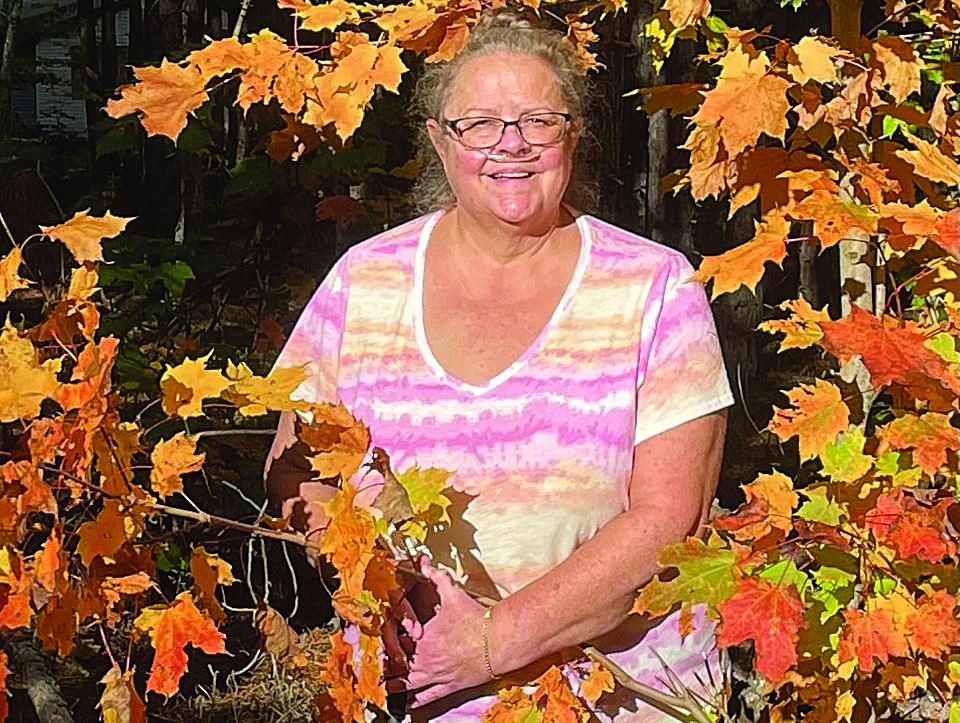
Courtesy Photo LuAnne Benac poses amid fall leaves in this undated photo she provided to The News.
ALPENA — In 2002, LuAnne Benac noticed she had a hard time catching her breath.
For the next 10 years, the Alpena resident ping-ponged from one specialist to another, desperate for a correct diagnosis as her body systems failed and her life became a list of symptoms, from severe dizziness to extreme fatigue to long-term gastrointestinal distress.
Finally, in 2012, a doctor extracted a wedge of Benac’s lung and told her she had a condition shared by only one in 1 million adults, one that, he said, would likely take her life within five years.
Nearly a decade and many treatments and setbacks later, Benac still lives, though she’s lost her ability to travel, mow the lawn, or take a walk with ease.
She’s developed a new appreciation for often-overlooked blessings, and is grateful for every breath she takes, even if it means carrying an oxygen tank that’s “a whole pain in the bottom to haul around,” Benac said.
“It’s been a long road, let’s just say that,” she said of her rare condition. “I’m just glad it happened to me so it didn’t have to happen to anyone else I know.”
When her symptoms first appeared, a pulmonologist thought she had a serious lung infection. He recommended forgoing treatment and nasty side effects, and Benac agreed.
When her body continued to get worse, she saw more doctors. Test after test indicated she was fine, and doctors had little to suggest to help her.
Meanwhile, she spent four years vomiting every day and trying to understand why.
In 2007, she suddenly lost all saliva and had to live on protein shakes for a year because she couldn’t swallow solid food. She bought a bag of ice every day to help quench her insatiable thirst and couldn’t sleep more than 20 minutes at a time because she drank water non-stop, finally to be diagnosed with diabetes insipidus.
While she could still hold down a job, she’d come home at night and sit in the dark, unable to bear light or stimulation of any kind.
Finally, in 2012, a doctor realized she had Langerhans cell histiocytosis, an extremely rare disorder, especially in adults.
The condition is in a medical gray area, considered a cancer by some medical professionals and, in Benac’s case, treated as a cancer, with chemotherapy.
When doctors examined the chunk of her lung — riddled with lesions and nodules — and reached the LCH diagnosis, they put her on oxygen, and she’s never come off of it.
If she got worse, they told her, she might only have five years to live.
She did get worse.
After a bone marrow biopsy to learn more about her sickness, she could barely move her spine for a year. It took her an hour and a half to get out of bed.
A few years later, when she spent another year trying to figure out why she was always dizzy, doctors had to remove part of her skull, which had been affected by the disorder.
Sudden hearing loss and extreme vision changes in 2018 led to surgery that could have led to facial paralysis and losing those senses permanently.
Doctors told Benac a common cold could kill her. Sneezes make her cringe. COVID-19 has been terrifying.
“So many things kept kicking me down,” she said. “I had to just keep crawling up that — it was a mountain. It wasn’t even a hill.”
Chemo made her lungs worse, and she looked into getting on a lung transplant list.
This summer, about a year after stopping treatment, her lungs are back to pre-chemo levels, and she’s no longer eligible for a transplant, Benac thinks.
“That’s really good news,” she said. “I didn’t really want to do a lung transplant, anyway.”
Still, she can’t go outside if it’s humid — or windy, or cold, or hot — without struggling to breathe. For a long time, she said, she would see people riding a bike past her house and start to cry.
Now, though, she’s learned to be happy for them and grateful that, once, she got to do such things, too, Benac said.
Always one who loved to entertain and cook lavish meals, she’s learned to find joy when she can prepare a simple meal and share it, or when she can find a way to do something kind for someone else.
“It just rebrightens up my soul,” she said.
Once a physical therapist assistant who helped others get better, she now overflows with thanks for the people who go out of their way to help her — her sister, her best friend, other friends, family, church members, neighbors, workers at Northeast Michigan Community Service Agency, Friends Together.
She’s been off chemotherapy for about a year and trying to regain strength. Recently, she and her sister traveled to the Tunnel of Trees on the west side of Michigan to enjoy fall foliage.
She can’t take walks in the woods, but she can still drive through them, she said cheerfully.
A very private person, Benac shared her story because, she said, she’s gotten strength from hearing what others have endured, and she wants to encourage others who suffer to keep going, keep trying, keep hoping for better.
Her faith, and the prayers of those who care for her, pulled her through some extremely dark days, she believes, and taught her to appreciate what she has while she has it.
“I can still see, still taste, still smell, still walk,” Benac said. “I’m grateful to God every day.”