
Changing wildlife communities
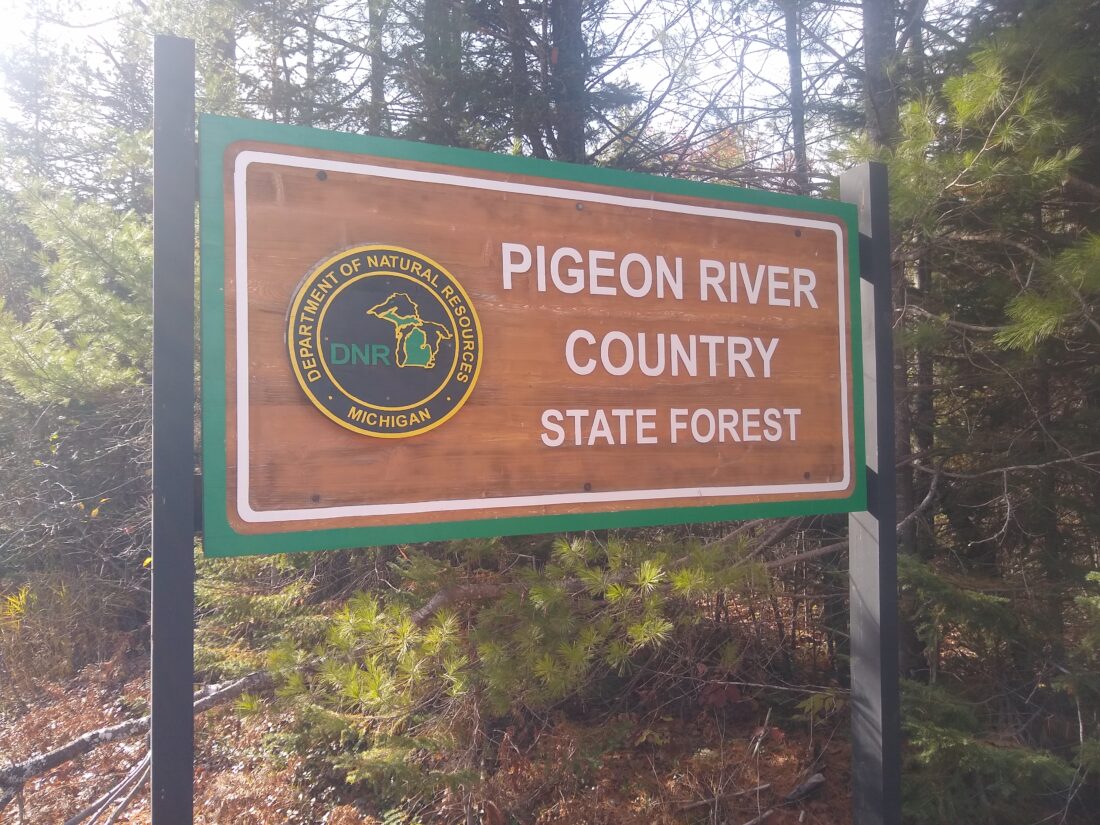
Courtesy photo The Pigeon River Country State Forest
From the historical Native American use of our forests and waters, to the shipping of copper, lead, and sawtimber starting in the late 19th century, to the modern day, land use–and our interactions with the ever-changing local flora and fauna–have changed over time.
I was reminded of this recently while visiting my cottage in the Keweenaw Peninsula. A flock of turkeys, with one enormous tom, greeted me. This species, whose distribution was once very limited, may now be found in every county in the state. What a change in 50 years.
Thinking more broadly, there are numerous other wildlife species that have experienced changes to their distribution and abundance in Michigan. For instance, prior to European settlement, moose, elk, and woodland caribou were distributed more broadly and far fewer white-tailed deer were found. All these ungulates were preyed upon by wolves, not coyotes; the latter species is a relatively new member of our wildlife community.
Some wildlife species were extirpated and recovered primarily on their own. The wolf, as an example, has recovered its ecological role as top-tier predator in the Upper Peninsula. After failed reintroductions in the late 20th century, individuals moved from farther west into the ecoregion and, given time, space, and safety, the species recovered.
Other species recovered indirectly or directly through human efforts: osprey, bald eagle, and peregrine falcon all benefitted from legislative changes to pesticide use. The elk, fisher, Kirtland’s warbler, Canada goose, and trumpeter swan clearly recovered because of direct efforts by State and Federal agencies.
But no other wildlife species exemplifies drastic change in distribution and population than the now extinct passenger pigeon, for which we have named streams (Pigeon River) and public areas (Pigeon River Country State Forest, see figure).
The passenger pigeon was a communal breeder and short distant migrant that ate nuts, other seeds, and berries. It is suggested that the bird favored the hard mast of, in decreasing order, American beech, various oak species, and American chestnut. Members of these tree species groups were historically found across much of eastern North American and it is in this range the bird nested.
However, as we know, nut-bearing trees produce their fruit irregularly. The passenger pigeon, therefore, evolved a communal strategy for finding food, especially during the spring breeding season. Large numbers of individuals spread over vast areas to find trees that had cropped the previous fall. Winter snows, it seems, protected nuts on the ground from the pigs that settlers released to forage. Remember, during much of this time game laws had not yet been established and native ungulate populations were suppressed. Positive search results were then communicated to the flock. After the breeding season, passenger pigeons would move south to the edge of the snow and would again return north before the snow melted.
The exploitation of passenger pigeon for human (and livestock) consumption is well documented. Birds were slaughtered wherever and whenever they were most vulnerable. But did this unregulated killing cause the species’ extinction?
In The Causes of Extinction of the Passenger Pigeon (1992, Current Ornithology), E.H. Bucher described several hypotheses to explain how one of the more abundant vertebrate species to have ever existed ceased to be. The author suggested 6 potential reasons for the species’ extinction, with landscape alteration through forest loss as the more likely cause.
Apparently, by 1878, when one of the larger flocks at that time was observed near Petoskey, the species was headed toward extinction. Many forests dominated by American beech and oak species across the range of the species had been cut. Unlike pine forests, these deciduous forests were growing on better soils and were converted to agricultural production, reducing the food and shelter base for the passenger pigeon.
Bucher wrote: “I consider the following to be the most likely explanation for the extinction of the passenger pigeon: habitat destruction and fragmentation, coupled with intense human predation, resulted in a decrease in population size to a limit below which detection of areas with good mast crop was increasingly difficult…..Habitat alteration alone was probably enough to lead the passenger pigeon to extinction even without direct persecution from humans.”
What can we learn from the passenger pigeon?
I often write the following in this column: one must know the past to understand the present and plan for the future. I stand by this assertion.
The story of the passenger pigeon illustrates the connectedness of wildlife, their habitats (or ecosystems when taken in the whole), and human activity. Even an abundant and wide-ranging species like the passenger pigeon can be pushed to extinction when little consideration is made of the impacts of human actions.
For many species currently residing around us, most of which are underappreciated nongame species, population declines and distribution contractions are ongoing. For instance, data from across North American documented how many species of birds, habitat generalists and specialists alike, are experiencing steep population declines. Many of these species are dependent on forests (2019, Science, v.366, pg.120+). Amphibians are another taxa of wildlife experiencing long-term, wide-spread population and distribution declines. Even the monarch butterfly has been considered for listing under the Endangered Species Act!
What can be done?
I often write how our forests have lost their natural complexity in form and function and suggest alternative strategies to management (2018, Forest Ecology and Management, v.421, pg.59+). Here, I suggest taking a step back.
We must first acknowledge that there is a problem with the distribution and abundance of many wildlife species. Next, we must be willing to discuss potential solutions. Above all, we must be able to talk (and listen!) about subjects and evidence that may make us feel uncomfortable. We must be willing to disagree and have our assumptions challenged by data, peer-reviewed literature, and logic.
The lessons of the passenger pigeon are all around us. If we value what we have, we must be willing to talk and listen about changes we must make. When we do this, the possibilities are endless.
Editorials and columns

No, Notre Dame doesn’t owe college football a bowl game
Changing wildlife communities
Don’t go wobbly on China
As the sun rises on a new Trump-era geopolitical chapter, Washington confronts a defining choice: Will America view ...

Pretty paper, pretty ribbons
Cry the beloved Europe?
Nothing bothers the European elite as much as American conservatives praising the European foundations of their ...
