Food insecurity steady as access increases
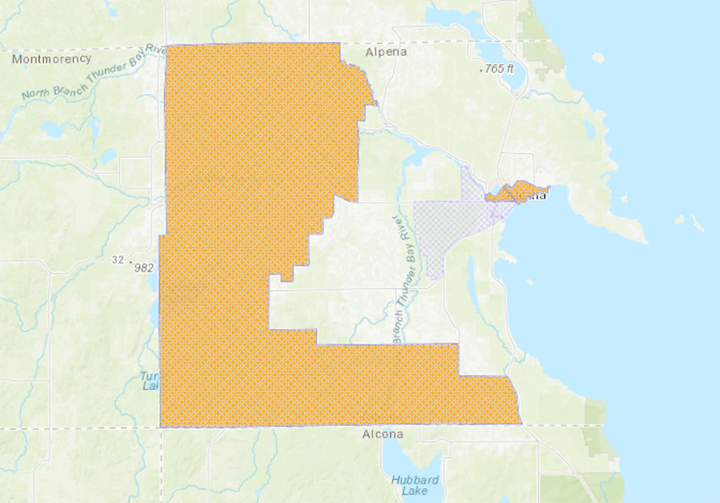
Courtesy Image This map provided by the U.S. Department of Agriculture’s Economic Research Service shows the Food Access Research Atlas, a map showing previous and current food deserts in Alpena County. The orange areas are the current food deserts in 2023. The crosshatched blue area shows the same data from 2015, meaning that, at present, the food desert in that part of the county has been eliminated.
ALPENA — As of 2022, more than 1.4 million people suffer from food insecurity in Michigan, according to Feeding America’s Map the Meal Gap.
The state has an average food insecurity rate of 14.2%, a number that many Northeast Michigan counties surpass.
The counties in the region average between 17% and 20% insecurity ratings, with the lowest being in Otsego County and the highest being in Montmorency County.
Alpena County sits on the lower end of that scale, at about 18%, but more than 5,000 people in the county are still dealing with food insecurity.
Many factors play into food insecurity, such as poverty and distance to supermarkets.

Courtesy Image This image provided by Feeding America shows the Michigan Food Insecurity Map, which shows the broad food insecurity rates across counties in Michigan. The majority of the state is between 13% and 26% food-insecure, and data shows Northeast Michigan tends to hover between the 17% and 20% marks.
The latter is calculated by the U.S Department of Agriculture through the Food Access Research Atlas, which shows areas suffering from low income and low access to grocery stores. That data is used to determine food deserts in the country, and, while Alpena has seen some of its food deserts reduced in the last nine years, parts of the county are still considered a food desert.
“Since 2013, the Economic Research Service has used the term ‘low-income and low-access’ to designate areas with limited access to healthy food,” USDA agricultural economist Alana Rhode wrote in an email.
Rhode is one of the people who helped create the atlas.
Rhode wrote that the two categories — low income and low access to grocers — are measured separately, but can overlap.
That is the case in Alpena County.
She explained that, for an area to be considered low access, at least 500 people have to be more than half an urban mile or 10 rural miles away from a large grocery store. The urban mile factors in lack of vehicle access, which she said is included in calculations.
That data aligns with one of the current food pantries in Alpena, which operates through the Salvation Army Church.
Maj. Prezza Morrison is a corps officer and the pastor of Alpena’s Salvation Army Church. She said that, while the pantry is open to everyone, most of the people it helps come from the north side of town, which is exactly where the food desert is.
“We probably have close to 25 a week that come into our food pantry,” she said. “It depends what time of the week it is or what time of the month it is, whether they received their food stamps, yet, or not, or other funding.”
Morrison said the pantry provides residents with a variety of options, such as canned goods, cereals, meats, and even fruits and vegetables. During the summer, she said they provide more children food options, as well, to make up for schools being closed.
“The hardest part is seeing that people have to come to a food pantry,” she said. “We want to hope that people can be stable on their own, but, the way the economy is right now, some of the services that are provided by the government don’t always cover the needs that our people have.”
Morrison said she’s seen instances of residents having emergencies such as illnesses or cars breaking down that have affected their income. As a result, those residents will skip out on buying food, but she says they know there are food pantries like hers to fall back on.
“I’m glad that we have not only our agency, but other agencies in town that provide food for people … because they need that food to function and to live,” she said. “The function is to think clearly to work better at their job, or, if they’re at school, to think clearly when they’re in school. They have less chance of having to go to the doctor or even to the dentist if they’re eating healthy.”
This week, Alpena opened a new ALDI grocery store on M-32, a store known for providing fresh produce and meat options at lower prices.
Morrison said she believes there are pros and cons to the stores opening for those currently struggling with food insecurity, as she said most of the pantry’s visitors walk or bike to the location.
“It will make it more difficult for them, but also the prices will be lower,” she said. “They might be able to afford some of those vegetables and fruit that they usually wouldn’t be able to afford. There’s going to be pros and cons, and I’m hoping there will be more pros than cons.”
This story was produced by the Michigan News Group Internship Program, a collaboration between WCMU Public Media and local newspapers in central and northern Michigan. The program’s mission is to train the next generation of journalists and combat the rise of rural news deserts.
-

- Courtesy Image This map provided by the U.S. Department of Agriculture’s Economic Research Service shows the Food Access Research Atlas, a map showing previous and current food deserts in Alpena County. The orange areas are the current food deserts in 2023. The crosshatched blue area shows the same data from 2015, meaning that, at present, the food desert in that part of the county has been eliminated.
-

- Courtesy Image This image provided by Feeding America shows the Michigan Food Insecurity Map, which shows the broad food insecurity rates across counties in Michigan. The majority of the state is between 13% and 26% food-insecure, and data shows Northeast Michigan tends to hover between the 17% and 20% marks.
Local News

Future path to fund Alpena Township Fire Department uncertain

Gov. Whitmer announces removal of orange barrels and other traffic barriers to ease Memorial Day travel

Pied Piper graduates turn the tassel

Hoitenga supports flexibility for Northern Michigan schools impacted by storms and flooding
Alpena library closed on Monday
ALPENA - The Alpena County George N. Fletcher Public Library will be closed on Monday, May 25th, 2026, in ...