Jury selection begins in Trout murder trial

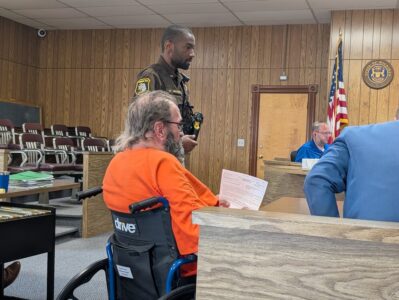
News Photo by Temi Fadayomi Attorney Bill Pfeifer, left, is seen with Alcona County Sheriff’s Office Sgt Scott McKenzie and Alcona County Jail Sgt. George Schrader as they escort defendant Aaron Trout in Alcona County’s 23rd Circuit Court on November 23.
HARRISVILLE — A jury has yet to be selected as day one of Aaron Trout’s murder trial came to an end on Monday.
Trout is facing murder and child abuse charges for the alleged killing of 2-year-old Jayde McDonnell, the child of his then-girlfriend, Adrienne Pavelka.
Day one of the expected three-week trial took place in Alcona County’s 23rd Circuit Court on Monday and is being presided over by Judge Laura Frawley.
The trial started with the prosecution — consisting of Alcona County Prosecutor Thomas Weichel and Assistant Prosecuting Attorney Steve Tyler — and the defense — consisting of Trout’s attorney, Bill Pfeifer — going over a plea deal that Trout was offered to have on record that he wants to proceed to trial.
After that, the potential jurors were allowed to enter the courtroom and the jury selection began. As a part of the selection process, jurors were asked if any of them had health issues or other circumstances that would make coming to trial — set to go from through Dec. 15 — detrimental to them.
Then, the remaining jurors were asked a series of questions meant to determine whether they would be biased in evaluating the evidence. Some of those questions were about relationships between the potential jurors and the witnesses that may be called to testify during the trial. If the potential juror made it clear that he or she could not unbiasedly evaluate the evidence, then he or she was dismissed and allowed to leave.
After that, 14 of the potential jurors selected were brought to the jury box of the courtroom, where they were asked additional questions by Frawley, Weichel, or Pfiefer. If any of them expressed issues with being able to unbiasedly judge the case, they would leave the room to be asked additional questions in private. Those the attorneys believed could not be impartial were also dismissed and allowed to leave.
According to Pfiefer, that approach was taken because of the more public nature of this case, to ensure that potential jurors with outside knowledge wouldn’t influence other jurors.
“This case is different due to its pretrial publicity,” said Pfiefer. “Both sides want to make sure jurors aren’t being influenced by outside knowledge.”
Jury selection will pick up again today.
Local News
VA resource fair in Alpena
ALPENA – The United States Department of Veterans Affairs Saginaw Healthcare System will host a veteran town hall ...
Class of 1962 to reunite
ALPENA — The Alpena High School Class of 1962 is having its annual class reunion on July 25 at the 19th Hole in ...
Kortman sentenced to 16 to 40 years in prison for drug trafficking
McVannel, Wesaw, Diemond thrive at FCCLA conference

Brown Trout: Kids Day offers free fun, school supplies, and fire safety