
Small counties grab new tech to prep for big emergencies
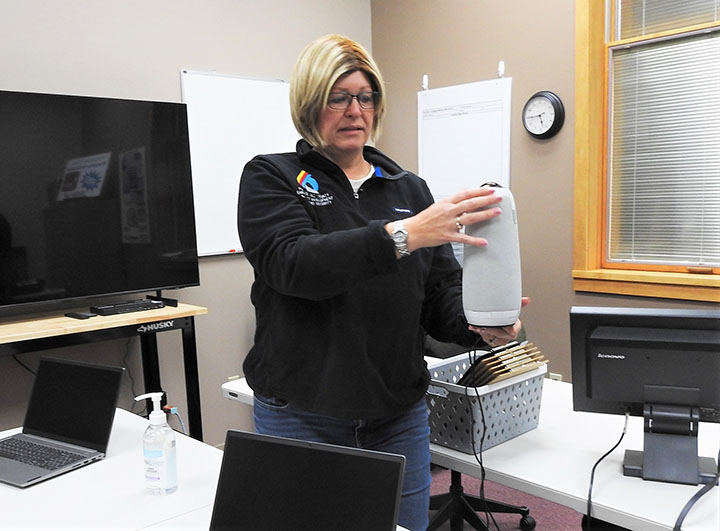
News Photo by Julie Riddle Sarah Melching, emergency management coordinator for Presque Isle County, holds an Owl videoconferencing camera in the county’s new Emergency Operations Center on Friday.

News Photo by Julie Riddle Sarah Melching, emergency management coordinator for Presque Isle County, holds new electronic tablets in the county’s new Emergency Operations Center on Friday.
News Photo by Julie Riddle Sarah Melching, emergency management coordinator for Presque Isle County, holds an Owl videoconferencing camera in the county’s new Emergency Operations Center on Friday.
News Photo by Julie Riddle Sarah Melching, emergency management coordinator for Presque Isle County, holds new electronic tablets in the county’s new Emergency Operations Center on Friday.
Trending
ALPENA -- Northeast Michigan counties are better prepared for large-scale emergencies thanks to equipment designed to connect people to information they need to save life and property.
Tablets, laptops, large-screen televisions, and a camera with a mind of its own fill a new Emergency Operations Center in Presque Isle County, the equipment added this summer courtesy of a federal Homeland Security Planning Board grant.
Other counties in the area received the same or similar equipment, said Sarah Melching, Presque Isle County emergency management coordinator.
The Emergency Operations Center, established this summer in a little-used room across from the Commissioners Room in the county courthouse, offers workspace for about six busy people.
Large counties would need much more space, but emergencies in rural areas mean emergency workers busy in the field, with few people free to work in a central communications hub, Melching said.
Still, she said, the new space and supplies mean an added degree of safety for residents.
Large emergencies happen rarely in small counties, but, when they do, the right technology and a place to use it could prove crucial, she said.
"It's starting to feel like we're more equipped," Melching said. "If anything should happen, we've got everything at our fingertips."
An Emergency Operation Center provides a centralized location where leaders within the emergency response web coordinate their response to a disaster or emergency.
In Alpena County, representatives of numerous agencies used the county's EOC as a home base from which to manage the county's response during early months of the COVID-19 pandemic.
Smaller counties don't always have access to funding to make such a space available, but the Homeland Security grant equipment helped bridge that gap, Melching said.
New electronic tablets give grab-and-go ease for people in charge of damage assessment in the wake of a natural disaster.
High-powered laptops can connect to giant TV screens at either end of the room, any of the screens ready to track weather patterns or wrangle data that responders can use to best protect residents from large human- or nature-caused threats.
At the center of the room, an Owl -- a narrow, foot-tall tower with a curved glass top, reminiscent of an oversized room freshener -- houses a specialty camera that, during meetings, turns of its own accord from speaker to speaker, providing an upgraded videoconference experience that lets participants talk face-to-face, albeit through a screen.
Should more people need to meet to coordinate the county's response, the equipment -- including a locking recharging storage cart -- can move to the larger meeting room across the hallway, Melching said.
The county might use the room -- stocked with regional maps, bins of clipboards, and stacks of coffee cups -- during an extensive missing person search, if an active shooter attacks, or when flood or fire threatens.
It might provide space for police heads, public relations officials, elected leaders, utilities experts, or Red Cross representatives.
When not needed for emergency response, Melching will use the room for training. People in charge of responding to emergencies can't wait until the time arrives to learn how to use the equipment and how to best communicate with it, Melching said.
Several years ago, Melching created a new logo for the county's emergency management team, hoping to make the office and its services more visible to the community.
She encourages residents to sign up for Code RED, a service that alerts residents to urgent matters like evacuation notices, road closures, missing persons, lockdowns, or water boil orders.
Now, she hopes the new equipment in Alpena-area counties prompts residents to ask questions about what they can do to better prepare themselves and their families for emergencies.
In the meantime, the devices give public officials a better chance at protecting their residents during a disaster.
"Let's hope it never happens here," she said. "But we're going to be prepared if it does."
Julie Riddle can be reached at 989-358-5693, jriddle@thealpenanews.com or on Twitter @jriddleX.