
Earbuds allow Ukrainian students to learn, connect at Alcona High School
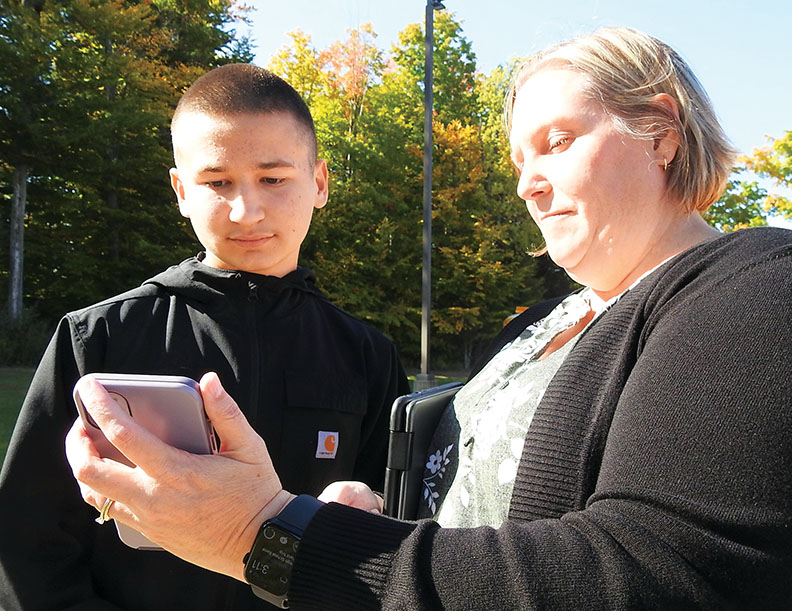
News Photo by Julie Riddle Seventh grader Arsenii Kiselov, left, communicates with Alcona Middle School/High School Principal Christie Thomas using a translation app on a smartphone outside the school on Tuesday.
LINCOLN — Two students who speak no English are making friends at a rural Northeast Michigan school, thanks to computers and two sets of earbuds.
Arsenii Kiselov, a seventh grader, and his sister, Daiana Kiselova, a sixth grader, arrived in Alcona County with their mother about a month ago from Ukraine.
Leaving behind their father, who was not allowed to leave the country, the children now attend Alcona Community Schools, thanks to a group of families in the area sponsoring Ukrainian refugees.
With only one language at their disposal, Arsenii and Daiana would have little chance of thriving in English-speaking classrooms without the help of technology, said Christie Thomas, Alcona Middle School/High School principal.
To communicate with the Ukrainian students, their teachers use earbuds that translate words of a speaker, sending them into the hearer’s ear in a different language with only a few seconds delay.
The teachers also make use of a translation app that turns spoken English into written Ukrainian words, and vice versa.
Neither approach works smoothly, at least not yet, Thomas said, and teachers can’t use the devices during oral instruction in a classroom, the ambient noises and technology glitches preventing smooth translation.
Teachers do use the devices to communicate with Arsenii and Daiana one-on-one, however, and the students can use Google Translate to turn web pages or digital documents into words they can understand, using the Ukrainian alphabet, so they can keep up with their schoolwork.
Other students talk to their Ukrainian classmates using the computers, as well, and the newcomers delight the Michigan natives and spark their curiosity, Thomas said.
When the new students first arrived, one Alcona County student made an inappropriate comment about them, but an older student quickly explained why that wasn’t OK, the principal said.
Daiana, who doesn’t know the English alphabet as well as her brother, has stickers on her keyboard to help her communicate. The sixth grader recently awed her classmates by finding and sharing an online video of her school in Ukraine.
The new students’ presence “gets us out of Alcona County,” expanding students’ understanding of and interest in the rest of the world, Thomas said.
Teaching the visiting students despite a sizable language barrier is a lot of responsibility, she said — and technology makes it possible for the school to fulfill that responsibility.
Recent booms in educational technology have provided many opportunities previous generations of teachers and parents would never have thought possible, said Ashlie O’Connor, instructional technology and data specialist for the Alpena-Montmorency-Alcona Educational Service District.
Even pre-COVID-19 pandemic, schools regularly added new tech to their arsenal, and the pandemic pushed that progress even faster, turning every teacher and student into a tech expert out of necessity.
“Now, we watch 5-year-olds getting on Google Meet like it’s no big deal,” said O’Connor, who said she marvels at the doors technology can open for schools — including the door that lets students who speak no English attend class in small-town Northeast Michigan.
A far cry from students staring at screens all day, simply consuming content, technology in schools lets young people create, finding expression for their unique voices, O’Connor said.
She described the computer program that, several years ago, allowed her grade school-aged daughter to write and illustrate stories that she then read to her class.
Without the technology that provided what O’Connor called a precious glimpse inside her child’s mind, “where would that story go?” she wondered.
Devices like the gadgets in two Ukrainian children’s ears help schools do what they do better, she said.
“Schools can use devices to remove barriers, connect kids, and create relationships,” she said. “I don’t know how technology could not be a part of education now.”
Local News

Hillman girls advance to district semifinals

Poetry at the Alpena museum

Alpena DARE program to be renamed Together for Youth
Posen VFW chicken dinner
POSEN — The VFW Posen Post 7804 Auxiliary will host a chicken dinner on Sunday from 3 p.m. until 6 p.m. The ...
Load restrictions in Alcona County
In accordance with the provisions of Section 722 of Act No. 300 of the Public Acts of 1949, as amended, the Alcona ...
Habitat seeking donations
ALPENA — Habitat for Humanity Northeast Michigan are seeking spring donations people with items to donate can ...