Prosecutor: Criminal charges decisions a deliberate process
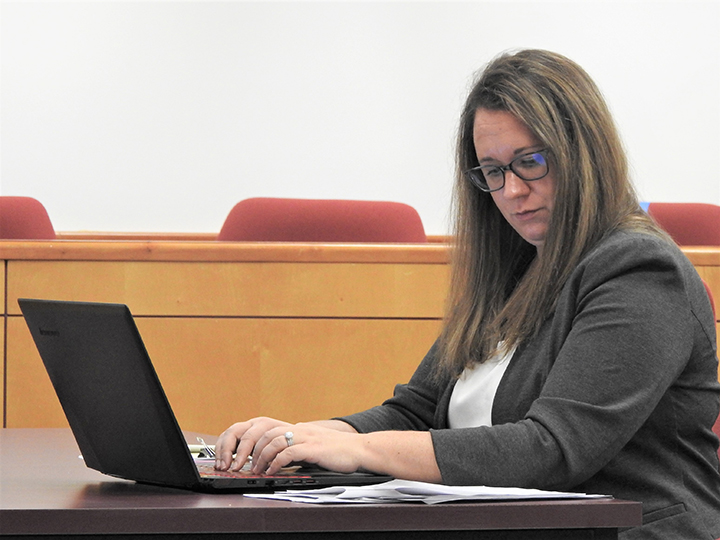
News File Photo Cynthia Muszynski addresses points in a case in the 88th District Court in this News file photo.
ALPENA — Justice takes time – at least, enough time to read through inches-thick stacks of paperwork, Alpena County Prosecutor Cynthia Muszynski said.
Currently working her way through police reports related to both threats of violence in Alpena schools and a pair of local homicides, Muszynski explained that the decision whether to turn those reports into charges cannot be made in haste, however impatient the public might be to hear her decision.
Once police submit reports to a prosecutor, the prosecutor has to use those reports to determine whether a crime was committed and whether police have the right suspect.
For a simple infraction, like driving with a suspended license, that decision-making process can take 10 minutes.
Other police reports take much more time to process – like the 400- to 500-page, 6-inch thick report currently on Muszynski’s desk.
Muszynski would not say whether that report related to police investigation of the 2021 deaths of Alpena women Brynn Bills and Abby Hill.
Muszynski earlier called Brad Srebnik, 35, a prime suspect in the deaths, which she classified as homicides, and police named Josh Wirgau, 34, a person of interest in Bills’ death after they found the teen’s body buried in Wirgau’s Alpena Township yard in September.
Police found Hill’s body in an Alpena Township area in October.
1st Lt. John Grimshaw, commander of the Michigan State Police-Alpena Post said in December that police felt they had enough evidence to charge people in the deaths and had submitted reports to the prosecutor’s office for review.
With police investigation related to Bills and Hill still underway, Muszynski on Tuesday said she wants all available information before proceeding with charges related to the deaths.
Muszynski is also reviewing police reports related to alleged threats made by an Alpena High School student and a Thunder Bay Junior High School student in early December. Those reports went to the prosecutor a week after the incidents.
Prosecutors in some counties brought charges against students shortly after threats closed multiple Michigan schools in the weeks following a November school shooting in Oxford that killed four and injured seven.
Having never charged juveniles with such a crime, Muszynski said she needed to take adequate time to conduct interviews and decide on charges fitting the facts of the incidents, she said, adding that she is close to deciding whether to press charges in one or both Dec. 9 threat incidents.
The alleged threats and homicide investigations are two examples among many cases for which the prosecutor’s office must decide whether to authorize criminal charges.
In 2020, the most recent year for which data are available, the Alpena County prosecutor’s office handled a caseload of more than 1,200 criminal cases, in addition to civil and other cases, according to State Court Administrative Office data.
Her office has seen an increase in the seriousness of assaults and the complexity of some local theft cases lately, increasing the size of the police reports requiring review, Muszynski said.
Those reports have to prove a crime was committed before she can charge someone with it, Muszynski said, explaining her review process.
If a crime did happen and police investigation seems to point to a suspect as the one responsible, the prosecutor still must weigh whether she has enough evidence to convince a jury of the person’s guilt beyond a reasonable doubt.
Reports without that level of evidence may be returned to police with a request to look again and provide more information. A prosecutor can’t tell police what to do, as that would impede the investigation, but, “I can suggest other rocks to look underneath,” Muszynski said.
In deciding on charges, Muszynski must consider what is fair, including to the defendant.
It’s not fair to charge someone with a crime and put them through the court process if she stands no realistic chance of proving they committed that crime, Muszynski said.
If someone committed a provable crime, she still needs to consider the best interest of the community in pressing charges. In some cases, charges that would allow a defendant to enter drug court or a program that could lead to no permanent criminal record might best serve the community if it leads to recovery from addiction or to productive membership in the community, the prosecutor said.
Local News

Montmorency County police update

Air quality alerts issued for northern Michigan as wildfire smoke blankets region
Wildfire smoke arrives, bringing unhealthy air quality to Northeast Michigan
Alpena Marina embraces busy season as Brown Trout festival nears
Target Alpena searches for new executive director
ALPENA — The Target Alpena Board of Directors announced on Wednesday that it is launching a search for its next ...