
Landfill on solid financial ground after years of budget woes
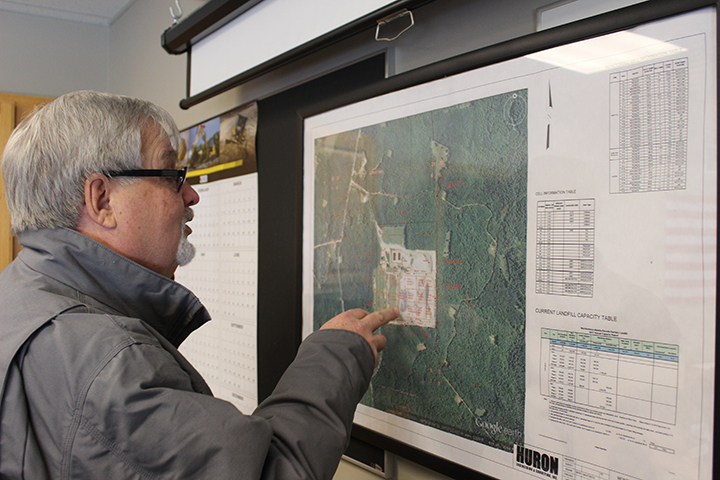
News Photo by Steve Schulwitz Alpena County Commissioner Bill Peterson points out on a map where the landfill in Atlanta was constructed. After several years of serious financial distress, the landfill has bounced back strong and is profitable.
ALPENA — The Montmorency-Oscoda-Alpena Solid Waste Authority landfill in Atlanta serves residents in the three counties and is on sturdy financial ground after years of dire budget woes.
The steps the landfill board and its administrators took to solidify finances required investment in technology and tweaks in operation, but the prime driver of the turnaround was an increase in refuse being brought to the dump.
In 2010, the landfill was staring at a $1.6 million deficit and its savings was on shaky ground, to say the least. A new cell — basically a large pit where trash is dumped and covered each night — was needed to make room for more garbage. Landfill officials needed to finance that project with a local contractor willing to work with them to make the project a reality.
Since that time, the landfill authority’s fund balance has climbed to about $2.3 million at the end of 2019.
When the landfill is profitable, the counties it serves benefit. Each year, the landfill gives each county a cash allocation they can use as they see fit. The landfill gives the money to the counties for the financial risk and the liability they have — should something go wrong, the counties could be on the hook for large, unexpected costs.
It wasn’t that long ago that the counties only received about $30,000 each, but that amount has ballooned to $175,000 the last three years. Both LaFleche and Alpena County Commissioner Bill Peterson said the money helps the county to cut into budget deficits that would be larger without it.
“It is a godsend,” LaFleche said. “It goes directly into our general fund, and we use it to help run the county.”
Peterson said each of the 23 townships in the three counties receive annual allocations, too. He said they will receive $823 each that is typically used for helping to pay for an initiative that helps keep trash out of the landfill.
“A lot of them put it toward the recycling programs, which helps us, because we don’t have to put all of the recycling materials into the landfill,” he said.
Montmorency County Commissioner Bert LaFleche has been on the landfill authority board since before the landfill was open. He said the lean years were stressful because all of the counties had large investments into the facility and liability, as well. LaFleche said having finances on stable ground now makes it easier to continue to make improvements that will help reduce costs further.
“We were in terrible trouble, and we got to the point we had to borrow money from one of our contractors just to have a cell built,” he said. “Now, business has picked up, everything is going good, and we’re healthy.
Financing has improved to the point that the landfill was able to pay cash for another cell that cost about $1.3 million in 2018 and other large purchases, such as a new dozer and loader and stormwater basins.
A NEW WAY TO SAVE MONEY
For years, the biggest expense at the landfill was the cost to have leachate hauled from the dump to a treatment facility in Alpena. Leachate is liquid that moves through or drains from a dump that becomes polluted. It costs hundreds of thousands of dollars annually to properly care for leachate, landfill Administrator Connie Gerrie said.
From January through July 2013, the landfill spent more than $1 million on leachate hauling.
In 2013, the landfill purchased what it refers to as a water cannon, which draws leachate stored in a pair of 1-million gallon lagoons and sprays it in the air over an empty cell, which allows the leachate to evaporate. The practice proved valuable and the cost of leachate was reduced to almost zero from 2013 through 2017.
Today, the landfill is once again hauling leachate. The cannons can’t be used because of the amount of precipitation that has amassed in cells and because of a low water table nearby. Still, Gerrie said, she doesn’t think the cost will reach the point that it did several years ago.
BOON TO REVENUE
The biggest boost to revenue at the landfill was because of an uptick in the amount of trash coming across the scales.
Residents and businesses pay a tipping fee for each cubic yard of trash. In 2015, 147,844 cubic yards was brought to MOA. That ballooned to 211,377 cubic yards in 2017. The amount has fallen somewhat in the last few years, but was still 195,868 cubic yards at the end of 2019.
Gerrie said that only once during that five-year stretch were tipping fees raised, from $32 a ton or $13.50 per cubic yard to $33 a ton and $14.40 per cubic yards. That increase took effect last year.
Gerrie said the landfill authority is always monitoring its finances and making adjustments to its budget based on the expected refuse coming in.
“The landfill’s budget is planned around our regular customers, and above-normal revenue from special projects is re-evaluated monthly,” she said. “Starting in 2017, these funds were earmarked on our balance sheet for future projects. At the end of the year, the engineers prepare an overview of what was completed, what needs to be finished, and what is coming up. Sort of like a never-ending work plan that is continuously changing.”
Peterson is one of two Alpena County representatives on the landfill board. He said former commissioners Cam Habermehl and Lyle VanWormer were on the board during the financial comeback and played large roles in that turnaround.
FUTURE EXPENSES
Peterson said there will be some big investments in the next few years that will be costly, so the landfill authority needs to continue to be mindful of its budget and fund balance.
He said the landfill plans to buy a new, $550,00 compactor, which compacts trash in the cells to create space, and a new, $300,000 water intake system for the lagoons was just completed. Peterson said another large project will be the installation of an injection well — expected to cost $1 million — to address leachate.
“That will help us dispose of the leachate, instead of us having to pay to haul it away, like we are forced to again now,” Peterson said. “We are continuing to invest in the landfill, but there are going to be savings attached to those projects down the road.”
As the trash continues to pile up and new cells are added and filled, the lifespan of the landfill shrinks.
Gerrie, the landfill administrator, said the landfill’s consultant does an assessment each year projecting the remaining years until the landfill will need to be closed. She said the latest estimate was 20 years, but he said that could go up or down, depending on how much trash is received.
Montmorency County’s LaFleche said there have been preliminary talks on what scenarios could be considered to expand the landfill to add years to its existence.
“The state gave us the property where the landfill is now, and we are still surrounded by state land,” LaFleche said. “I think the best-case option would be for the state to give us more land. You never know what the state is going to do, though.”
Peterson said selling the landfill to a private company is also an option. The proceeds from the sale could be split three ways between the counties. He said that revenue would greatly help the finances of each, but there is also a big negative to a sale to private enterprise.
“We would lose control of what the customers are being charged, and it is possible they could be charged a much higher rate,” Peterson said. “Those things are things I’m sure that would be considered, but we still have time to look into all of our options.”
Steve Schulwitz can be reached at 989-358-5689 at sschulwitz@thealpenanews.com. Follow him on Twitter @ss_alpenanews.com.
Landfill intake by cubic yards
This is the amount of solid waste that came into the Montmorency-Oscoda-Alpena Solid Waste Authority landfill in Atlanta annually since 2015
2015: 147,844
2016: 174,746
2017: 211,377
2018: 190,837
2019: 195,868
Source: Montmorency-Oscoda-Alpena Solid Waste Authority
Local News
Despite recent heavy rainfall be cautious with recreational fires
Smith sentenced to 2 years probation on impersonation charge
Alcona County police update
Recent actions taken by law enforcement agencies in Northeast Michigan. This has been only lightly edited. ALCONA ...
Beach cleanup in Alpena
Cavitt announces May office hours
Delta Kappa Gamma update
ALPENA — On April 11, the Alpha Xi Chapter of Delta Kappa Gamma met at noon at the First United Methodist Church ...