Pharmacist: Alpena County among top opioid prescribers
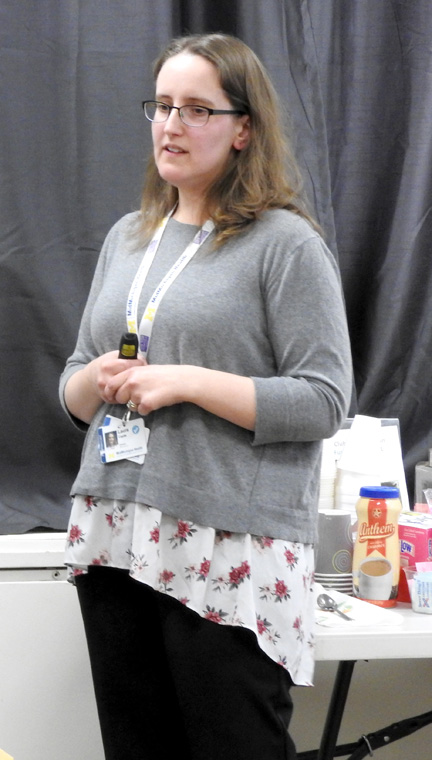
News Photo by Crystal Nelson Laura Caplis, pharmacy manager at MidMichigan Medical Center-Alpena, speaks to the Association of Lifelong Learners on Tuesday at Alpena Community College about how laws in the state have changed relating to the prescribing of opioids as well as the rising cost of prescription drugs.
ALPENA — Members of the Association of Lifelong Learners were able to hear about how the nationwide opioid crisis is impacting the region and the state and how state laws are changing to add more protections for the consumers and more regulations for those who prescribe the drugs.
Laura Caplis, pharmacy manager at MidMichigan Medical Center-Alpena, on Tuesday showed Lifelong Learners members a map compiled by the U.S. Centers for Disease Control and Prevention, showing 129.6 prescriptions of opioids were filled per 100 people in Alpena County in 2013, which she said amounted to more than one prescription for every person in the county.
In 2017, the number decreased slightly to 113 per 100 people, but Alpena County was among seven counties in the state with the highest prescription rates.
Otsego County had the highest prescribing rate, at 143.2 per 100 people, according to the CDC.
“This is based on dispensing, pharmacy dispensing, not necessarily where the person lived when something was filled,” she said of the data, adding that Alpena has more pharmacies than Alcona or Presque Isle counties. “So we’re drawing from a larger area into our county.”
Caplis went on to discuss a number of state laws enacted recently to address how opioid pills are prescribed. She said a patient-provider relationship needs to be established for opioid pills to be prescribed, and that the provider has to discuss the risks of opioid therapy with the patient, who is then required to sign a consent form.
Providers are only able to prescribe opioids for acute pain for seven days, she said. After seven days, the patient would need to be reevaluated by their provider before more pills could be prescribed.
Additionally, Caplis said insurance companies are beginning to put rules in place and that pharmacists are seeing more and more insurance companies requiring prior authorizations. Insurance companies might also request proof the patient has tried other therapies or may only pay for a limited number of tablets per day, she said.
“The best way to use opioids safely is to only use opioids prescribed to you,” she said. “Use the lowest effective dose that you can for the least amount of time necessary. If it’s something you are on for a while, I would wean off of it slowly, especially after a real prolonged use, because there will be some withdrawal symptoms.”
Caplis also encouraged seniors to dispose of any unused opioids at take-back boxes that can be found at local pharmacies and local police stations. She said the National Prescription Drug Take Back Day happens Saturday, where unused prescription drugs can be dropped off between 10 a.m. and 2 p.m. at the Alpena County Sheriff’s Office or the Michigan State Police-Alpena Post.
In addition to the discussion about opioids, Caplis talked about the nuances of Medicare Part D, the rising cost of prescription drugs, and how to make prescription drugs more affordable.
Marlene Bartz, a member of Lifelong Learners, said she found the presentation to be “very interesting and very informative.” Bartz said Caplis covered the things the group wants to know about and that the information was very applicable to seniors.
Marcia Connolly, who serves on the group’s curriculum committee and coordinated Tuesday’s event, said the committee decided it would be a good topic because the cost of prescription drugs, as well as the opioid crisis, has been in the public eye.
Crystal Nelson can be reached at cnelson@thealpenanews.com or 989-358-5687.
Local News
Rep. Cavitt testifies on plan to cut waste, help counties save money
No paper on Friday
ALPENA - There will not be a paper published on Friday due to the Juneteenth federal holiday. The print and online ...
Alpena begins sestercentennial celebration with two sculpture dedications
Dennis and Beverly Neumann celebrate 60 years

Welcome to Alpena