Efforts under way to create path to crash site
OSSINEKE TOWNSHIP – Saturday marks the 39th year since a U.S. Air Force KC-135 plane crashed in Ossineke Township, northwest of Hubbard Lake, killing 15 of the 20 men on board.
Now, one of the first emergency responders to reach the scene of the disaster wants permission to mark a path to the crash site so survivors and relatives of the crash victims can pay their respects. He’s already helped mark the spot with a memorial and reunite four of the five survivors for the 30th anniversary, and he’s working with the Department of Natural Resources to make the trail a reality.
“We recently met with the DNR on that, and all the feedback was pretty positive,” he said. “We’re just waiting to see where that goes.”
In 1976, Allen Ratz was a fire chief at the Alpena Combat Readiness Training Center, then known as the Phelps-Collins Air National Guard Base, and a member of the Hubbard Lake Fire Department. He and four others from the local fire department responded to what had been reported as a dump fire early on Sept. 26. They soon realized it was something much larger.
Ratz said he and firefighter Daryl Kauffman arrived at the crash site to find five survivors, four of whom were badly injured and one who barely had a scratch. Dale Solon, the unscathed survivor, said he didn’t remember anything between realizing the flight was getting a little rough and running through the woods.
An Air National Guard unit from Fort Wayne, Ind., was at Phelps-Collins for exercises, Ratz said. He contacted the base and requested helicopters to air-lift the injured men to Alpena General Hospital. They eventually were transferred to a military burn center in Texas to treat their extensive injuries.
Fred Anderson was one of those survivors. Now living in Sandwich, Mass., he said he remembers asking Solon to help keep him warm, as temperatures were in the low 40s that morning, and the survivors had been left vulnerable to the cold.
“We were all going into shock, because once you burn your skin off, you don’t have any insulation,” he said. “I was telling this guy, this young airman, to come over here and hold onto me, give me a hug so I could get some of his body heat.”
Kauffman said he’d held Anderson, who thought he had broken his back, for a long time before a helicopter air-lifted survivors to the hospital. Kauffman and Ratz had planned to stay and help identify the victims, but after the military took over, the two rode out on a helicopter instead.
Unlike Ratz, Kauffman didn’t have the military experience, so he had no idea what to expect when searching for the crash site. The two ended up using much of their clothing as makeshift bandages.
“All we could think was, we just got to get them out of there, we’ve got to keep these guys alive,” he said.
The plane was headed to Wurtsmith Air Force Base in Oscoda when it crashed, Anderson said. He and more than a dozen other top performing officers with Strategic Air Command were headed to headquarters in Omaha, Neb., for a motivational briefing from command’s senior officers. What had been planned as a pat on the back for the men on board ended in disaster.
Anderson, a B-52 pilot, had been seated next to his bombadier when the plane crashed. The man died in the accident, and Anderson’s wife and the bombadier’s wife were close friends. He found it impossible to explain to her why he lived and her husband didn’t.
Along with his memories, Anderson still has scars on his hands and feet from his burns, he said, and revisiting the site in 2006 was a difficult experience. There’s talk about going again next year for the 40th anniversary, but no solid plans as of yet. It’s good to see the others again, but there’s some trepidation as well.
“We really don’t want to relive the thing,” he said. “It’s like those guys going back to Normandy. It’s tough to go back and walk through it again.”
Ratz agreed the experience can be an emotional one, as he’s led the mother and daughter of one of the victims to the crash site before. Still, he believes the visit can be healing even after so many years have passed.
The crash site is in a dense cedar swamp, and it’s hard to find without help, Ratz said. He contacted Thunder Bay Trails Association President Randy Fairbanks and asked him for help in presenting a plan to the DNR. So Fairbanks included it with a trail proposal for nearby Chippewa Hills Pathway. A longtime resident of the area, Fairbanks had never seen the crash site before until Ratz led him there.
Cody Stevens, Atlanta Unit Manager with the DNR’s Forest Resources Division, said they’re working with a small group of locals, and the department’s Parks and Recreation Division, to see if a trail to the site is possible. Aside from the swampy surroundings, it could be considered a sensitive site that may be damaged by an increase of users.
Jordan Travis can be reached via email at jtravis@thealpenanews.com or by phone at 358-5688. Follow Jordan on Twitter @jt_alpenanews. Read his blog, A Snowball’s Chance, at www.thealpenanews.com.
Local News
State Emergency Operations Center issues updates from severe weather

Alpena library, WCMU present The Librarians
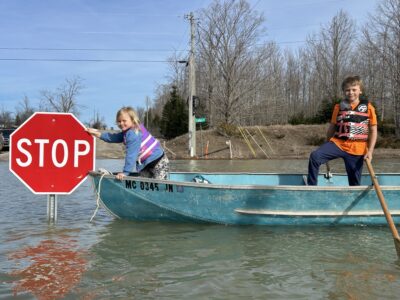
Where is the road?
Bus routes affected by flooding, school closures so far avoided
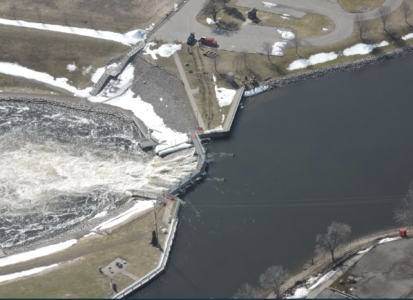
SEOC launches website in response to water levels at Cheboygan Dam