
The Chinook: A race against invasive species
Fisheries heritage on the Great Lakes – Part 2
Trending
This is the second installment of a two part series covering fisheries heritage on the Great Lakes, covering the recovery of the Great Lakes fisheries and the contributions of the Michigan Department of Natural Resources research vessel, Chinook.
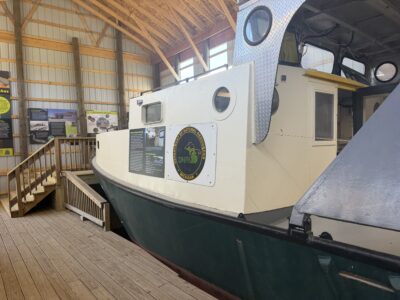
ALPENA -- Jim Johnson, retired fisheries biologist and Besser Museum curator, gave The News a one-on-one curator tour of the museum's Great Lakes Fisheries Heritage exhibit, which features a retired Great Lakes Michigan Department of Natural Resources (DNR) research vessel, Chinook. The retired vessel tells the story of Great Lakes' struggle to overcome decades of overfishing and the introduction of invasive species.
According to Johnson, the Chinook was built for the DNR, then called the Michigan Department of Conservation,) Law Enforcement Division in 1947. The vessel was transferred to serve the Fisheries division research program in 1968 and was officially retired in 2016.
"It basically enforced laws on the commercial fisheries," Johnson said. "There was no recreational fishery then to speak of on the Great Lakes but it was all commercial fishing."
Johnson added that previous to its research role, the vessel would have sailed the Great Lakes enforcing fishery laws and retrieving abandoned nets.
Around 1967, the DNR began stocking salmon in the Great Lakes to re-stabilize the ecosystem after overfishing and invasive species wiped out the fishing population. The boat was renamed to Chinook as an homage to the fish the vessel was monitoring.
"That was the boat's first assignment," he said. "Where do they go? How do you catch them?"
Johnson said that while out on assignment, the Chinook's crews would report back to Lansing every day regarding data they were able to collect from salmon they caught.
"Where are the salmon, how you catch them, and how are they doing?" he said. "The salmon were doing great."
Johnson explained that the DNR was unsure as to how salmon would fare in the Great Lakes. To everyone's surprise, the salmon thrived, ushering in new hope for the Great Lakes ecosystem amid an uncertain time.
"The salmon were doing great, way better than anybody expected," he said. "The survival rate of the first stock was just astounding."
Previous to the vessel monitoring salmon, the DNR was faced with the challenge of overcoming the introduction of invasive species in the Great Lakes.
According to Johnson, by 1938 the DNR had determined that sea lamprey had invaded every Great Lake. By 1946, Johnson said "all the big fish were dead."
By a stroke of luck, the DNR had begun working on a solution to the lamprey problem and by 1950, fisheries were being treated to remove lampreys. Johnson said the Hammond Bay Biological Station was critical in the Great Lakes' recovery.
"The thing that changed everything, made it possible to recover from the lamprey was ... Hammond Bay Biological Station," Johnson said. "Without this station ... our beaches would be littered with dead fish."
Johnson said that the state had assigned the task of "fixing" the sea lamprey problem in the Great Lakes to Vern Applegate and his staff at Hammond Bay.
"One guy and a tiny staff at Hammond Bay ... 'Fix it!'" Johnson said. "The first thing he did was identify that their life story was really unique."
He explained that Applegate had discovered that lampreys have a window of three to seven years when they stick to tributaries until they mature to spawn. He said like salmon, when lamprey spawn, they die.
Moving forward, Johnson said this was an important discovery because it narrowed the amount of legwork fisheries employees had to complete before making any kind of dent into the lamprey situation. With Lake Huron spanning 14 million acres, Johnson said it would be impossible to treat the entirety of the lake. Instead, there are 120 tributaries connected to Lake Huron that are home to lamprey.
"If you had to treat 14 million acres, forget it," he said. "But with lampreys, they're just in these 120 little tributaries, and one humongous one."
Johnson said that a tributary in the St. Marys River, which connects water from Lake Superior to Lake Huron, is the most affected by lamprey.
Applegate and his staff tested 6,000 different chemicals to find one that was uniquely toxic to lampreys and didn't kill anything else, Johnson said. From there, the DNR began to treat tributaries around the Great Lakes and by 1965, the DNR had hope that the Great Lakes' ecosystem could be restored.
Johnson explained that a trickle down effect from salmon fisheries popping up along the Great Lakes shores was economic development.
"It was amazing how fast the motels and restaurants sprung up," he said.
He said that research vessels no longer had to be equipped to support overnight stays on the boat because crews would dock at the end of the day and stay the night ashore.
Currently, Johnson said that conservation efforts on Lake Huron have led to an increase in lake trout and walleye for recreational fishing, thriving the most among the rest of the Great Lakes.
"Now Lake Huron produces more fish in its recreational fishery than all the other Great Lakes combined, because we have a recovered walleye population,” he said. "Probably the best walleye, recreational fishery on the planet, right here on Lake Huron."
Johnson said that though there have been improvements to the Great Lakes' ecosystem through the past few decades, the threat from invasive species has not gone away. Quagga and zebra muscles remain a concern, and the looming threat of invasive carp.
Kayla Wikaryasz can be reached at 989-358-5688 or kwikaryasz@TheAlpenaNews.com.