
U.S. Fish and Wildlife to survey Great Lakes tributaries to search for invasive sea lampreys
Trending
LANSING -- The U.S. Fish and Wildlife Service will conduct work in Long Lake Outlet - Devils Lake, in Alpena County from June 16 – 25 to estimate the abundance of sea lampreys. The information gathered will be used to determine the need for control measures.
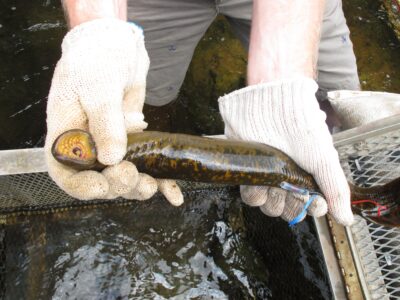
Sea lampreys are parasitic fish native to the Atlantic Ocean that invaded the Great Lakes via shipping canals in the early 1900s and remain a major threat to the fishery. They attach to fish with a suction-cup mouth lined with sharp teeth, feed on their body fluids and can kill up to 40 pounds of fish during their parasitic phase.
Sea lamprey larvae hatch from eggs deposited by adult lampreys in gravel nests, and drift into silty bottom areas where they burrow and grow for several years. In some areas, larvae will drift out of the tributaries and settle in the immediate offshore areas near the mouth of the system.
Failure to detect and eliminate larvae will allow the sea lampreys to transform into parasitic adults and prey on host fish in the Great Lakes.
A first step in the control of sea lampreys is to survey Great Lakes tributaries to determine if sea lamprey larvae are present. Fishery biologists and technicians conduct surveys for sea lamprey larvae in hundreds of Great Lakes tributaries each year. Most surveys are conducted by electrofishing, but in deep waters crews use Bayluscide 3.2% Granular Sea Lamprey Larvicide, a lampricide approved by the U.S. Environmental Protection Agency and Health Canada Pest Management Regulatory Agency. This lampricide is specially formulated onto sand granules and covered with a time-release coating. The lampricide is sprayed over a measured surface area of water where it sinks to the bottom, rapidly dissolves, and causes larval sea lampreys to leave their burrows and swim to the surface where they are collected.
The U.S. Environmental Protection Agency and Health Canada Pest Management Regulatory Agency have reviewed human health and environmental safety data for the lampricides and
concluded that Bayluscide poses no unreasonable risk to the general population and the environment when applied at concentrations necessary to detect larval sea lampreys.
Applications are conducted in accordance with State of Michigan permits.
The sea lamprey control program is contracted through the Great Lakes Fishery Commission to the Service and Fisheries and Oceans Canada. Established in 1955 by the U.S. and Canadian governments, the Commission began chemical control of sea lampreys in 1958 as a response to the catastrophic damage of their invasion. Since that time the highly successful program has contributed significantly to the maintenance of the $5.1 billion Great Lakes sport and commercial fisheries. For more information on the Commission, visit www.glfc.org.
The Service works closely with the U.S. Geological Survey to support research, such as the development of supplemental control techniques to be used in areas where lampricides are particularly challenging to apply. In addition, the Service maintains a partnership with the U.S. Army Corps of Engineers in developing a comprehensive barrier strategy for sea lamprey-producing streams, and is investigating barrier design, traps, attractants, and biological control as part of a robust research program administered by the Commission.
For additional information in Canada call 1-800-553-9091. To reach the Marquette Biological Station call 1-906-226-6571 or to reach the Ludington Biological Station call 1-231-843-7300.