Thunder Bay National Marine Sanctuary hosts citizen scientists
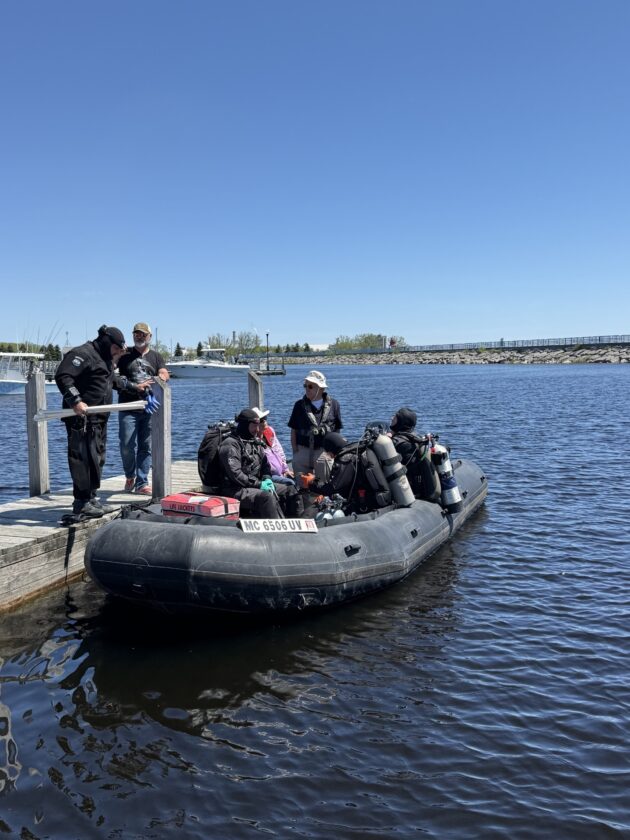
Courtesy photo Divers are seen boarding a boat at the Alpena Boat Harbor. The Noble Odyssey Foundation assisted divers, taking them out to restored reef habitats in the sanctuary to collect data.
ALPENA – The Thunder Bay National Marine Sanctuary (TBNMS) hosted a group of divers for citizen science training on May 30 and 31, led by Alicia Arkwright and James Mott.
According to a press release on Tuesday from Arkwright, divers from across the state gathered at TBNMS for a hands-on training focused on monitoring rocky reef habitats, an emerging effort to expand underwater data collection in the region.
Akwright told The News on May 29 that divers hold a special connection to the underwater worlds they explore. She said it’s kind of like how hikers have their favorite trails or how anglers have their favorite fishing spots.
“People talk about the trails they walk on, the lakes they fished on … I am convinced that diving does the same for folks. You are rarely underwater and it broadens perspectives.”
Arkwright explained that the training that occurred last month is part of a pilot program to encourage partners to recognize the impact citizen scientists can have on data collection.
“The long term goal is having a long term data set for fisheries,” she said. “It would be supportive of Great Lakes research.”
She explained that the divers included in the pilot program go through a “semi-rigorous” certification process. She said that individuals who are participating come from a range of fields, such as education, engineering, and are people who work in adjacent scientific fields.
“We are mainly targeting a wide breadth of people to participate,” she added.
Arkwright explained that there is a general lack of knowledge about reef habitats in the Great Lakes and this pilot program is aiming to bridge that gap and build an accurate representation of what reef habitats look like and how they interact with the Great Lakes ecosystem.
According to the release, participants began the weekend at the Alpena Plaza Community Pool, where they practiced foundational diving techniques such as buoyancy, trim, and balance alongside proper handling of scientific equipment. The group applied those skills in open water at Rockport State Recreation Area, diving in 48-degree conditions with clear visibility.
On Sunday, the release stated that trainees were joined by Captain Luke Clyburn of the Noble Odyssey Foundation, who provided vessel support and transported the group to restored reef complexes in TBNMS. There, divers practiced collecting quantitative data on reef conditions using standardized scientific methods. Throughout the weekend, in-water photography and shore support was provided by Brandon Schwarts and Andrew Ellenberger.
Arkwright told The News that photographing the reef habitats was an important part of the data collection initiative because those photos will “paint a picture of what that habitat looks like.” She said that most people don’t spend much time underwater so the visuals can be hard to imagine.
According to the release, this research initiative was inspired by the threat of spawning reefs being impacted by invasive species such as zebra and quagga mussels, along with other environmental stressors.
“This is about empowering the dive community to contribute directly to Great Lakes science and conservation,” Arkwright said in the release. “These habitats are essential to sustaining fish populations, and increasing our ability to monitor them may help to inform management and restoration efforts.”
Organizers plan to expand the initiative through additional training and coordinated field days, with the goal of monitoring more reef systems across the basin and continuing to build a community of engaged citizen scientists, the release stated.
Kayla Wikaryasz can be reached at 989-358-5688 or kwikaryasz@TheAlpenaNews.com.
Local News

Health department 2024 audit nears completion

The Salvation Army of Alpena collecting undergarments for back to school

New Great Lakes Now episode

Pickleball tournament coming to Alpena Aug. 22–23
UPDATED: 9 candidates to run for 4 APS school board seats