The invention of Great Lakes offshore sportfishing – part 3
Courtesy art
During the late 1960s, the Fisheries Division of the Department of Natural Resources (DNR) turned an aquatic wasteland into one of North America’s most sensational recreational fisheries. The DNR harnessed a disastrous alewife invasion and restored a balanced ecosystem in our Great Lakes. This column is the last of three about the creation of the Great Lakes offshore recreational fishery.
In my previous two columns I described how invasive alewives exploded in number because their predators had been eliminated by invasive sea lampreys. In summer of 1967 an estimated 20 billion dead alewives littered the beaches of Lake Michigan. The DNR introduced two Pacific salmon species to convert the superabundant alewives into a recreational fishery and reduce the nuisance die-offs. The results were spectacular.
This allowed the DNR to shift its focus to restoring native predators of the Great Lakes-lake trout and walleye. This was a good thing for Lake Huron because we would soon need these predators to keep the new offshore recreational fisheries afloat.
Quagga mussels undermine the fishery
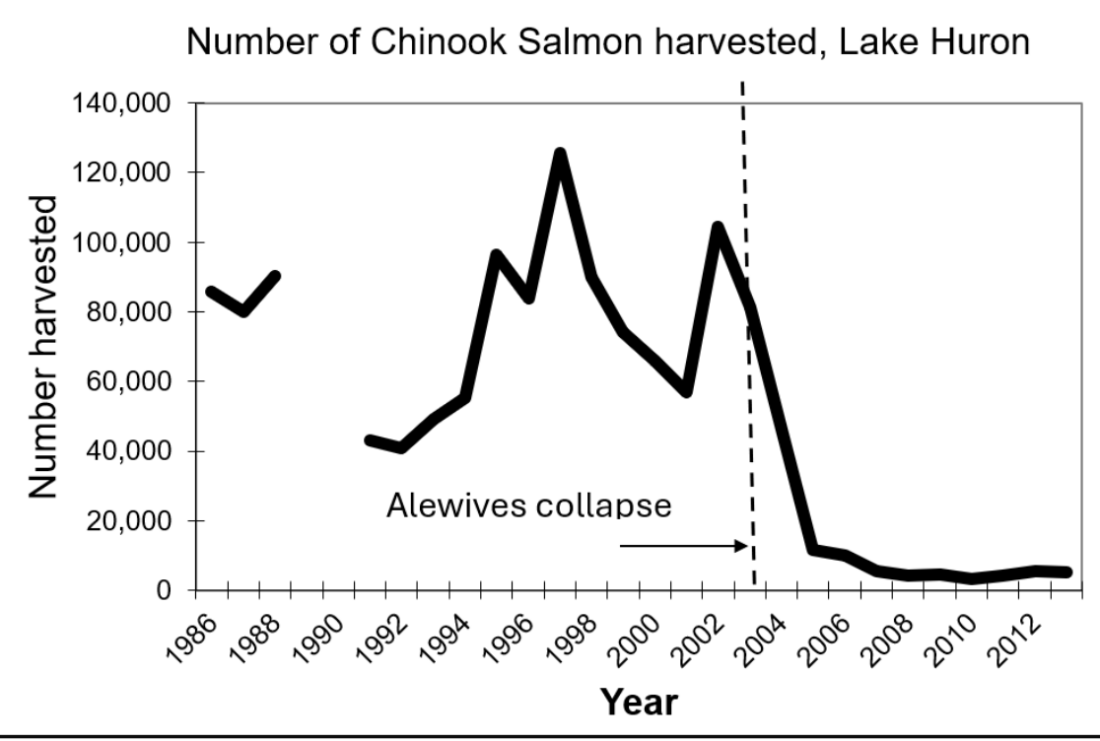
During 2004-2006, Lake Huron’s salmon fishery suddenly declined as alewives, the prey of choice for Chinook salmon, almost disappeared. I remember the first warning sign: in the late 1990s, I was aboard the RV Chinook when we discovered salmon were extremely thin and most of their stomachs were empty-they were failing to find food. At the same time, salmon were spawning in such huge numbers they were taxing the alewife prey base, and invasive quagga and zebra mussels were out-competing alewives for food. Caught between the invasive mussels and a surge in salmon reproduction, the alewife population collapsed. By 2006, salmon were all but gone (see the figure).
Then, walleye and lake trout came to the rescue. Until 2006, walleye had not been reproducing–alewives had consumed almost all hatched walleye fry. Consequently, the DNR and cooperating angling groups raised walleye large enough to escape predation and stocked nearly one million of them annually. But when alewives disappeared, the Saginaw Bay walleye population surged, propelled by huge year classes of wild fish. Stocking was no longer necessary.
Today walleye numbers continue to swell; 2025 was a record year with over a half million walleye harvested. The number of fish anglers harvest from Lake Huron now surpasses those of the other Great Lakes. Lake trout are also recovering, thanks to a healthier diet (few alewives), harvest regulation, and more effective sea lamprey control.
In the 1990s, a new invader entered the picture, one that could make use of invasive mussels. Round gobies, like the mussels, gained access to the Lakes from ballast water of sea-going ships. Gobies readily feed on invasive mussels and, in turn, predator-fish feed on them. The future of Lake Huron’s fisheries is now anchored by fish such as native lake trout, walleye, and smallmouth bass that feed mostly on round gobies–the most abundant source of prey today. Invasive mussels and gobies have engineered a new food web, with native game species securing a new future for Lake Huron’s recreational fishery.
What if salmon had never been introduced?
Many have argued that nonnative predators, like salmon, should never have been introduced. Would we purposely introduce another nonnative fish today? Almost certainly not. But the circumstances were vastly different during the 1960s when the governor told then-DNR fisheries chief Dr. Howard Tanner to do something– “do anything”–to save our beaches.
What if Dr. Tanner had chosen to combat invasive alewives and rainbow smelt with native species rather than Pacific salmon? We can never know for sure, but available evidence points to a likely outcome. Let’s assume lake trout and walleye would have been the mainstays of a native-based recovery effort. Salmon eggs had been offered by West Coast states, but lake trout eggs were in short supply. It would have taken until at least 1975 to develop a lake trout egg supply large enough to begin stocking the Great Lakes. Plus, lake trout grow slowly, so the stocked fish would not have impacted alewife abundance until at least 1980. Most of Michigan’s hatcheries were too warm for lake trout or too small to raise significant numbers of them. With federal hatchery assistance, several million yearling lake trout are stocked annually in Michigan’s Great Lakes. While this number sounds promising, lake trout were being harvested by tribal, Ontario, and other states’ commercial fisheries that still allowed the use of gill nets. Nearly half of larger lake trout in Treaty Waters of lakes Huron and Michigan died in gill nets each year. Consequently, too few lake trout survived to effectively combat the alewife. Meanwhile, alewife populations would go unchecked, annual die-offs would have continued, and beaches would have remained unsanitary wastes of dead fish.
Walleye thrive in warmer waters and would bring balance back to Lake Erie, but in the colder upper Lakes, they concentrate in warmer shallows, such as Saginaw Bay and Green Bay. There, the billions of spawning alewives would consume nearly all recently hatched walleye fry. It took salmon and the invasive mussels to bring alewives down.
Even with today’s diminished salmon numbers, Dr. Tanner remains the chief architect of our recreational offshore fisheries. Had he not introduced Pacific salmon, my guess is a large offshore fishery would have developed only for walleye in Lake Erie and the Saginaw Bay and Green Bay areas. Lake trout would have proved too few and too small for today’s multi-billion dollar offshore recreational fishery to be realized. Because of the periodic alewife die-offs, coastal tourism would not have fully recovered. Dead alewives would continue to litter our beaches.
Today, Pacific salmon are almost gone from Lake Huron. But they enabled the recoveries of both walleye and lake trout–the mainstays of today’s Lake Huron fishery. And the huge alewife die-offs of the 1960s are a thing of the past. Salmon mowed down alewives to the point that an ecological balance emerged with fewer alewives and a healthy, thiamine-rich prey base for native predators that sustain our fishery today.
Dr. Tanner’s gambling with Pacific salmon was incredibly lucky. When Chinook salmon ran out of alewives in Lake Huron, they did not turn to other species for prey. Instead, they quietly bowed out, leaving behind a balanced ecosystem dominated by self-sustaining, native predator fish. We have Dr. Tanner, plus a healthy dose of good luck, to thank for this serendipitous achievement.
It’s fitting that the replacement for the RV Chinook–the DNR’s Lake Huron research vessel named for one of the salmon Dr. Tanner introduced–was named the RV Howard Tanner, after the chief architect of today’s Great Lakes recreational fishery. The Tanner now occupies the DNR’s vessel dock at their fisheries office on the Thunder Bay River.
The RV Chinook is now “retired” at the Besser Museum where she is a centerpiece of the new Fisheries Heritage Exhibit. Be sure to visit the new Exhibit at Besser, come aboard the Chinook and the 1928 commercial fishing vessel Katherine V, and learn more about our shared Great Lakes fishery Heritage during our “Log Cabin Days” celebration on June 27.
Tight lines!
Local News
Congrats Steve!

Cavitt testifies on plan to help Michigan’s first-time homeowners
Masons support Friends Together

Szymanski earns Mahaz Family Spartan Scholarship

Officials hopeful Bay View Park restrooms ready for July 4