The invention of Great Lakes offshore sportfishing – Part 1
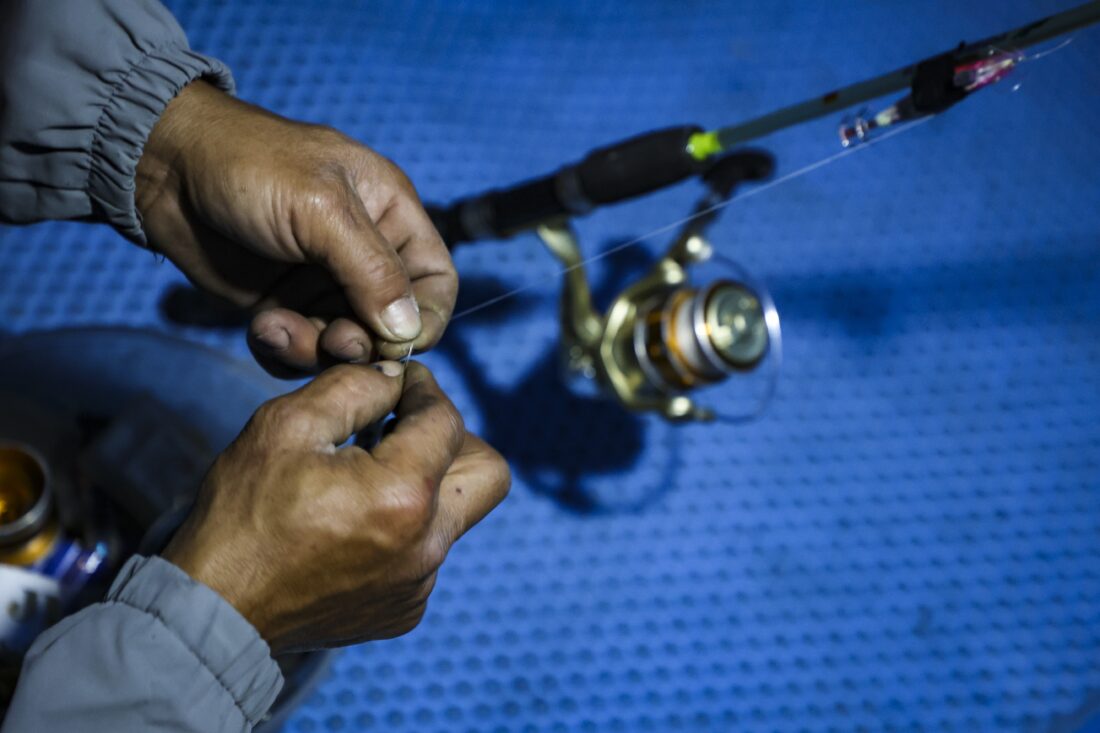
AP file photo of a person baiting a fishing pole.
During the late 1960s, the DNR’s Fisheries Division of the Department of Natural Resources (DNR) turned an aquatic wasteland into one of North Americas’ most sensational recreational fisheries. In doing so, the DNR harnessed a disastrous alewife invasion and restored a balanced ecosystem in our Great Lakes. We will review this sweeping story over the final three installments of this series of columns about our Great Lakes fishery heritage.
Unlike Michigan’s inland fishing, the offshore hook-and-line fisheries of the Great Lakes had to be invented – designed from scratch. Natural inland lakes host an array of mostly native fish, many of which are treasured by anglers. For example, sunfish, bass, walleye, perch. But the Great Lakes were different in two respects: 1) their huge size and 2) the absence of larger-sized, native fish species which had been annihilated by overfishing and the invasive sea lamprey.
Think about it – back in the mid-20th century, few people could afford boats large enough to safely fish the offshore waters of the Great Lakes, and the prime quarry, lake trout and walleye, were depleted by a vast commercial fishery. It was almost impossible for hook-and-line anglers to compete with thousands of miles of commercial gill nets. Then came sea lampreys, which used man-made navigation systems to invade the upper lakes, and literally wiped out the remaining large fish, particularly the lake trout. This limited recreational fishing to species that were too small to interest lamprey. Yellow perch, and sometimes cisco (then known as lake herring), which could be caught from piers or shore, were the mainstay of this earliest Great Lakes sport fishing.
The first attempt at offshore recreational fishing for lake trout was during the 1930s at Raff’s Camp in Northport, on West Grand Traverse Bay, Lake Michigan. George Raff’s large cabin cruiser, the Joann (owned by Guy Weiner) was up to the task of fishing offshore. Their innovations are commemorated with a Michigan Historical Marker at Northport’s Marsden Dame Marina. Lake trout seek deep water, especially during summer. Therefore, lures, sometimes fashioned from metal shaped from tin cans, were lowered using heavy weights on wire lines. The reels for wire lines were large and cumbersome, sometimes fashioned from bicycle wheels or wood spools. These fledgling sportfishing efforts were dashed by the sea lamprey invasion – offshore sportfishing vanished by the late 1950s.
Oddly enough, it was the invasive alewife that presented the opportunity for the Great Lakes to become the multi-billion-dollar sport fishery they are today. Like the sea lamprey, alewives found their way from the Atlantic Ocean to the Great Lakes via man-made navigation canals that circumvented Niagara Falls (the falls had blocked upstream invasions of fish from the Atlantic). Alewives are a “prey fish” meaning they are meant to be eaten by larger fish. But in the 1960s, in the wake of overfishing and the depredations of sea lampreys, there were no larger fish in the Great Lakes. Free of predators, alewife numbers exploded. Eventually, these small invasive fish were dying by the billions from the stresses of overpopulation and old age. Michigan’s beaches were buried under over a billion pounds of dead, rotting alewives in the summer of 1967. The beaches of the Sleeping Bear Dunes area were sanitation risks and were consequently closed to visitors. This was a disaster for tourism. Something had to be done. Then Governor George Romney pleaded with the DNR to do something, ANYTHING, to reduce the alewife catastrophe.
Enter Dr. Howard Tanner, credited as the architect of today’s Great Lakes offshore recreational fishing. Dr. Tanner, an Antrim County, Michigan native, became Chief of the DNR’s Fisheries Division during the mid-1960s, just as sea lamprey control was suppressing the invasive lampreys. Tanner had spent years working in the Rocky Mountain West on man-made reservoirs and to him, the Great Lakes were just bigger versions of his western reservoirs, where he helped to design lake fisheries on newly impounded rivers. To Dr. Tanner, the control of sea lampreys and the plea from the governor to “do anything” to deal with alewives, meant the time was ripe for him to design a new Great Lakes fishery. The superabundance of alewives was not a problem to Dr. Tanner; it was an opportunity to introduce predators that were “designed” to feed on alewives. He hoped those introduced predator fish would stimulate a recreational fishery.
But first, he had to reduce the use of gill nets in Michigan’s commercial fishery; otherwise, the stocked fish would end up dead in gill nets. So, he converted the Michigan-licensed commercial fishery to trap nets, which corral in net pens but seldom harm their catch.
For restocking, he chose ocean predators – Pacific salmon – that specialized in feeding on ocean prey such as Pacific herring, which are much like alewives. Dr. Tanner chose coho and Chinook salmon, specifically, for three reasons:
1) They grow FAST, meaning they would consume huge amounts of alewives each day compared with our native predators. Chinook salmon, for example, grew to about 20 pounds in 3 years, but the native lake trout require close to 20 years to reach that size.
2) Salmon eggs were available – Dr Tanner had just been offered millions of coho salmon eggs from the State of Oregon. A large enough supply of lake trout eggs to restock the Great Lakes would take years to develop.
3) Dr. Tanner understood that Pacific salmon would prove to be incredibly exciting sport fish. Salmon were known to be far more energetic at the end of a line than lake trout or walleye. Thus, he viewed salmon as an opportunity to convert ruinous numbers of alewives into a world-class recreational fishery.
The fish were only one element of the architecture. Other elements of this novel recreational fishery would require: 1) Fishing boats suitable for the Great Lakes, 2) Public access sites for boat launching and for refuge from storms, and 3) Fishing tackle, and methods for presenting lures in deep water. But these elements of the new fishery would come later.
The first coho salmon were stocked in 1966; Chinook salmon followed in 1967. The results surpassed all expectations.
Soon waters near the stocking sites were teaming with big, mature salmon returning to spawn. But Michigan anglers were totally unprepared to exploit this new opportunity. Few people had suitable boats and there were too few boat launch sites on the Great Lakes at that time. Chaos ensued, as sport fishers launched small boats off beaches – boats too small to safely navigate the big lakes. And the fishing was spectacular, far exceeding anything Michigan anglers had ever experienced. The urge to capitalize on this exceptional fishing – which became known as “salmon fever” – clouded judgement.
Tragedy struck on September 23, 1967, during the height of this first huge salmon run. A violent storm caught nearly 1,000 boats off the shores of northern Lake Michigan. Most were small boats designed for inland lakes. Many boats were swamped in the surf while trying to land; others capsized offshore. Many required rescue and seven people drowned.
Eventually, Great Lakes anglers invested in bigger, safer boats and the State began a program of “harbors of refuge”, most with public boat launching ramps. Sanity was slowly restored. That will be the story for the second installment of The Invention of Offshore Fishing” next week.
Be sure to visit the new Besser Museum Fishery Heritage Exhibit this June, where you can learn more about our shared Great Lakes fishery heritage.
Local News
St Matthew to host garage sales
ALPENA — St Matthew Lutheran Church is hosting its annual garage sale on July 31 from 9 a.m. until 3 p.m., Aug. ...
Aid by the Dozen meets
ALPENA — The July meeting of the Aid by the Dozen was held on July 15 at the 19th hole. Lori Zeller was the ...

Northern Strike returns to Michigan

DHD4 reports 12 confirmed cases of cyclosporiasis, one death

Alcona County Sheriff’s Office seeks new law enforcement millage