Birch bliss
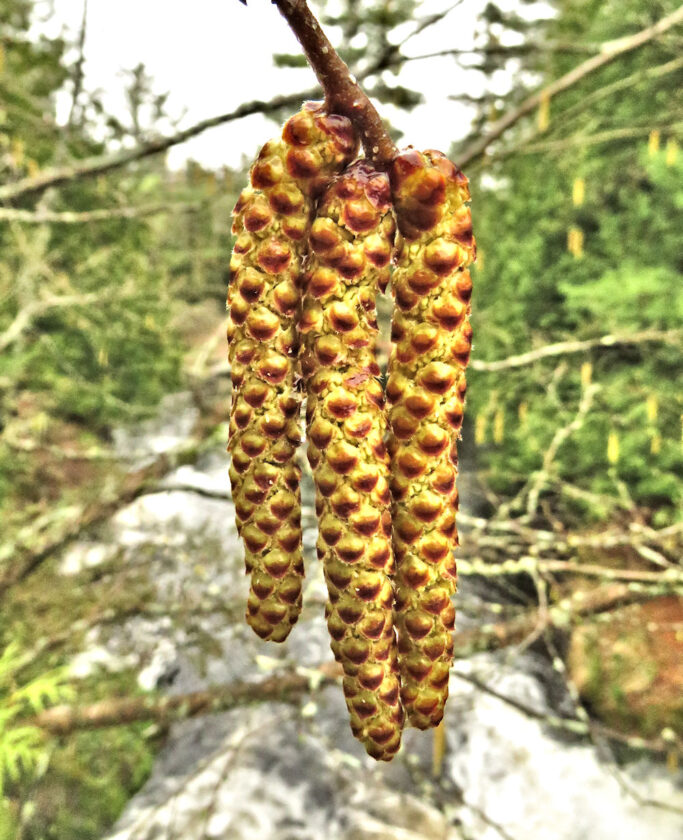
Courtesy photo Ironwood fruits that resemble hops.
Walking amid a brilliant paper birch stand remains an iconic memory for many folks who have wandered into the northwoods. The autumn season swaps out the green canopy for one of gold. Then, blankets of white snow complement the gently sloughing white bark.
I suspect that if Lake States residents were polled about their favorite trees, paper birch would fall among the top five. Many learned about birch bark canoes in grade school, lit a campfire with birch bark for tinder, or even wrote a love note on a strip of bark.
While prominent among the most popular species, the family represents only a small portion of the forest volume, less than four percent. Sometimes, white-phase quaking aspen is mistaken for paper birch. However, the aspen has no exfoliating bark and no black “mustaches”.
While paper birch might be a rock star among dendrological wonders, the species has a number of close cousins. The genus Betula has four players in forest communities. The most common is yellow birch, followed by paper birch, with gray birch and river birch less prevalent. There are also a couple of exotic species scattered across southern Michigan.
The family Betulaceae hosts three other genera in Lake States forests. Ironwood (Ostrya), musclewood (Carpinus), and the alders (Alnus). Several common names exist for ironwood and musclewood. The most confusing ones are hornbeam (musclewood or blue beech) and hophornbeam (ironwood). Sometimes, musclewood is also called ironwood. Thank goodness for Latin names.
Grouse and deer hunters, and others, who have stumbled through woody tangled wetlands are familiar with tag alder, sometimes called speckled alder. The Latin name has changed for this shrub (occasionally tree size) from Alnus rugosa to Alnus incana.
The only alder to regularly reach tree size is the exotic European alder (A. glutinosa), found mostly in southeastern Michigan.
Several other shrubby family members occur frequently, such as other alders, hazelnuts, and bog birch.
The fruits of most members of the birch family have small woody cones, even though they are not conifers. The male flowers consist of catkins, which appear early in the spring, even before all the snow has melted. The separate female flowers inconspicuously cluster on small stubs. Ironwood and musclewood have different looking fruits. The “hop like” fruits of ironwood led to the alternative common name of hop-hornbeam.
Different birches occupy a wide range of ecological environments, from dry sandy soils to wetlands. Paper birch and yellow birch exemplify this wide spectrum.
Paper birch prefers full sun. Its life strategy is to grow fast and die a violent death. It is short-lived. Fire is the friend of paper birch, as it’s one of the tree species that readily exploits post-fire conditions. The lack of catastrophic disturbances is one of the main reasons why paper birch is declining across the Lake States.
On the other hand, yellow birch grows on richer and moister soils, has a long lifespan, and can tolerate a fair amount of shade. It sometimes occurs in association with hemlock. As forests continue to age, shade tolerant species become increasingly prevalent, at the expense of the more sun-loving species.
Ironwood especially takes advantage of shady forests, reaching “pest status” in some areas. The wood is very dense, thus the name. Claims have been made that the wood can even spark from chainsaws. It certainly dulls saw teeth quickly.
Birch family leaves all look roughly similar and are about the same size, from two to four inches long. The shape is stereotypical of tree leaves and the margins are variously serrate.
Bark characteristics vary widely, from the peeling nature of paper and yellow birch to the smooth sinuous shapes that give musclewood its name. Ironwood bark is quite shreddy. Most alders have a coppery maroon color with prominent white spots, which are called lenticles and assist with gas exchange.
Young yellow birch twigs have a pleasant taste of wintergreen, almost as strong as the leaves and fruits of the evergreen and aromatic wintergreen plant.
Yellow birch and paper birch have commercial value, often in a hardwood mix that’s delivered to a pulp mill. However, higher quality trees are prized for their color and grain patterns. Veneer peeled or sliced from logs create beautiful furniture. The bright wood of paper birch has long been made into various small implements, such as spoons and tool handles. And, of course, paper birch bark ranks high in cultural value due to its utility for containers, baskets, and craft items.
Local News

Health department 2024 audit nears completion

The Salvation Army of Alpena collecting undergarments for back to school

New Great Lakes Now episode

Pickleball tournament coming to Alpena Aug. 22–23
UPDATED: 9 candidates to run for 4 APS school board seats