
NRC passes new deer regulations, ‘one buck rule’
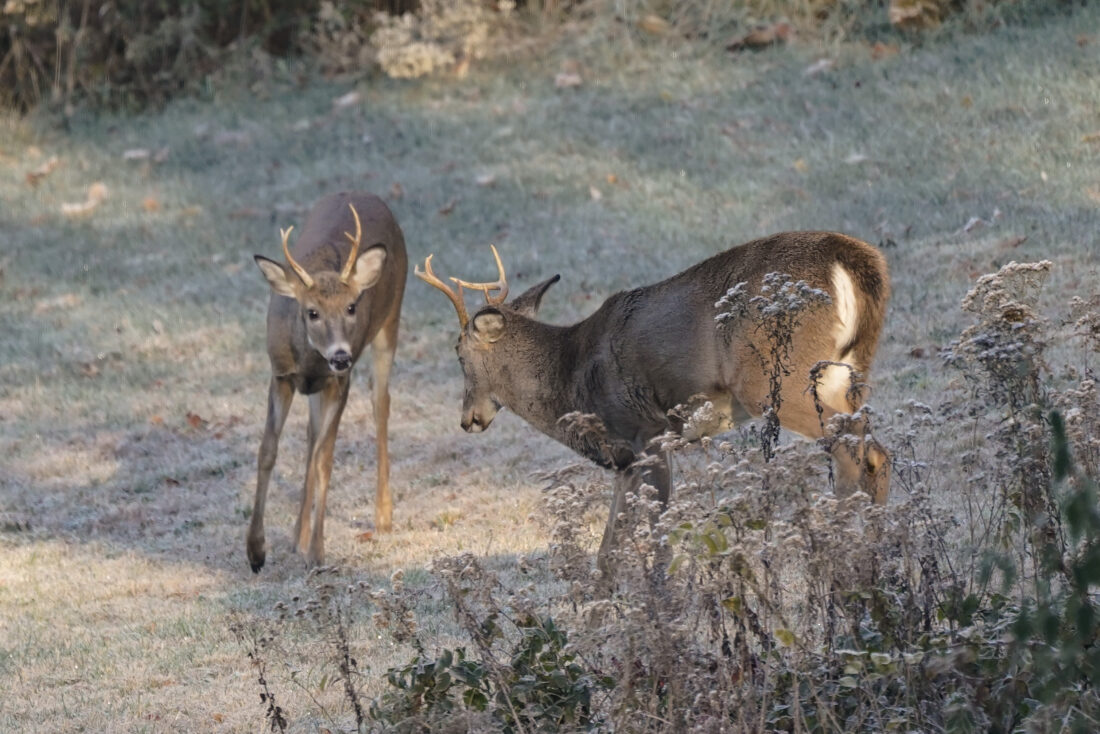
AP file photo. A pair of young antlered deer graze on the edge of the woods in a frost covered field.
ALPENA — Deer hunters in Northeast Michigan are going to have to abide by some new hunting regulations, including how large a buck must be and how many can be taken.
At its May 13 meeting, the Michigan Natural Resources Commission (NRC) approved deer regulation changes for the 2026 and 2027 hunting seasons, according to the Michigan Department of Natural Resources (DNR).
The NRC is a seven-member public body, whose members are appointed by the governor. These members acted on and amended recommendations developed by the DNR “to support healthy deer populations while balancing hunter opportunity and public feedback,” a DNR press release on Friday stated.
The DNR presented those recommendations to the NRC on April 8. According to the DNR, under Michigan law, the NRC has the authority to regulate the taking of game and establish hunting regulations.
A significant change garnering attention from hunters statewide includes the new “one buck rule” which will take effect in 2027. This rule limits harvest to one buck per hunter in the Lower Peninsula.
According to the DNR, under this new regulation, a single deer license in the Lower Peninsula will be valid for one deer with at least three antler points on one side or for one antlerless deer. A deer combination license will allow hunters to take one antlered deer and one antlerless deer, or two antlerless deer. Existing DMU-specific antler point restrictions will remain in place. Upper Peninsula deer regulations will remain unchanged.
The NRC also approved a pilot “earn a second buck” program in the southern Lower Peninsula (Zone 3), according to the DNR. Under the pilot program, hunters must first harvest an antlerless deer before becoming eligible to harvest a second buck with a four-point antler point restriction. The department will determine participating counties at a later date and will bring forward a Wildlife Conservation Order amendment in July outlining the program parameters.
In addition, the NRC expanded exceptions authorizing deer management assistance permits for the take of antlered deer causing horticultural damage because of the new one-buck limit in the Lower Peninsula, according to the release. These exceptions will require approval from wildlife and law enforcement supervisors.
State Sen. Michele Hoitenga, R-Manton, told The News that she is currently torn on the decisions made by the NRC.
“I watched as fellow hunters from across the state passionately advocated for various policies, sharing diverse experiences and perspectives at the NRC meeting,” she stated. “It was clear that no matter the outcome, there would be both satisfied and frustrated attendees. I personally felt some of the NRC decisions were commendable, and others fell far short.”
She said that she is trying to decide how these new regulations align with the the protection and stewardship of Michigan natural resources.
“Ultimately, conservation decisions should prioritize the protection and management of our wildlife resources,” she said. “I’m still reflecting on the final NRC decisions and how they align with this crucial objective.”
She added that she is still advocating for baiting reform in the state, which was not a topic of discussion for the recent NRC meetings.
“Baiting has been and remains the biggest topic I hear about from hunters and that issue was not discussed by the NRC,” she said.
State Representative Cam Cavitt, R-Cheboygan, was not able to provide a statement before The News’ print deadline on Friday.
Changes approved for the 2026 deer seasons included the following, according to the DNR:
– The NRC eliminated the antlerless deer hunting access drawing in the Upper Peninsula. Deer Management Units (DMUs) 351 and 352 have been rescinded and hunters in the Upper Peninsula will only be able to use universal antlerless deer licenses in DMUs 022, 122, 155, 255, 121, and 055 during the 2026 season.
– The statewide muzzleloader deer season was reduced from 10 days to three days. The season will begin on the first Friday in December. In the Lower Peninsula, any legal firearm may be used during this season, which will now be called the December Firearm Deer Season.
– Late Antlerless Firearm Deer Season will open earlier, beginning on the Monday following the December Firearm Deer Season and continuing through Jan. 1. The season will be open across the Lower Peninsula except in DMUs 245 (South Fox island) and 145 (North Manitou island). DMU 115 (Beaver and Garden Islands) is now open for both early and late antlerless firearm deer seasons.
– The Limited Firearms Deer Zone in the Lower Peninsula was eliminated, allowing the use of all legal firearms, including bottleneck cartridges, throughout the Lower Peninsula. Firearms larger than .22 rimfire are now permitted statewide.
– Residents with a valid senior deer license, senior deer combination license, or senior antlerless deer license are now authorized to use a crossbow during the late archery deer season in the Upper Peninsula.
– The extended late antlerless firearm deer season and the January archery deer seasons were eliminated, concluding all deer hunting seasons after Jan. 1.
– Early antlerless firearm deer season will run concurrently with the Liberty Hunt during the second weekend in September. The Liberty Hunt and Early Antlerless Firearm Deer seasons will be on Sept. 12 and 13 this year.
– Authorization for the department to establish universal antlerless deer license use limits in consultation with the NRC. The universal antlerless deer license use limits will be reviewed and published annually. This change applies limits on the number of universal antlerless licenses that hunters may use within individual DMUs or counties.
Kayla Wikaryasz can be reached at 989-358-5688 or kwikaryasz@TheAlpenaNews.com.
Local News
Chillin’ chipmunk

The Katherine V: A bygone era of gill net fishing

Sandcastle building contest ready to roll
DNR reopens the Cheboygan lock

Lots to do on Fourth of July Weekend
Starlite Beach splash park hours extended
ALPENA - The City of Alpena will be extending the hours of operation of the Starlite Beach splash bark beginning ...