
Cranberries: Northeastern Michigan grown
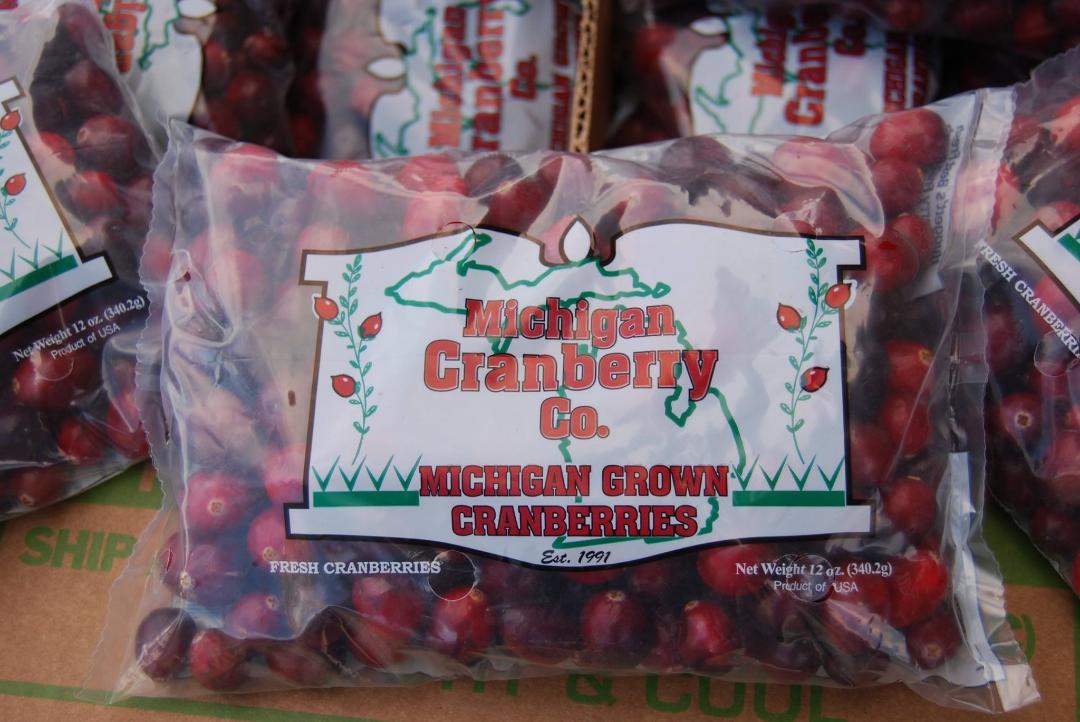
Courtesy photo
CHEBOYGAN COUNTY — Across the United States cranberry bogs (or marshes) can be found in Wisconsin, Massachusetts, New Jersey, Oregon, and Washington states. Statistics reveal Wisconsin has at least 60 percent of this juicy berry market.
Michigan may be a small grower in the cranberry business, but according to Michigan State University’s Agriculture Extension Services (MSU), cranberry bogs can be found in the state’s southwestern portion and northeastern Michigan
The Michigan Cranberry Company is located at 9972 Alpena State Road in Cheboygan County. The 25-plus year-old company has up to 300 acres devoted to cranberry growing.
The operation’s history goes back well over 40 years when Wally and Sharon Huggett owned and operated a multi-state sod growing and sales business in Michigan’s thumb region. They grew cranberries near their sod business. However, for various reasons they never produced a quality harvest.
In a telephone interview Wally confirmed, “To grow cranberries you need the right topography, soil content, and water table,”
On June 11, 1985, Huggett’s 25th wedding anniversary, Wally as a private pilot and his wife took flight over an abandoned northeastern Michigan peat mining site. After viewing, they conducted soil samples and water availability of the site. They determined it would make an excellent cranberry bog site,
They purchased the acreage and made their initial bog planting in 1993. Wally noted it takes about five years to produce a cranberry harvest. Indeed, the first harvest from the bog occurred in 1998.
Today, the Michigan Cranberry Company is the state’s largest producer of cranberries. In fact, the company annually grows three to up to six million pounds of cranberries. A third of the crop is sold to Ocean Spray.
When harvested, in the late fall, the majority of the cranberries are shipped to a southwestern Michigan refrigeration and freezer complex for packaging and distribution.
A Michigan Farm News article, on the company. notes the cranberry bogs are flooded and frozen in December, entombing the cranberry vines to protect them during the harsh winter. The article also revealed two semi-trucks are loaded with honeybees to annually pollinate the crop.
In a Michigan Ag Today interview, Wally commented, “Indigenous Americans would harvest Michigan cranberries from their canoes and use them to preserve venison.” He added, “While there are hundreds of ways to enjoy the fruit now, it’s amazing we’re still eating the same things our ancestors ate thousands of years ago.”
According to MSU, the state offers the ideal climate, soil combination, fresh water, and processing infrastructure to grow this tart and nutritious fruit.
The fruit is grown on scraggly low-lying vines in beds layered with sand, peat, gravel, and clay. Cranberries are harvested in the flooded bogs. During the harvesting process, the berries float to the top allowing for picking.
Cranberry growing season is year-round. Cranberries are traditionally harvested from mid-September to early November. The berries are harvested by hand rakes or water reels called “eggbeaters.” In turn, floating booms are used to corral the berries.
MSU reveals cranberries are used as fresh fruit, for juice, sauce, or as dried fruit. In addition, berries can be added to numerous other prepared foods. Outside of foods, Web MD cites concentrated cranberry pills are used for urinary tract infections.
Local News

Onaway school board: Winfield voted in as new board member, Hart announces retirement
Cranberries: Northeastern Michigan grown
Lifelong Learners have busy week planned
ALPENA — The Association of Lifelong Learners at Alpena Community College has multiple events this week. And have ...

Kayla Wikaryasz – News Staff Writer

Oh what a beautiful morning!
