Unusual stories from the Mighty Mac Bridge
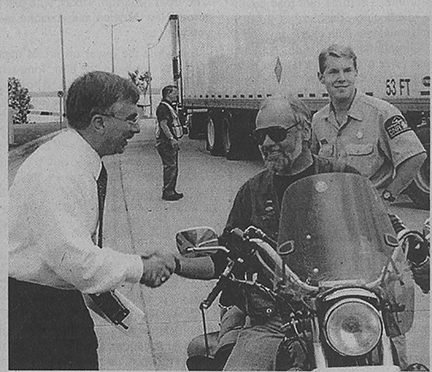
Courtesy photo Presque Isle County resident Daniel J. Gilmet is seen riding his motorcycle. Gilmet was the 100-millionth vehicle to cross the Mackinac Bridge in 1998.
When Nov. 1, 2027 arrives, it will mark the 70th anniversary of when the 26,372-foot Mackinac Bridge opened.
In many aspects, the bridge linking Michigan’s lower mitten and Upper Peninsula, provides an ongoing visual image for the state.
Construction began in 1954 and involved over 350 specialized engineers and 3,500 on-site construction workers. Five workers perished while building the bridge. The total design and construction costs pressed over $95 million. In 2025 dollars, it equates to nearly $1.1 billion.
Early on, when construction began, 44-foot high and 116-foot-wide steel caissons (foundations) were thrust into the Straits’ bedrock and later filled with concrete. The caissons came from Alpena, Michigan.
The bridge remains one of North America’s longest suspension bridges.
When you have been around for nearly seven decades you have stories to tell. Journalist and historian, Mike Fornes of Mackinaw City, has written numerous books about the region, including topics such as the Grand Hotel, the building of the Mackinac Bridge, and the original USCG ice cutter Mackinaw.
One of Fornes’ books is the 180 page “It Happened on the Mackinac Bridge”.
In part, here are several accounts from his book:
Under the bridge
On April 28, 1959, USAF Captain John S. Lappo was flying from an overseas mission in a six engine B-47 bomber. He was on-route to a Columbus, Ohio Air Force base.
“The Muskegon, Michigan native was known for being a little on the daring side,” Fornes stated.
As he approached Michigan, and neared the Straits of Mackinac, he shared with his navigator and crew he was going to fly the 28-foot-high nuclear armed bomber under the Mackinac Bridge.
The margin of error would be tight, in that from the waterline to the bridge’s underside, it was less than 155 feet. USAF regulations stated an aircraft could be no less than 500 feet from the ground or water surface.
With a swoop he flew under the bridge and later landed at his destination.
That evening, at the base, rumors flew abound. Subsequently, Lappo faced a military court martial. He received a fine of $300 and was prohibited from flying for the Air Force.
By the way, his father was a USAF General. Dad was not at all pleased.
Wagon Ho!
In 1973, an Amish and horse drawn covered wagon was on route from the New England region heading west. The driver was Roland Church, along with his wife and two daughters. They were on a Christian mission.
Fornes stated Church’s wagon normally traveled 25 miles per day. They never traveled on Sunday.
Consulting with the Bridge Authority and local public safety officials, Church and his family paid the multi-axel fee and traversed with an escort over the bridge’s five-mile span.
The trek began at 5 a.m. when traffic was light.
Over the edge
Fornes commented, from his residence, he has a commanding view of the Straits and the bridge. On Sept. 22, 1989, 31-year-old Leslie Pluhar, a restaurant server from Royal Oak, was on route to see her boyfriend who resided north of Saint Ignace.
Pluhar was driving a 1987 Yugo subcompact which weighed slightly over 1,800 pounds.
At approximately 6:40 p.m., that Friday evening, Fornes noticed a flurry of red and blue emergency vehicles heading north on the bridge.
It was an overcast evening with mostly dry roadways. The winds over the Straits were in the mid-30s.
Quickly making contacts, Fornes captured the account for a northern Michigan television station of a tragic incident, which was viewed by others crossing the bridge.
Pluhar was passing a semi-truck at a high rate of speed. Apparently, she lost control when the Yugo impacted the four-inch raised-center curbing. Most likely, she attempted to regain control and oversteered, hitting the lower-pipe railing and subsequently flipping over the higher railing.
The subcompact plunged over 170 feet at a speed projected to be 70 mph into the Straits waters.
For over a week, the Michigan State Police and USCG search teams were hampered by high winds and waves up to nine feet.
Since they were unable to quickly retrieve the car, the driver wasn’t immediately identified. But when Pluhar never arrived at her boyfriend’s residence her family presumed it was her.
On Sept. 27, using sonar, the search team located the car. The vehicle was found 150 feet east of the bridge resting on the bottom at a depth of 150 feet. The Yugo was near the edge of a steep 300-foot underwater ridge.
Authorities commented the subcompact vehicle was smashed almost beyond recognition, sustaining intense “accordion damage” from hitting a bridge steel beam before plunging over the side.
Pluhar’s family filed lawsuits worth millions of dollars against multiple parties. In the end, media accounts state in 1997 a settlement of $500,000 was acquired.
The 100th millionth
Annually, well over four million vehicles cross the Mighty Mac.
June 25, 1998, was a warm and sunny day at the Straits. It was the weekend of the annual St. Ignace classic car show.
Presque Isle County resident Daniel J. Gilmet was preparing to cross the bridge with his 1981 lowrider, Harley Davidson motorcycle. Accompanying Gilmet, also on a motorcycle, was Jim Smith.It was Gilmet’s birthday.
It was nearing 5:15 p.m. with Gilmet in the lead, preparing to enter the Saint Ignace toll booth.
“All of a sudden at the booth, a siren blared, and a massive group began to converge on me. I thought I was under arrest — but for what?” Gilmet stated.
He quickly learned he was the 100-millionth vehicle to cross the bridge.
Surrounded by Bridge Authority representatives, print and electronic media, as well as local dignitaries, he received complimentary hotel accommodations, meals and beverages, passes to tourism sites, golf and recreation passes, and related awards.
“They even returned my $1 motorcycle bridge toll,” Gilmet said.
Gilmet and Smith headed west of Saint Ignace on U.S. Route 2 where they overnighted at a Naubinway motel. That evening they dined at a nearby restaurant and tavern; just in time for the local television news.
On the television screens was the coverage of Gilmet at the bridge. Patrons began to turn their heads as they recognized Gilmet.
“The beer and comments begin to flow, along with a massive photo shoot,” Gilmet commented.
The following July 18, Gilmet exchanged wedding vows with his wife, Brenda. Their subsequent Upper Peninsula honeymoon was fully paid for them courtesy of the Bridge Authority recognition.
In the months to follow, Gilmet and Smith returned to the bridge to partake in one of the awards: a trip to the top of the bridge 500 feet above the water line via a small elevator.
“The winds were low and the vistas incredible,” Gilmet said.
The return elevator trip began well. However, the elevator stopped short of its final stop. Gilmet, Smith, and their escorts began a challenging trek exiting through a series of ladders in a dimly lit tunnel. On their way down, they noted interior wall graffiti created decades ago by bridge construction crews.
“It was indeed my precious 15 minutes of fame,” Gilmet said.
The 200 millionth vehicle crossing occurred in June 2022 by the Dalman family of Tawas City, Michigan.
Local News

Friends Together brings popcorn factory to downtown Alpena
Unusual stories from the Mighty Mac Bridge

Lt. Col. Freudenburg takes on leadership as Alpena CRTC commander

Kiwanis Club visits APS third grade students
Five MyMichigan Medical Centers earn Blue Distinction Center+ designations for knee and hip replacements