Historical artifacts, monuments, and memorials
A path through time: Celebrating the 50th anniversary of the Alpena Bi-Path

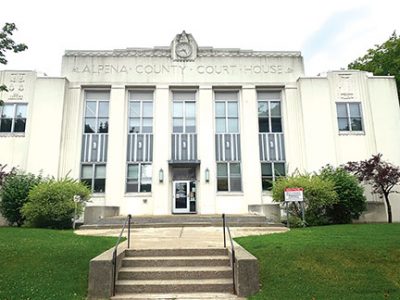
News File Photo The Alpena County courthouse is seen in this August 2021 News archive photo.
The Alpena Bi-Path is, in many respects, an intersection of art, nature, and community. For fifty years, the pathway has connected neighborhoods, parks, riverfront landscapes, sculptures, memorials, and historic landmarks into a shared public experience. While many visitors come to appreciate the sculptures and natural beauty along the route, another form of artistic expression quietly surrounds the path–architecture and the historical markers associated with these iconic architectural assets of our community.
A number of buildings and historic structures along and near the Alpena Bi-Path represent a different kind of artistry. These structures tell the story of a community shaped by industry, commerce, culture, and civic life. Together, they form an open-air gallery of architectural heritage, offering travelers along the Bi-Path a journey not only through time and our collective space, but also through shared physical institutions.
Downtown Alpena: Where architecture represents our story
Few places along the Bi-Path illustrate this relationship between architecture and community identity more clearly than historic downtown Alpena. Lining the streets near the Thunder Bay River are buildings whose façades reflect the craftsmanship and ambition of earlier generations, as well as the community’s prosperity. Many date to the late nineteenth and early twentieth centuries, when Alpena was emerging as an important lumbering town grounded in Great Lakes commerce and shipping.
Walking or biking the Bi-Path through downtown offers views of structures whose architectural styles range from Victorian and Romanesque influences to early twentieth-century commercial design. Decorative brickwork, arched windows, ornamental cornices, and carefully proportioned storefronts demonstrate that these buildings were designed not only for function but also for beauty–evidence of an era when a community’s affluence left legacies and a level of architectural continuity many historic towns have struggled to achieve and preserve. In Alpena, these historic features still endure today.
In this sense, architecture becomes another form of public art. Like sculpture, it shapes the way people experience place. Each building reflects the values and aspirations of the era in which it was built–evidence of a community that believed its public spaces should inspire as well as serve their purpose.
Civic landmarks along the bi-path
Several civic landmarks located along or near the Alpena Bi-Path help anchor Alpena’s historical landscape and our collective civic life. These structures and their corresponding historical markers represent important confluences of aesthetic quality, institutional structure, and community identity – creating a real sense of a unique place, with a now-historic pathway weaving throughout and helping tie it all together.
Alpena County Courthouse – historical marker (1999)
One of the most striking examples of architecture along the Bi-Path is the Alpena County Courthouse, an Art Deco structure that has stood as a centerpiece of county government since 1935. At the time of its construction, architect William H. Kuni of Detroit described it as groundbreaking–“the first monolithic building erected in a cold climate.”
Constructed largely of local Portland cement, the courthouse demonstrated that winter construction with cement was possible, an innovation that also provided much-needed employment during the Great Depression. The building was financed through local bonds and the Works Progress Administration, making it not only an architectural landmark but also a reflection of a community working together during challenging times. Today, the courthouse is recognized on the National Register of Historic Places, affirming its importance both locally and nationally.
Alpena City Hall – historical marker (2002)
Another prominent landmark along the Bi-Path is Alpena City Hall, located on Government Square at the intersection of First Avenue and Park Place. Completed in 1908, the building was designed by Bay City architects Clark and Munger in the Georgian Revival style, constructed primarily of Bedford limestone from Indiana.
At the time, the decision to use imported limestone rather than local materials stirred considerable public debate, as Alpena was home to a growing cement industry. Yet the finished structure proved to be both elegant and enduring. City Hall has remained the center of civic activity in Alpena for more than a century. Local contractor Richard Collins supervised construction, while Alpena craftsmen from Northern Planing Mill and A.B. Crow contributed to the carpentry and marble work.
Originally crowned with a cupola that remained until the 1950s, the building continues to stand as one of the community’s most recognizable architectural landmarks.
Monarch Milling Company – historical marker (1999)
Further illustrating Alpena’s industrial and commercial heritage is the Monarch Milling Company site along Campbell Street. Constructed in 1914 and beginning operations in 1916, the mill served as an important part of Alpena’s economic life for decades.
By 1920, the operation had become known as the Alpena Flour Mills, producing “Leader” and “Velvo” brand flour that supplied households and businesses throughout the region. For forty years, the mill played an integral role in the community’s daily life before closing in 1956. Though the industry has faded, the historical marker preserves the memory of a time when local manufacturing and milling were central to Alpena’s economy.
Architecture as community art
Viewed together, these buildings and markers remind us that architecture is one of the most enduring forms of artistic expression. The structures that frame Alpena’s downtown streets and public and commercial spaces represent generations of builders, designers, and citizens who believed that their community deserved buildings of quality and distinction.
Seen from the Bi-Path perspective, these architectural landmarks become part of a broader cultural landscape. Just as sculptures punctuate the trail with moments of reflection, historic buildings provide a backdrop that deepens the experience of place.
Looking forward: Preserving Alpena’s historic character
As Alpena celebrates the 50th Anniversary of the Bi-Path, these architectural landmarks invite us to consider not only the past but also the future. Communities across the country are recognizing the importance of preserving historic downtown districts, both as cultural assets and as drivers of economic vitality.
The architectural heritage visible along the Bi-Path strengthens the case for continued preservation efforts and, perhaps, broader recognition through historic district designations. Such recognition would affirm what residents already appreciate: that Alpena’s historic buildings are not simply remnants of the past but living expressions of the community’s identity.
For those traveling the Alpena Bi-Path–whether walking, biking, or simply pausing to read the markers–the experience becomes something more than recreation. It becomes a journey through a living timeline, where architecture, history, and community converge along a pathway that continues to connect Alpena’s past, present, and future.
Lifestyles
Historical artifacts, monuments, and memorials

Up and coming up at Art in the Loft

Hello Sun!

Busy April for Alcona library

Caregiver empowerment and wellness conference