
‘A tomato fresh from the garden is heavenly’
Growers give tips on starting your own garden

Courtesy Photos This Robarge “Campbell’s” tomato is a special variety that has been in the family for 55 to 60 years. Mary Centala has continued her late Uncle Claude Robarge’s tradition by seed saving to keep this tasty tomato coming back year after year.
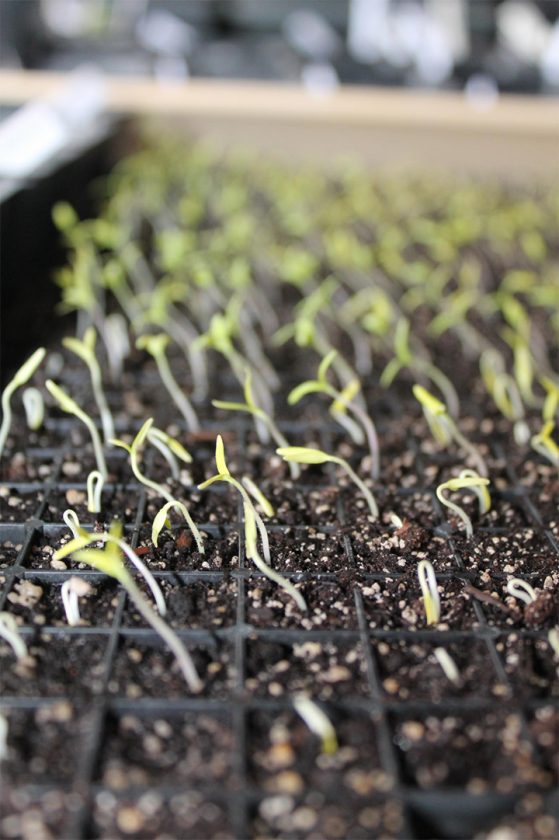
Seedlings are sprouting at Mary Centala’s Heritage Acres greenhouse.
Courtesy Photos This Robarge “Campbell’s” tomato is a special variety that has been in the family for 55 to 60 years. Mary Centala has continued her late Uncle Claude Robarge’s tradition by seed saving to keep this tasty tomato coming back year after year.
Seedlings are sprouting at Mary Centala’s Heritage Acres greenhouse.
Trending
Planting your own vegetable garden is a popular idea right now, as people remain home weathering the COVID-19 outbreak. Not only is gardening a therapeutic pastime, it yields crops the whole family can enjoy, and it saves a trip to the store to buy produce. And homegrown vegetables taste better and are more nutritious, growers say.
Local gardeners encourage newcomers to get their hands dirty this spring, summer and fall.
Mary Centala and her husband Mike own Heritage Acres greenhouse, which has been operating since the early 2000s at their homestead north of Hubbard Lake Road about nine miles out of Alpena.
Centala's advice for new growers is to start small and plant the vegetables you like to eat.
"Don't get too big," said Centala, a certified master gardener. "Because then the weeds take over and you get disheartened. And I hate to see people lose interest right off the bat."
If you like beans, plant beans.
"You plant what you like, because if you're more interested in eating it, you're going to take better care of it," Centala said.
Tomatoes are a favorite for first-time growers.
"Traditionally, when people come to my greenhouse, if they plant nothing else, they plant tomatoes," Centala noted. "Because a tomato fresh from the garden is heavenly. Especially when it's warmed in the sun and you pick it right then and there."
Centala grows many kinds of tomatoes in the greenhouse.
"At one time I grew over 100 types of tomatoes," she said.
She said in addition to tomatoes, many people like to start with cucumbers, peppers or potatoes, but with potatoes you have to scout them out to make sure the bugs aren't getting them.
Centala added that in northern Michigan, you have to find the right varieties of plants that will grow well in our cooler climate, which limits the options. The only way to get around that is by seed saving to acclimate new strains to our climate, but that takes a lot of effort and expertise. Beginners should stick to the basics and find types of plants recommended for your USDA Plant Hardiness Growing Zone. To find your zone, visit the U.S. Department of Agriculture website and type in your zip code at planthardiness.ars.usda.gov. Most people in Alpena, Alcona, Presque Isle and Montmorency counties are in Zone 4A or 4B, or Zone 5 if you are closer to Lake Huron.
Different plants require different types of soil, and some, such as peppers, should be grown without fertilizer, Centala explained. She learned this from her late cousin Margaret Robarge.
Centala said she was getting beautiful pepper plants, but no peppers. Then she noticed the birds had scattered sunflower seeds into her garden near her pepper plants. That year, she got a bountiful crop of peppers.
"Because sunflowers are a heavy seeder, meaning they require more fertilizer than some of your other plants," Centala explained. "They sucked up the extra energy so I actually got a crop of peppers."
Centala plants marigolds alongside some of her vegetables, which is called companion planting.
"The marigolds draw the beneficial insects," she said. "And they detract the bugs that want to go for your plants. They draw them to themselves so that they don't bother your plants."
She said planting green beans and potatoes near the marigolds yields better crops.
"I rotate my crops, like you're supposed to, to try to keep the bugs at bay," she added. "Because if you have the same crops in the same areas all the time, you get diseases you could avoid."
Centala said gardening is a science. It takes a lot of experimentation to get it right, and you keep learning as you go.
"Having a successful garden is a combination of luck, hard work, and science," she said.
Rose Bisanz owns The Rose Garden of Greens in Ossineke. She grows more than 40 types of vegetables that grow well in northern Michigan.
Her advice for first-time growers is "just jump in."
"There's a lot of veggies that are easy -- very easy -- to grow. Start with those ones, basically, and just jump in," Bisanz said. "If you can just throw in a couple bean plants, that right there, you're one step closer to being self-sufficient.
"Whether you are providing yourself 5 percent of your food from your garden, or you get to the point where you're providing yourself with 50 percent, you're one step closer to being self-sufficient, and I highly recommend that to anybody," Bisanz said. "And that's coming from somebody who is selling vegetables for a living.
"I still love seeing people gardening on their own," Bisanz said. "I always tell people, if you want to know where your food is coming from, and you want to always have food available, your first go-to is growing your own."
She loves sharing her love of fresh, healthy food.
"Gardening for me, and being able to provide that first step in your kitchen, which is the vegetables, it's just a wonderful experience," Bisanz said.
For the first-time gardener, choosing where to put your new garden is step one.
"You're going to look at your sunlight, you're going to look at your soil, and you're going to look at your water," Bisanz said. "You want to find the spot in your yard that has the best sun. … For the most part you're going to want somewhere you've got 12 hours of sunlight throughout the whole day, especially with vegetables."
Raised beds are a great option for beginners, she said.
"The biggest thing I recommend for people just getting into gardening just for themselves, and especially if they live in town, in Alpena, jump into a raised bed," Bisanz said. "It's the easiest way to get the best soil, the best drainage, and everything."
She said tutorials are available online about how to build a raised bed, and how to layer your soil.
"A lot of people will put logs in the bottom for drainage," Bisanz added. "And the other thing is just access to water. Where is the spigot from the house? Where are you getting your water?"
Using a book as a resource is best, she said, because then you can take it out in the garden with you.
"I have a great Michigan gardening book that is meant for Michigan, and our climate, and it will show you every single plant, vegetable, and it will give how far apart you can space it, how deep you plant it, everything," Bisanz added.
Billie and her husband Bill farm at White Barn Gardens on M-72, two-and-a-half miles west of Harrisville. Look for the big white barn with a sunflower painted on it. She sells vegetables and flowers at her roadside stand.
It's too early to break ground in her garden because it sits on dense clay. But soon she will start with peas and onions, which are cold crops.
"What I suggest always is start out small," Thompson said. "If you start out too big you're going to fail, and you're going to be disappointed. Plant what you like, and do it small. You can really squeeze a lot of stuff into a small space."
She plants a lot of vegetables and herbs, as well as flowers.
Centala encourages gardeners to plant more this year if they can, as a safeguard against a possible food shortage, as well as a sustainability effort as times change amid a global pandemic.
"Our world has changed tremendously in just the last couple months," Centala said. "My parents grew up during the Depression, and they used to talk about various things they had to do, because they had to do them."
Centala added that growing your own garden is beneficial, no matter what happens.
"Even if the world changes and you don't need that food, it doesn't hurt to arm ourselves with the knowledge of how to do it."