
‘Mom knows best’
Leave them be, and go away
Trending
ALPENA -- In northern Michigan, one of spring's most precious treats is a glimpse of a baby animal, curled up in the woods or frolicking in a field.
Though miniature deer, raccoons, and birds may tug at heartstrings, a glimpse is all that a human should take, according to the Michigan Department of Natural Resources.
Every spring, Shelby Hiestand, DNR wildlife biologist for Presque Isle, Montmorency, and Alpena counties, receives dozens of phone calls from concerned residents asking what to do to help baby animals who have been left alone in the woods, seemingly in danger.
Don't do anything, Hiestand tells them.
Animals parent differently than humans, following the same instincts that have allowed their species to survive for generations. What may seem to be a baby animal abandoned by its parent is actually a safe, well-cared-for offspring with a nearby mother who is waiting for you to go away.
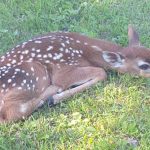
One of the joys of living in northern Michigan is the occasional sighting of a white-spotted fawn, curled into a nest in the woods or bundled on the side of a road. All spots and spindly legs, the young deer look vulnerable as they huddle motionless on the ground, their mother nowhere to be seen.
While fawns may seem to be abandoned, that is very much not the case, Hiestand said. Fawns are scentless, trained by their mothers to remain motionless, their coats camouflaging them from the eyes of predators. Mother deer check on their offspring several times a day, but they intentionally stay at a distance to keep their own scent away from their fawn as a protective measure.
Every bit as adorable as fawns, baby raccoons may sometimes be seen playing in the daytime, unaccompanied by an adult. While a responsible human parent would not leave young children unsupervised to take a nap, raccoon parents know that they can safely sleep while their young ones romp, Hiestand said, freeing the lucky human to watch the fun without worrying about the tiny masked creatures.
A baby bird at the base of a tree looks like it needs a lift back up to its home. Depending on its color, that might be true, Hiestand said. Nestling birds, pink and featherless, do need a helping hand and can be gently scooped up and placed into the nest.
Commonly-held beliefs about transferring human smells onto a baby bird, causing it to be rejected by its parents, are untrue and not a cause for concern, the wildlife biologist said. Birds actually have a poor sense of smell and, like other animals, won't be kept away by human scents transferred to their babies.
Older fledgling birds, in "that goofy teenage phase" with feathers coming in, can safely be left at the base of a tree, where its parents will bring it food as it gains strength to fly, Hiestand said.
"You have that instinct that they need help, but they really don't. Mom knows best," Hiestand said.
Removing baby animals from their natural habitat is not only illegal but also dangerous to the animal, according to Jessie Curtis, Alpena County DNR conservation officer.
Local residents may be moved by compassion to take baby animals home to care for them, thinking they are acting in the animal's interest. Instead, removing animals from the wild not only takes them away from their mothers' care but also endangers their lives, and potentially the lives of the humans hoping to help them.
The only people who can legally rehabilitate wild animals are trained, licensed wildlife rehabilitators, Hiestand said.
"They train them to not be pets," Curtis said of trained rehabilitators in their intentional and careful work with wild animals. "It's not a petting zoo animal. They're supposed to be wild."
Habituated does not mean domesticated, Hiestand said. While a wild animal may lose their fear of humans, they don't develop the bonds of affection and interdependence found in household pets.
"You feel like they're tame, but they're really not," Hiestand said. "They'll always be a wild animal."
Cute baby animals, as they mature and develop adult animal behaviors, become increasingly dangerous to humans, Hiestand said. Habituated deer, especially bucks, can become aggressive as they mature. Children have been injured by the wildlife their family was raising, and diseases transferred from wild animals to humans have caused blindness and other problems, especially in children.
Comfort with humans is not in a wild animal's best interest, no matter how well-intentioned a person's actions may be, Hiestand said. Animals that lose their fear of humans don't develop the survival instincts needed to keep them safe.
"They don't view people as a threat, and obviously that's not good for wild animals," Hiestand said, "especially ones that are hunted."
People hoping to save a wild animal by caring for it themselves should remember to think in the animal's long-term best interest, Curtis said. She has encountered adult raccoons being kept in a cage, the cute baby having grown into a dangerous adult animal that could no longer live in the wild because it hadn't learned vital survival instincts.
"That animal doesn't want to be sitting in a cage," Curtis said. "That animal wants to be in the woods, wild. It was born to be out there."
Julie Riddle can be reached at 989-358-5693 or jriddle@thealpenanews.com.