
NOAA scientists study mussels in Great Lakes
Trending
ALPENA -- An invasive species has become an important research organism for National Oceanic and Atmospheric Administration scientists.
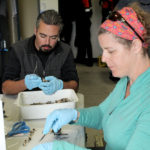
"We're here to study the zebra and quagga mussels," physical scientist Dr. Ed Johnson said. We're all scientists from NOAA headquarters and we're part of a national monitoring program that started in 1987 that uses mussels, oysters, clams as a sentinel organism to monitor chemical contamination."
Because the mussels don't move, they accumulate the chemical contaminants in the water and food they consume into their body tissues.
"When you measure their soft tissue, you're measuring the condition from the location from where they were harvested from. Today we harvested these mussels out at Thunder Bay Island at one of the mooring buoys in the sanctuary," Johnson said.
These mussels will be used as the clean site reference since they have very little contamination. They will compare the clean mussels with those collected in very contaminated sites in the Great Lakes basin.
"Next week we will spend time in Milwaukee looking at chemicals coming from the river and waste water plant outfall. Outfall water is pretty clean but there are chemicals not removed in the process that you don't think about pharmaceuticals, therapeutic drugs people take, hormones," Johnson said.
They will look at the biological responses of the mussels to determine if there are problems at all.
"We know these chemicals are coming out. They're in low concentrations, but there's is a wide mixture of chemicals," Johnson said. "So what are the effects of an organism being exposed to the broad mixture?"
He said the sanctuary is uniquely perfect for them to do their work.
"They have the capacity with the divers, boats and staff to do the collection. It creates an opportunity for them to help us and for us to train them. They're helping us by building capabilities in diving. This week we're learning new diving techniques we'll apply other places within the Great Lakes basin," he said.
Maritime archaeologist John Bright said the diving technique they showed the scientists involves the use of a tethered communications linked to the surface.
"This allows divers the opportunity to operate individually in the water, or in teams of similarly tethered divers. It gives them a direct access to the surface to talk and discuss where they are, what they're seeing and what they're doing. So the sampling and movements and activity in the water can be more coordinated in real time," Bright said.
He said since the sanctuary had the new filtration system installed in the sanctuary dive tank last year there is clear, clean water all season long, which allows them to utilize the tank for multiple uses.
"That confined water link between training and building skills is essential to any dive training mission. It really enhances the training in combination with classroom facilities, museum facilities, research vessels and proximity to water it offers an ideal venue for this sort of work," Bright said.
In general there are lot of possibilities for capacity building to work with the people in Alpena, Johnson said.
Jordan Spence can be reached via email at jspence@thealpenanews.com or by phone at 358-5687.